

P A T T E R N S I N T H E I N T E G U M E N T OF I N S E C T S
45
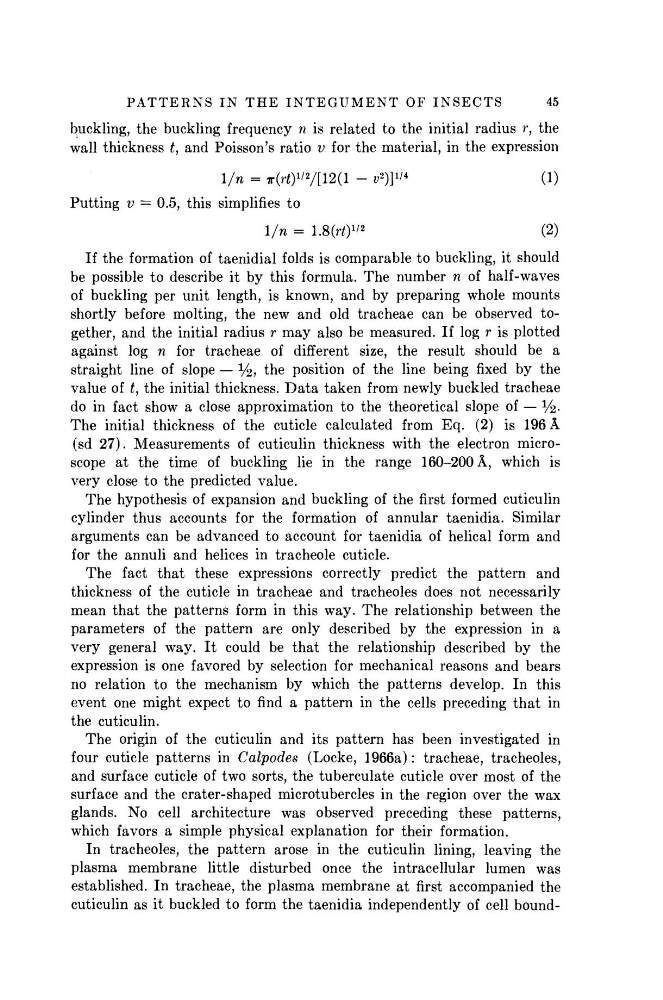
buckling, the buckling frequency n is related to the initial radius r, the
wall thickness t, and Poisson's ratio v for the material, in the expression
1/n = 7r(r*)
1/2
/[12(l - v*)]
1 '*
(1)
Putting v — 0.5, this simplifies to
1/n = 1.8(r/)
1/2
(2)
If the formation of taenidial folds is comparable to buckling, it should
be possible to describe it by this formula. The number n of half-waves
of buckling per unit length, is known, and by preparing whole mounts
shortly before molting, the new and old tracheae can be observed together, and the initial radius r may also be measured. If log r is plotted
against log n for tracheae of different size, the result should be a
straight line of slope — y%, the position of the line being fixed by the
value of t, the initial thickness. Data taken from newly buckled tracheae
do in fact show a close approximation to the theoretical slope of — V2·
The initial thickness of the cuticle calculated from Eq. (2) is 196 Â
(sd 27). Measurements of cuticulin thickness with the electron microscope at the time of buckling lie in the range 160-200 Â, which is
very close to the predicted value.
The hypothesis of expansion and buckling of the first formed cuticulin
cylinder thus accounts for the formation of annular taenidia. Similar
arguments can be advanced to account for taenidia of helical form and
for the annuli and helices in tracheole cuticle.
The fact that these expressions correctly predict the pattern and
thickness of the cuticle in tracheae and tracheoles does not necessarily
mean that the patterns form in this way. The relationship between the
parameters of the pattern are only described by the expression in a
very general way. It could be that the relationship described by the
expression is one favored by selection for mechanical reasons and bears
no relation to the mechanism by which the patterns develop. In this
event one might expect to find a pattern in the cells preceding that in
the cuticulin.
The origin of the cuticulin and its pattern has been investigated in
four cuticle patterns in Calpodes (Locke, 1966a) : tracheae, tracheoles,
and surface cuticle of two sorts, the tuberculate cuticle over most of the
surface and the crater-shaped microtubercles in the region over the wax
glands. No cell architecture was observed preceding these patterns,
which favors a simple physical explanation for their formation.
In tracheoles, the pattern arose in the cuticulin lining, leaving the
plasma membrane little disturbed once the intracellular lumen was
established. In tracheae, the plasma membrane at first accompanied the
cuticulin as it buckled to form the taenidia independently of cell bound-
45
buckling, the buckling frequency n is related to the initial radius r, the
wall thickness t, and Poisson's ratio v for the material, in the expression
1/n = 7r(r*)
1/2
/[12(l - v*)]
1 '*
(1)
Putting v — 0.5, this simplifies to
1/n = 1.8(r/)
1/2
(2)
If the formation of taenidial folds is comparable to buckling, it should
be possible to describe it by this formula. The number n of half-waves
of buckling per unit length, is known, and by preparing whole mounts
shortly before molting, the new and old tracheae can be observed together, and the initial radius r may also be measured. If log r is plotted
against log n for tracheae of different size, the result should be a
straight line of slope — y%, the position of the line being fixed by the
value of t, the initial thickness. Data taken from newly buckled tracheae
do in fact show a close approximation to the theoretical slope of — V2·
The initial thickness of the cuticle calculated from Eq. (2) is 196 Â
(sd 27). Measurements of cuticulin thickness with the electron microscope at the time of buckling lie in the range 160-200 Â, which is
very close to the predicted value.
The hypothesis of expansion and buckling of the first formed cuticulin
cylinder thus accounts for the formation of annular taenidia. Similar
arguments can be advanced to account for taenidia of helical form and
for the annuli and helices in tracheole cuticle.
The fact that these expressions correctly predict the pattern and
thickness of the cuticle in tracheae and tracheoles does not necessarily
mean that the patterns form in this way. The relationship between the
parameters of the pattern are only described by the expression in a
very general way. It could be that the relationship described by the
expression is one favored by selection for mechanical reasons and bears
no relation to the mechanism by which the patterns develop. In this
event one might expect to find a pattern in the cells preceding that in
the cuticulin.
The origin of the cuticulin and its pattern has been investigated in
four cuticle patterns in Calpodes (Locke, 1966a) : tracheae, tracheoles,
and surface cuticle of two sorts, the tuberculate cuticle over most of the
surface and the crater-shaped microtubercles in the region over the wax
glands. No cell architecture was observed preceding these patterns,
which favors a simple physical explanation for their formation.
In tracheoles, the pattern arose in the cuticulin lining, leaving the
plasma membrane little disturbed once the intracellular lumen was
established. In tracheae, the plasma membrane at first accompanied the
cuticulin as it buckled to form the taenidia independently of cell bound-