

34
M I C H A E L L O C K E
derivatives, this paper will concentrate on three topics which have received least attention in the literature on insect development, but which
have general relevance for morphogenetic studies: (1) the formation of
surface patterns, (2) the gradient organization of the epidermis, and (3)
the three-dimensional patterns resulting from cycles of activity in time.
A. The Structure of the Integument—Types of Cuticle
The structure of the integument has been extensively monographed
and reviewed (Wigglesworth, 1953, 1957; Richards, 1951, 1958; Locke,
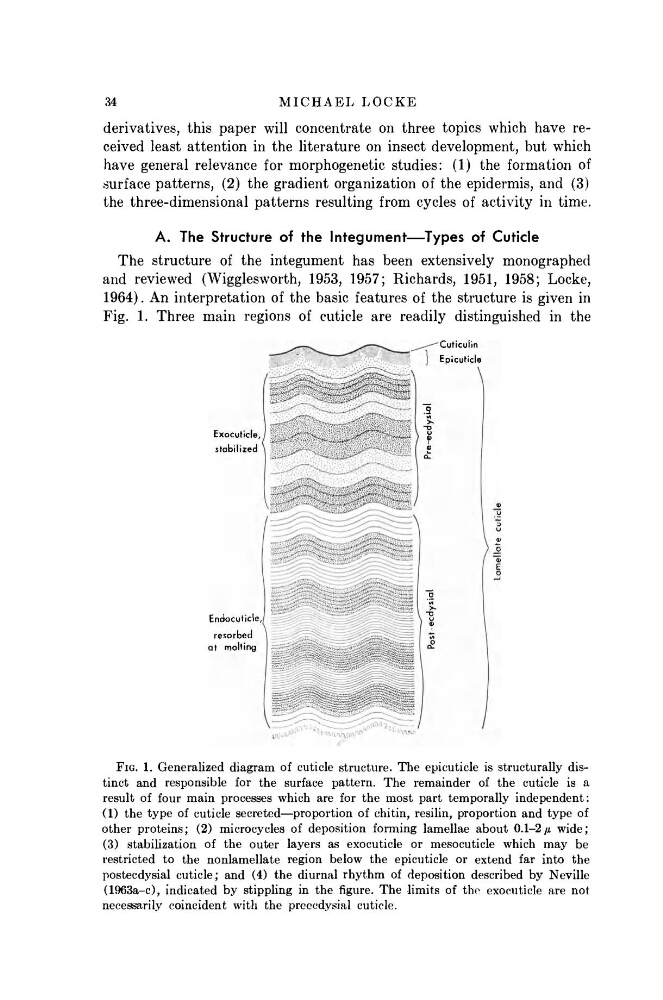
1964). An interpretation of the basic features of the structure is given in
Fig. 1. Three main regions of cuticle are readily distinguished in the
/:
Exocuticle,!
stabilized \
\
EndocuticleJ
resorbed
at molting
V
FIG. 1. Generalized diagram of cuticle structure. The epicuticle is structurally distinct and responsible for the surface pattern. The remainder of the cuticle is a
result of four main processes which are for the most part temporally independent:
(1) the type of cuticle secreted—proportion of chitin, resilin, proportion and type of
other proteins; (2) microcycles of deposition forming lamellae about 0.1-2μ wide;
(3) stabilization of the outer layers as exocuticle or mesocuticle which may be
restricted to the nonlamellate region below the epicuticle or extend far into the
postecdysial cuticle; and (4) the diurnal rhythm of deposition described by Neville
(1963a-c), indicated by stippling in the figure. The limits of the exocuticle are not
necessarily coincident with the preecdysial cuticle.
" ^ T - a - V T , ^ " ^
M I C H A E L L O C K E
derivatives, this paper will concentrate on three topics which have received least attention in the literature on insect development, but which
have general relevance for morphogenetic studies: (1) the formation of
surface patterns, (2) the gradient organization of the epidermis, and (3)
the three-dimensional patterns resulting from cycles of activity in time.
A. The Structure of the Integument—Types of Cuticle
The structure of the integument has been extensively monographed
and reviewed (Wigglesworth, 1953, 1957; Richards, 1951, 1958; Locke,
1964). An interpretation of the basic features of the structure is given in
Fig. 1. Three main regions of cuticle are readily distinguished in the
/:
Exocuticle,!
stabilized \
\
EndocuticleJ
resorbed
at molting
V
FIG. 1. Generalized diagram of cuticle structure. The epicuticle is structurally distinct and responsible for the surface pattern. The remainder of the cuticle is a
result of four main processes which are for the most part temporally independent:
(1) the type of cuticle secreted—proportion of chitin, resilin, proportion and type of
other proteins; (2) microcycles of deposition forming lamellae about 0.1-2μ wide;
(3) stabilization of the outer layers as exocuticle or mesocuticle which may be
restricted to the nonlamellate region below the epicuticle or extend far into the
postecdysial cuticle; and (4) the diurnal rhythm of deposition described by Neville
(1963a-c), indicated by stippling in the figure. The limits of the exocuticle are not
necessarily coincident with the preecdysial cuticle.
" ^ T - a - V T , ^ " ^