

D E V E L O P M E N T S I N S E X U A L O R G A N O G E N E S I S
299
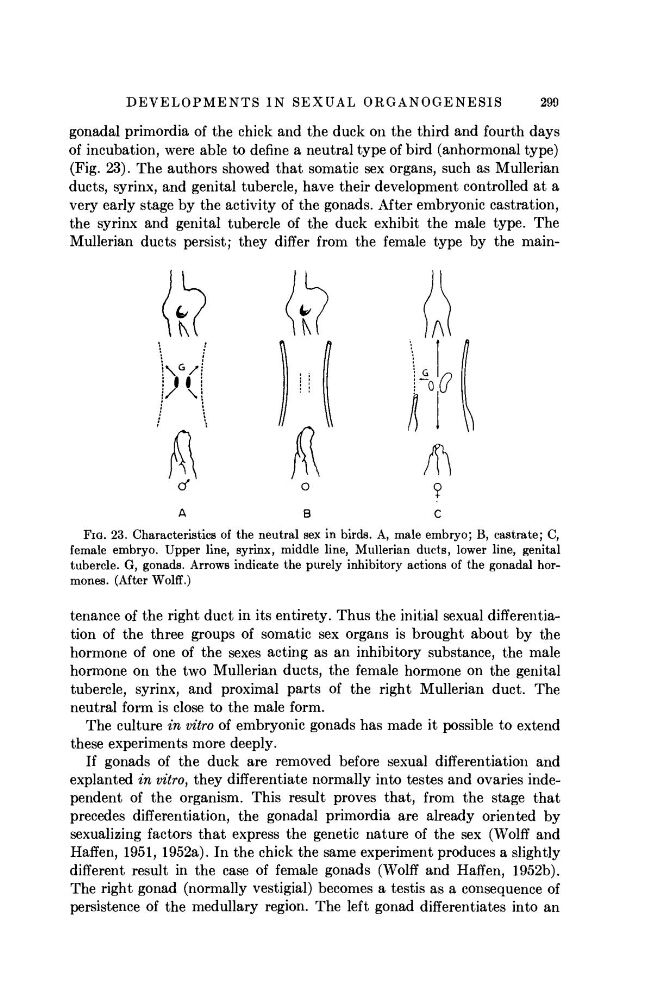
gonadal primordia of the chick and the duck on the third and fourth days
of incubation, were able to define a neutral type of bird (anhormonal type)
(Fig. 23). The authors showed that somatic sex organs, such as Mullerian
ducts, syrinx, and genital tubercle, have their development controlled at a
very early stage by the activity of the gonads. After embryonic castration,
the syrinx and genital tubercle of the duck exhibit the male type. The
Mullerian ducts persist; they differ from the female type by the mainΔ
B
C
FIG. 23. Characteristics of the neutral sex in birds. A, male embryo; B, castrate; C,
female embryo. Upper line, syrinx, middle line, Mullerian ducts, lower line, genital
tubercle. G, gonads. Arrows indicate the purely inhibitory actions of the gonadal hormones. (After Wolff.)
tenance of the right duct in its entirety. Thus the initial sexual differentiation of the three groups of somatic sex organs is brought about by the
hormone of one of the sexes acting as an inhibitory substance, the male
hormone on the two Mullerian ducts, the female hormone on the genital
tubercle, syrinx, and proximal parts of the right Mullerian duct. The
neutral form is close to the male form.
The culture in vitro of embryonic gonads has made it possible to extend
these experiments more deeply.
If gonads of the duck are removed before sexual differentiation and
explanted in vitro, they differentiate normally into testes and ovaries independent of the organism. This result proves that, from the stage that
precedes differentiation, the gonadal primordia are already oriented by
sexualizing factors that express the genetic nature of the sex (Wolff and
Haffen, 1951, 1952a). In the chick the same experiment produces a slightly
different result in the case of female gonads (Wolff and Haffen, 1952b).
The right gonad (normally vestigial) becomes a testis as a consequence of
persistence of the medullary region. The left gonad differentiates into an
299
gonadal primordia of the chick and the duck on the third and fourth days
of incubation, were able to define a neutral type of bird (anhormonal type)
(Fig. 23). The authors showed that somatic sex organs, such as Mullerian
ducts, syrinx, and genital tubercle, have their development controlled at a
very early stage by the activity of the gonads. After embryonic castration,
the syrinx and genital tubercle of the duck exhibit the male type. The
Mullerian ducts persist; they differ from the female type by the mainΔ
B
C
FIG. 23. Characteristics of the neutral sex in birds. A, male embryo; B, castrate; C,
female embryo. Upper line, syrinx, middle line, Mullerian ducts, lower line, genital
tubercle. G, gonads. Arrows indicate the purely inhibitory actions of the gonadal hormones. (After Wolff.)
tenance of the right duct in its entirety. Thus the initial sexual differentiation of the three groups of somatic sex organs is brought about by the
hormone of one of the sexes acting as an inhibitory substance, the male
hormone on the two Mullerian ducts, the female hormone on the genital
tubercle, syrinx, and proximal parts of the right Mullerian duct. The
neutral form is close to the male form.
The culture in vitro of embryonic gonads has made it possible to extend
these experiments more deeply.
If gonads of the duck are removed before sexual differentiation and
explanted in vitro, they differentiate normally into testes and ovaries independent of the organism. This result proves that, from the stage that
precedes differentiation, the gonadal primordia are already oriented by
sexualizing factors that express the genetic nature of the sex (Wolff and
Haffen, 1951, 1952a). In the chick the same experiment produces a slightly
different result in the case of female gonads (Wolff and Haffen, 1952b).
The right gonad (normally vestigial) becomes a testis as a consequence of
persistence of the medullary region. The left gonad differentiates into an