

DEVELOPMENTS IN SEXUAL ORGANOGENESIS
275
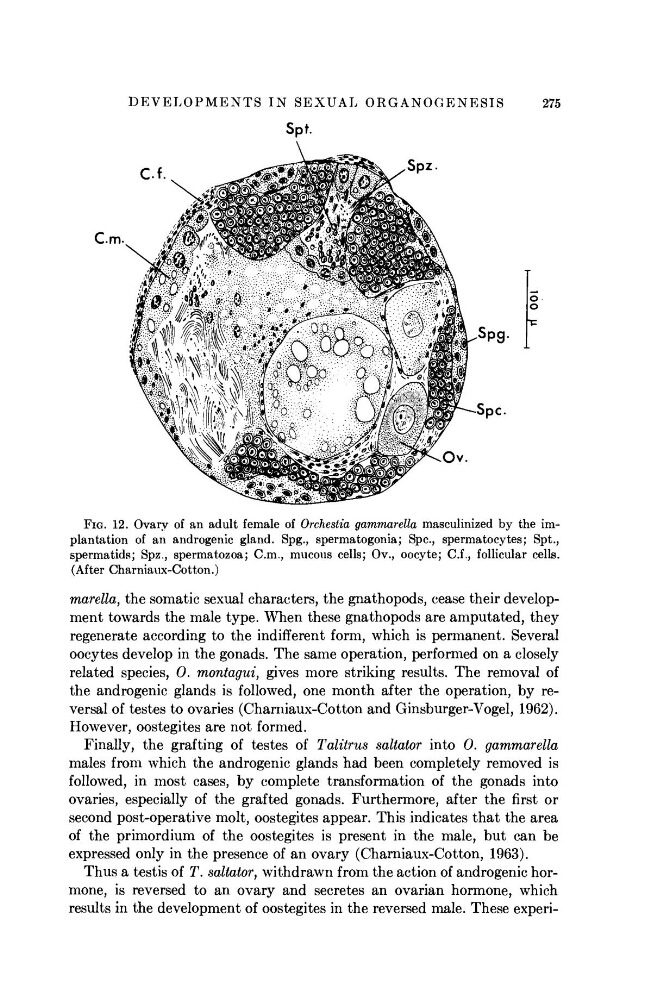
FIG. 12. Ovary of an adult female of Orchestia gammarella masculinized by the implantation of an androgenic gland. Spg., spermatogonia; Spc, spermatocytes; Spt.,
spermatids; Spz., spermatozoa; Cm., mucous cells; Ov., oocyte; C.f., follicular cells.
(After Charniaux-Cotton.)
marella, the somatic sexual characters, the gnathopods, cease their development towards the male type. When these gnathopods are amputated, they
regenerate according to the indifferent form, which is permanent. Several
oocytes develop in the gonads. The same operation, performed on a closely
related species, 0. montaguij gives more striking results. The removal of
the androgenic glands is followed, one month after the operation, by reversal of testes to ovaries (Charniaux-Cotton and Ginsburger-Vogel, 1962).
However, oostegites are not formed.
Finally, the grafting of testes of Talitrus saltator into 0. gammarella
males from which the androgenic glands had been completely removed is
followed, in most cases, by complete transformation of the gonads into
ovaries, especially of the grafted gonads. Furthermore, after the first or
second post-operative molt, oostegites appear. This indicates that the area
of the primordium of the oostegites is present in the male, but can be
expressed only in the presence of an ovary (Charniaux-Cotton, 1963).
Thus a testis of T. saltator, withdrawn from the action of androgenic hormone, is reversed to an ovary and secretes an ovarian hormone, which
results in the development of oostegites in the reversed male. These experi-
275
FIG. 12. Ovary of an adult female of Orchestia gammarella masculinized by the implantation of an androgenic gland. Spg., spermatogonia; Spc, spermatocytes; Spt.,
spermatids; Spz., spermatozoa; Cm., mucous cells; Ov., oocyte; C.f., follicular cells.
(After Charniaux-Cotton.)
marella, the somatic sexual characters, the gnathopods, cease their development towards the male type. When these gnathopods are amputated, they
regenerate according to the indifferent form, which is permanent. Several
oocytes develop in the gonads. The same operation, performed on a closely
related species, 0. montaguij gives more striking results. The removal of
the androgenic glands is followed, one month after the operation, by reversal of testes to ovaries (Charniaux-Cotton and Ginsburger-Vogel, 1962).
However, oostegites are not formed.
Finally, the grafting of testes of Talitrus saltator into 0. gammarella
males from which the androgenic glands had been completely removed is
followed, in most cases, by complete transformation of the gonads into
ovaries, especially of the grafted gonads. Furthermore, after the first or
second post-operative molt, oostegites appear. This indicates that the area
of the primordium of the oostegites is present in the male, but can be
expressed only in the presence of an ovary (Charniaux-Cotton, 1963).
Thus a testis of T. saltator, withdrawn from the action of androgenic hormone, is reversed to an ovary and secretes an ovarian hormone, which
results in the development of oostegites in the reversed male. These experi-