

D E V E L O P M E N T S I N SEXUAL O R G A N O G E N E S I S
271
does not modify the development of these individuals into adult females.
On the contrary, the same operation performed on male larvae near the
time of the third molt resulted in the development of females in 14 out of
18 cases.
These results, which bring to mind certain new developments, would
tend to show that the neuroendocrine system is controlled first by the
genetic constitution of the individual, and that its action occurs at a specific
time to induce the development of apical tissue in the still undifferentiated
gonads. As a consequence, masculinization of the individual follows. The
female would represent the neutral sexual type, developing in the absence of
a sexualizing endocrine secretion.
C. Endocrine Controls in Sexual Differentiation in Crustaceans:
The Androgenic Gland
1. Amphipods
The most extensive studies on this group are by Charniaux-Cotton
(1952, 1957, 1959a, 1961a, 1965a,b). In Orchestia gammarella, the young
at the time of hatching are identical and sexually undifferentiated. The
gonads consist of a long mesodermal cord containing germ cells in its
anterior region. Each of these gonads is continued into a gonoduct that
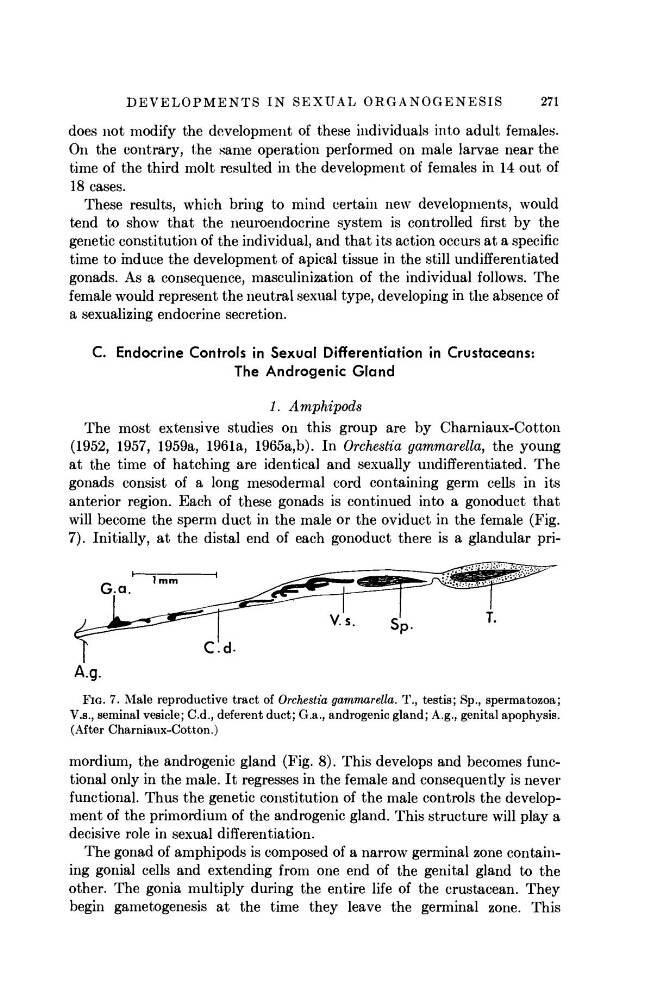
will become the sperm duct in the male or the oviduct in the female (Fig.
7). Initially, at the distal end of each gonoduct there is a glandular priFIG. 7. Male reproductive tract of Orchestia gammarella. T., testis; Sp., spermatozoa;
V.s., seminal vesicle; C.d., deferent duct; G.a., androgenic gland; A.g., genital apophysis.
(After Charniaux-Cotton.)
mordium, the androgenic gland (Fig. 8). This develops and becomes functional only in the male. It regresses in the female and consequently is never
functional. Thus the genetic constitution of the male controls the development of the primordium of the androgenic gland. This structure will play a
decisive role in sexual differentiation.
The gonad of amphipods is composed of a narrow germinal zone containing gonial cells and extending from one end of the genital gland to the
other. The gonia multiply during the entire life of the crustacean. They
begin gametogenesis at the time they leave the germinal zone. This
271
does not modify the development of these individuals into adult females.
On the contrary, the same operation performed on male larvae near the
time of the third molt resulted in the development of females in 14 out of
18 cases.
These results, which bring to mind certain new developments, would
tend to show that the neuroendocrine system is controlled first by the
genetic constitution of the individual, and that its action occurs at a specific
time to induce the development of apical tissue in the still undifferentiated
gonads. As a consequence, masculinization of the individual follows. The
female would represent the neutral sexual type, developing in the absence of
a sexualizing endocrine secretion.
C. Endocrine Controls in Sexual Differentiation in Crustaceans:
The Androgenic Gland
1. Amphipods
The most extensive studies on this group are by Charniaux-Cotton
(1952, 1957, 1959a, 1961a, 1965a,b). In Orchestia gammarella, the young
at the time of hatching are identical and sexually undifferentiated. The
gonads consist of a long mesodermal cord containing germ cells in its
anterior region. Each of these gonads is continued into a gonoduct that
will become the sperm duct in the male or the oviduct in the female (Fig.
7). Initially, at the distal end of each gonoduct there is a glandular priFIG. 7. Male reproductive tract of Orchestia gammarella. T., testis; Sp., spermatozoa;
V.s., seminal vesicle; C.d., deferent duct; G.a., androgenic gland; A.g., genital apophysis.
(After Charniaux-Cotton.)
mordium, the androgenic gland (Fig. 8). This develops and becomes functional only in the male. It regresses in the female and consequently is never
functional. Thus the genetic constitution of the male controls the development of the primordium of the androgenic gland. This structure will play a
decisive role in sexual differentiation.
The gonad of amphipods is composed of a narrow germinal zone containing gonial cells and extending from one end of the genital gland to the
other. The gonia multiply during the entire life of the crustacean. They
begin gametogenesis at the time they leave the germinal zone. This