

242
B. L. ASTAUROV
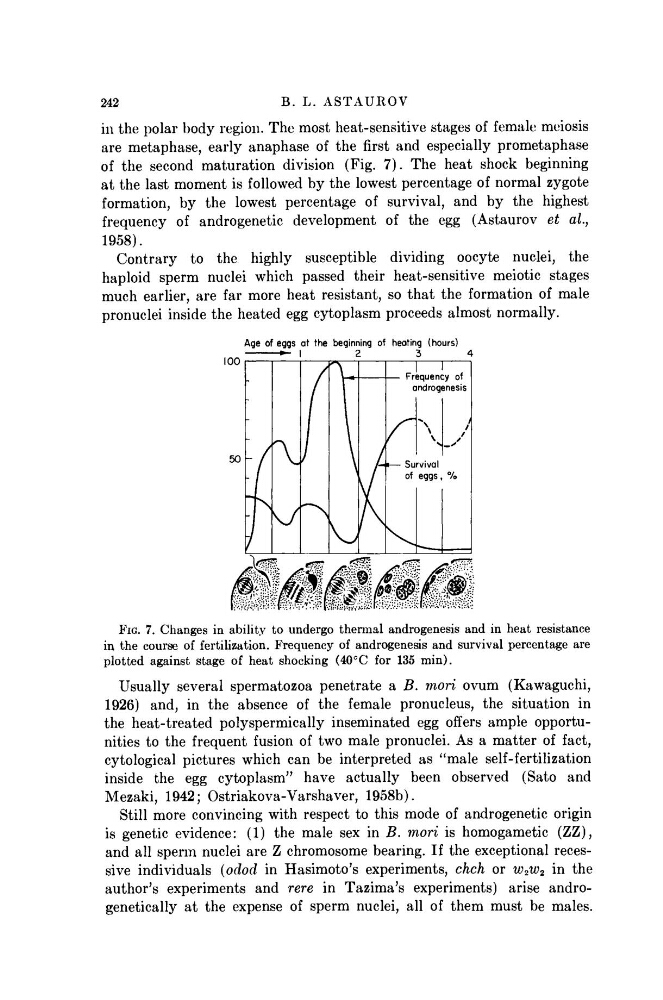
in the polar body region. The most heat-sensitive stages of female meiosis
are metaphase, early anaphase of the first and especially prometaphase
of the second maturation division (Fig. 7). The heat shock beginning
at the last moment is followed by the lowest percentage of normal zygote
formation, by the lowest percentage of survival, and by the highest
frequency of androgenetic development of the egg (Astaurov et al,
1958).
Contrary to the highly susceptible dividing oocyte nuclei, the
haploid sperm nuclei which passed their heat-sensitive meiotic stages
much earlier, are far more heat resistant, so that the formation of male
pronuclei inside the heated egg cytoplasm proceeds almost normally.
Age of eggs at the beginning of heating (hours)
FIG. 7. Changes in ability to undergo thermal androgenesis and in heat resistance
in the course of fertilization. Frequency of androgenesis and survival percentage are
plotted against stage of heat shocking (40°C for 135 min).
Usually several spermatozoa penetrate a B. mori ovum (Kawaguchi,
1926) and, in the absence of the female pronucleus, the situation in
the heat-treated polyspermically inseminated egg offers ample opportunities to the frequent fusion of two male pronuclei. As a matter of fact,
cytological pictures which can be interpreted as "male self-fertilization
inside the egg cytoplasm" have actually been observed (Sato and
Mezaki, 1942; Ostriakova-Varshaver, 1958b).
Still more convincing with respect to this mode of androgenetic origin
is genetic evidence: (1) the male sex in B. mori is homogametic (ZZ),
and all sperm nuclei are Z chromosome bearing. If the exceptional recessive individuals (odod in Hasimoto's experiments, chch or w 2 w 2 in the
author's experiments and rere in Tazima's experiments) arise androgenetically at the expense of sperm nuclei, all of them must be males.
B. L. ASTAUROV
in the polar body region. The most heat-sensitive stages of female meiosis
are metaphase, early anaphase of the first and especially prometaphase
of the second maturation division (Fig. 7). The heat shock beginning
at the last moment is followed by the lowest percentage of normal zygote
formation, by the lowest percentage of survival, and by the highest
frequency of androgenetic development of the egg (Astaurov et al,
1958).
Contrary to the highly susceptible dividing oocyte nuclei, the
haploid sperm nuclei which passed their heat-sensitive meiotic stages
much earlier, are far more heat resistant, so that the formation of male
pronuclei inside the heated egg cytoplasm proceeds almost normally.
Age of eggs at the beginning of heating (hours)
FIG. 7. Changes in ability to undergo thermal androgenesis and in heat resistance
in the course of fertilization. Frequency of androgenesis and survival percentage are
plotted against stage of heat shocking (40°C for 135 min).
Usually several spermatozoa penetrate a B. mori ovum (Kawaguchi,
1926) and, in the absence of the female pronucleus, the situation in
the heat-treated polyspermically inseminated egg offers ample opportunities to the frequent fusion of two male pronuclei. As a matter of fact,
cytological pictures which can be interpreted as "male self-fertilization
inside the egg cytoplasm" have actually been observed (Sato and
Mezaki, 1942; Ostriakova-Varshaver, 1958b).
Still more convincing with respect to this mode of androgenetic origin
is genetic evidence: (1) the male sex in B. mori is homogametic (ZZ),
and all sperm nuclei are Z chromosome bearing. If the exceptional recessive individuals (odod in Hasimoto's experiments, chch or w 2 w 2 in the
author's experiments and rere in Tazima's experiments) arise androgenetically at the expense of sperm nuclei, all of them must be males.