

CYTOGENETIC MECHANISMS IN SILKWORMS
237
TABLE II
A Tentative Design for Experimental Production of the "Amphidiploids"
(2 n Bombyx mori -\-2nB.
mandarina)
Parents
*Ί
J 4 n mori x c? mandarina
Allotriploids
3 n, (2 n mori + 1 n mandarina)
o o o + d W
both quite sterile
when crossed
Thermal activation of unfertilized 3 n oocytes
(46°C during 18 min)
P x First
parthenogenetic
generation
Tetraploid
progeny
from back
crosses
Tetraploid
inter se
crosses
(
£$£ Pure triploids 3n (2w mori + In mandarina)
f 3 n (2 n mori + 1 w mandarina)
γ$$ Mixoploids <
( ^ 6 n (4n mori + 2n mandarina)
£^ 3 n x /3n\
î Î — )
x & 2 n mandarina . Partly fertile, 1% eggs hatch (6 n)
Random back
crosses withj
mandarina
males
3 n female pronucleus
(2 n mori + 1 n mandarina
1 n male pronucleus
(In mandarina)
4 w "Amphidiploids" (2 w wor/ + 2 n mandarina)
bisexual race
divergence, these silkworm species (or subspecies) could be crossed
(although not easily) and gave quite fertile hybrids. The absence of
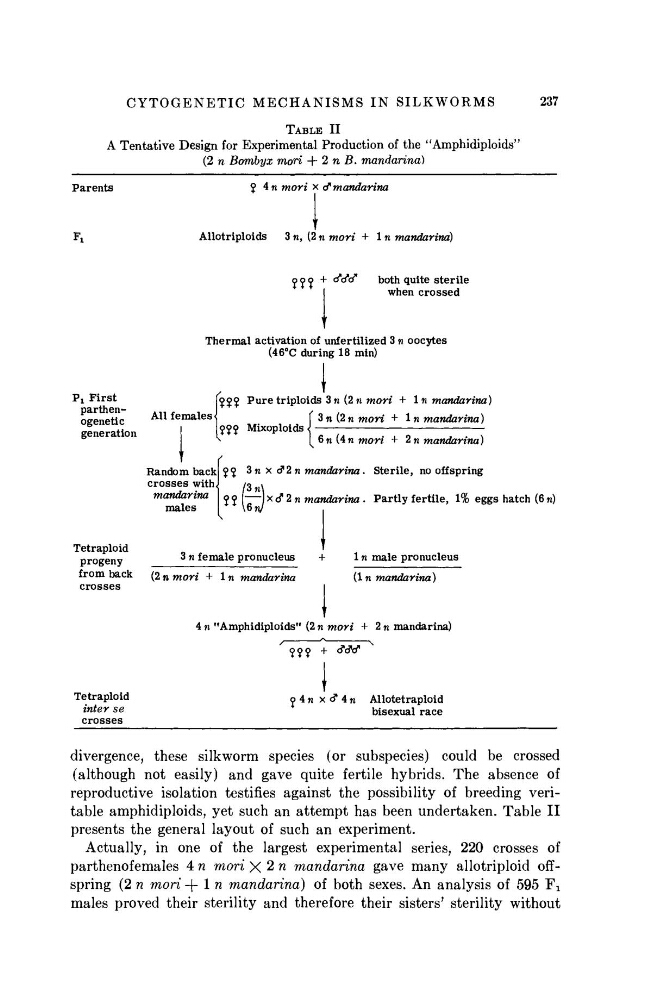
reproductive isolation testifies against the possibility of breeding veritable amphidiploids, yet such an attempt has been undertaken. Table II
presents the general layout of such an experiment.
Actually, in one of the largest experimental series, 220 crosses of
parthenofemales 4 n mori X 2 n mandarina gave many allotriploid offspring (2 n mori - f i n mandarina) of both sexes. An analysis of 595 Fi
males proved their sterility and therefore their sisters' sterility without
237
TABLE II
A Tentative Design for Experimental Production of the "Amphidiploids"
(2 n Bombyx mori -\-2nB.
mandarina)
Parents
*Ί
J 4 n mori x c? mandarina
Allotriploids
3 n, (2 n mori + 1 n mandarina)
o o o + d W
both quite sterile
when crossed
Thermal activation of unfertilized 3 n oocytes
(46°C during 18 min)
P x First
parthenogenetic
generation
Tetraploid
progeny
from back
crosses
Tetraploid
inter se
crosses
(
£$£ Pure triploids 3n (2w mori + In mandarina)
f 3 n (2 n mori + 1 w mandarina)
γ$$ Mixoploids <
( ^ 6 n (4n mori + 2n mandarina)
£^ 3 n x /3n\
î Î — )
x & 2 n mandarina . Partly fertile, 1% eggs hatch (6 n)
Random back
crosses withj
mandarina
males
3 n female pronucleus
(2 n mori + 1 n mandarina
1 n male pronucleus
(In mandarina)
4 w "Amphidiploids" (2 w wor/ + 2 n mandarina)
bisexual race
divergence, these silkworm species (or subspecies) could be crossed
(although not easily) and gave quite fertile hybrids. The absence of
reproductive isolation testifies against the possibility of breeding veritable amphidiploids, yet such an attempt has been undertaken. Table II
presents the general layout of such an experiment.
Actually, in one of the largest experimental series, 220 crosses of
parthenofemales 4 n mori X 2 n mandarina gave many allotriploid offspring (2 n mori - f i n mandarina) of both sexes. An analysis of 595 Fi
males proved their sterility and therefore their sisters' sterility without