

CYTOGENETIC MECHANISMS IN SILKWORMS
3/7
235
Oocyte I
Triploid
female P,
■ \
Equational \ ^ ρ ^
-il^Èù^
Equational
maturation
wJfcs
pJ^Â
maturation
division
^wVJ
)rr\
v division
I ^\v Heating
Triploid
] ( 4 6 o C | 8 m i n u t e s ) /
, \ λ ^ S o m a t i c
cleavage·..· 3/7
Zn
3/7 + 3/^ Poliplo.dization
ilization
Mixoploid
6 / 7
female P,
x
Perish due
to
aneuploidy
Heating
(46°C-,
18 minutes) I
i V i K · «
Hexaploid
Tiff9ÇS^
parthenoge9Ε£Χ,*9
nesis till now,
< & ·
Triploid ameiotic
parthenogenesis
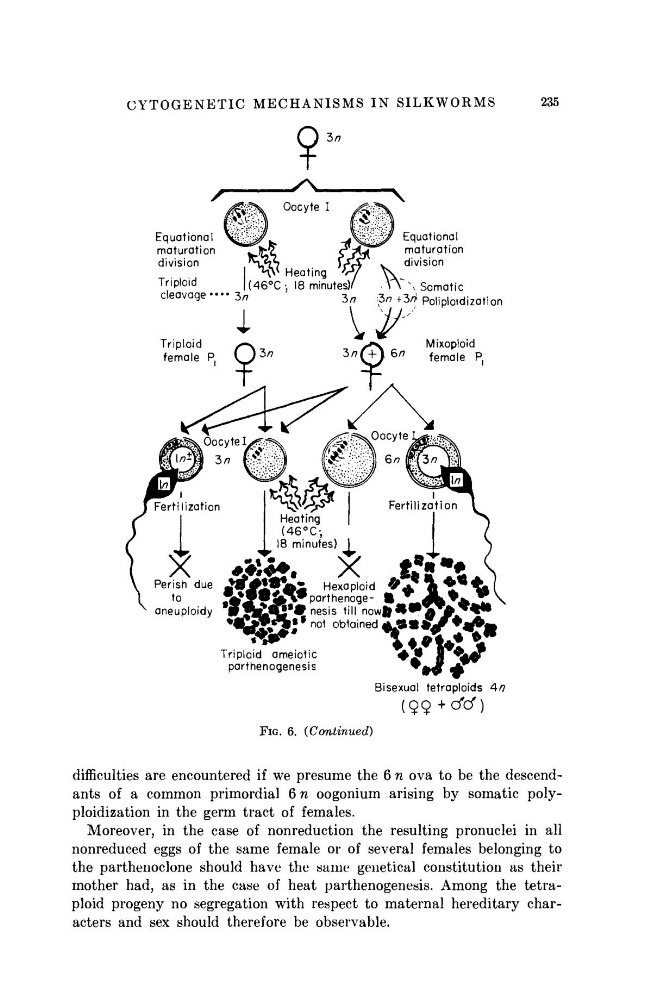
FIG. 6. {Continued)
not obtained
difficulties are encountered if we presume the 6 n ova to be the descendants of a common primordial 6 n oogonium arising by somatic polyploidization in the germ tract of females.
Moreover, in the case of nonreduction the resulting pronuclei in all
nonreduced eggs of the same female or of several females belonging to
the parthenoclone should have the same genetical constitution as their
mother had, as in the case of heat parthenogenesis. Among the tetraploid progeny no segregation with respect to maternal hereditary characters and sex should therefore be observable.
3/7
235
Oocyte I
Triploid
female P,
■ \
Equational \ ^ ρ ^
-il^Èù^
Equational
maturation
wJfcs
pJ^Â
maturation
division
^wVJ
)rr\
v division
I ^\v Heating
Triploid
] ( 4 6 o C | 8 m i n u t e s ) /
, \ λ ^ S o m a t i c
cleavage·..· 3/7
Zn
3/7 + 3/^ Poliplo.dization
ilization
Mixoploid
6 / 7
female P,
x
Perish due
to
aneuploidy
Heating
(46°C-,
18 minutes) I
i V i K · «
Hexaploid
Tiff9ÇS^
parthenoge9Ε£Χ,*9
nesis till now,
< & ·
Triploid ameiotic
parthenogenesis
FIG. 6. {Continued)
not obtained
difficulties are encountered if we presume the 6 n ova to be the descendants of a common primordial 6 n oogonium arising by somatic polyploidization in the germ tract of females.
Moreover, in the case of nonreduction the resulting pronuclei in all
nonreduced eggs of the same female or of several females belonging to
the parthenoclone should have the same genetical constitution as their
mother had, as in the case of heat parthenogenesis. Among the tetraploid progeny no segregation with respect to maternal hereditary characters and sex should therefore be observable.