

THE BIOLOGY OF TERATOMAS
19
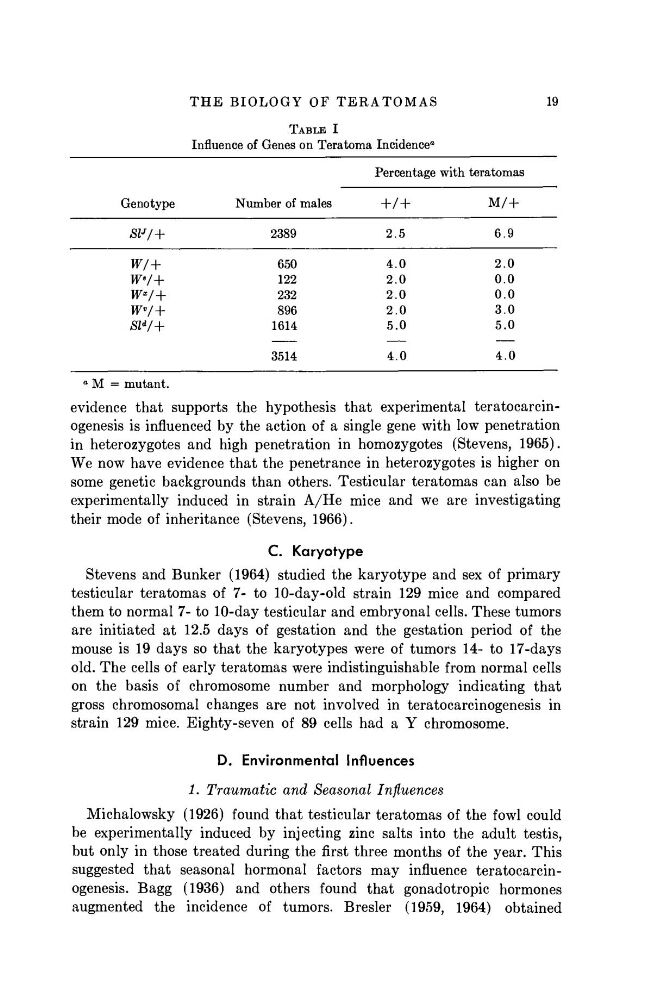
TABLE I
Influence of Genes on Teratoma Incidence
0
Genotype
SV/+
W/+
W/+
w*/+
W
v
/+
Sl
d /+
Number of males
2389
650
122
232
896
1614
3514
Percentage with teratomas
+/+
2.5
4.0
2.0
2.0
2.0
5.0
4.0
M/+
6.9
2.0
0.0
0.0
3.0
5.0
4.0
° M = mutant.
evidence that supports the hypothesis that experimental teratocarcinogenesis is influenced by the action of a single gene with low penetration
in hétérozygotes and high penetration in homozygotes (Stevens, 1965).
We now have evidence that the penetrance in hétérozygotes is higher on
some genetic backgrounds than others. Testicular teratomas can also be
experimentally induced in strain A/He mice and we are investigating
their mode of inheritance (Stevens, 1966).
C. Karyotype
Stevens and Bunker (1964) studied the karyotype and sex of primary
testicular teratomas of 7- to 10-day-old strain 129 mice and compared
them to normal 7- to 10-day testicular and embryonal cells. These tumors
are initiated at 12.5 days of gestation and the gestation period of the
mouse is 19 days so that the karyotypes were of tumors 14- to 17-days
old. The cells of early teratomas were indistinguishable from normal cells
on the basis of chromosome number and morphology indicating that
gross chromosomal changes are not involved in teratocarcinogenesis in
strain 129 mice. Eighty-seven of 89 cells had a Y chromosome.
D. Environmental Influences
1. Traumatic and Seasonal Influences
Michalowsky (1926) found that testicular teratomas of the fowl could
be experimentally induced by injecting zinc salts into the adult testis,
but only in those treated during the first three months of the year. This
suggested that seasonal hormonal factors may influence teratocarcinogenesis. Bagg (1936) and others found that gonadotropic hormones
augmented the incidence of tumors. Bresler (1959, 1964) obtained
19
TABLE I
Influence of Genes on Teratoma Incidence
0
Genotype
SV/+
W/+
W/+
w*/+
W
v
/+
Sl
d /+
Number of males
2389
650
122
232
896
1614
3514
Percentage with teratomas
+/+
2.5
4.0
2.0
2.0
2.0
5.0
4.0
M/+
6.9
2.0
0.0
0.0
3.0
5.0
4.0
° M = mutant.
evidence that supports the hypothesis that experimental teratocarcinogenesis is influenced by the action of a single gene with low penetration
in hétérozygotes and high penetration in homozygotes (Stevens, 1965).
We now have evidence that the penetrance in hétérozygotes is higher on
some genetic backgrounds than others. Testicular teratomas can also be
experimentally induced in strain A/He mice and we are investigating
their mode of inheritance (Stevens, 1966).
C. Karyotype
Stevens and Bunker (1964) studied the karyotype and sex of primary
testicular teratomas of 7- to 10-day-old strain 129 mice and compared
them to normal 7- to 10-day testicular and embryonal cells. These tumors
are initiated at 12.5 days of gestation and the gestation period of the
mouse is 19 days so that the karyotypes were of tumors 14- to 17-days
old. The cells of early teratomas were indistinguishable from normal cells
on the basis of chromosome number and morphology indicating that
gross chromosomal changes are not involved in teratocarcinogenesis in
strain 129 mice. Eighty-seven of 89 cells had a Y chromosome.
D. Environmental Influences
1. Traumatic and Seasonal Influences
Michalowsky (1926) found that testicular teratomas of the fowl could
be experimentally induced by injecting zinc salts into the adult testis,
but only in those treated during the first three months of the year. This
suggested that seasonal hormonal factors may influence teratocarcinogenesis. Bagg (1936) and others found that gonadotropic hormones
augmented the incidence of tumors. Bresler (1959, 1964) obtained