

228
B. L. ASTAUROV
endomitotic polyploidization in the majority of differentiated tissues and
organs (silk and rectal glands, Malpighian tubes, corpora adiposa, etc.)
is a phenomenon sui generis, and it will not be discussed in this review.
Contrary to the normal development of the fertilized egg, frequent
cases of a casual occurrence of polyploidy can be found in the course of
meiotic parthenogenesis, both rudimentary and complete (Sato, 1931;
Frolova, 1935; Tchou-Su and Chao-Ju-Yi, 1936). In the case of ameiotic
artificial heat parthenogenesis, accidental somatic polyploidization is
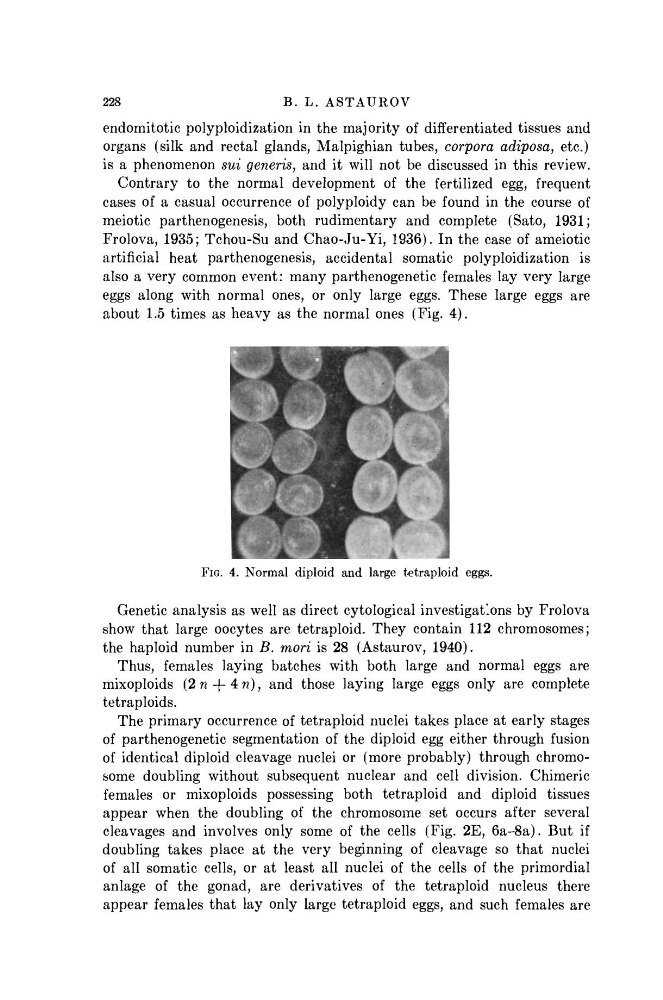
also a very common event: many parthenogenetic females lay very large
eggs along with normal ones, or only large eggs. These large eggs are
about 1.5 times as heavy as the normal ones (Fig. 4).
FIG. 4. Normal diploid and large tetraploid eggs.
Genetic analysis as well as direct cytological investigations by Frolova
show that large oocytes are tetraploid. They contain 112 chromosomes;
the haploid number in B. mori is 28 (Astaurov, 1940).
Thus, females laying batches with both large and normal eggs are
mixoploids (2n + 4 n ) , and those laying large eggs only are complete
tetraploids.
The primary occurrence of tetraploid nuclei takes place at early stages
of parthenogenetic segmentation of the diploid egg either through fusion
of identical diploid cleavage nuclei or (more probably) through chromosome doubling without subsequent nuclear and cell division. Chimeric
females or mixoploids possessing both tetraploid and diploid tissues
appear when the doubling of the chromosome set occurs after several
cleavages and involves only some of the cells (Fig. 2E, 6a-8a). But if
doubling takes place at the very beginning of cleavage so that nuclei
of all somatic cells, or at least all nuclei of the cells of the primordial
anläge of the gonad, are derivatives of the tetraploid nucleus there
appear females that lay only large tetraploid eggs, and such females are
B. L. ASTAUROV
endomitotic polyploidization in the majority of differentiated tissues and
organs (silk and rectal glands, Malpighian tubes, corpora adiposa, etc.)
is a phenomenon sui generis, and it will not be discussed in this review.
Contrary to the normal development of the fertilized egg, frequent
cases of a casual occurrence of polyploidy can be found in the course of
meiotic parthenogenesis, both rudimentary and complete (Sato, 1931;
Frolova, 1935; Tchou-Su and Chao-Ju-Yi, 1936). In the case of ameiotic
artificial heat parthenogenesis, accidental somatic polyploidization is
also a very common event: many parthenogenetic females lay very large
eggs along with normal ones, or only large eggs. These large eggs are
about 1.5 times as heavy as the normal ones (Fig. 4).
FIG. 4. Normal diploid and large tetraploid eggs.
Genetic analysis as well as direct cytological investigations by Frolova
show that large oocytes are tetraploid. They contain 112 chromosomes;
the haploid number in B. mori is 28 (Astaurov, 1940).
Thus, females laying batches with both large and normal eggs are
mixoploids (2n + 4 n ) , and those laying large eggs only are complete
tetraploids.
The primary occurrence of tetraploid nuclei takes place at early stages
of parthenogenetic segmentation of the diploid egg either through fusion
of identical diploid cleavage nuclei or (more probably) through chromosome doubling without subsequent nuclear and cell division. Chimeric
females or mixoploids possessing both tetraploid and diploid tissues
appear when the doubling of the chromosome set occurs after several
cleavages and involves only some of the cells (Fig. 2E, 6a-8a). But if
doubling takes place at the very beginning of cleavage so that nuclei
of all somatic cells, or at least all nuclei of the cells of the primordial
anläge of the gonad, are derivatives of the tetraploid nucleus there
appear females that lay only large tetraploid eggs, and such females are