

CYTOGENETIC MECHANISMS IN SILKWORMS
211
proportion corresponds to that infinitesimal group of eggs whose destiny
is the successful completion of parthenogenetic development. Nevertheless, several painstaking studies have given rather concordant results
which permit an outline of the cytogenetic developmental mechanism of
spontaneous parthenogenesis both abortive and complete (Bataillon and
Tchou-Su, 1933; Frolova, 1935; Henking, 1892; Kawaguchi, 1934a; Sato,
1929, and cited in Tazima, 1964; Sato, 1931).
As a rule both maturation divisions take place; the first of them is
reductional, the second is equational (Fig. 2D, 2a,b, and 3a,b). Thus
spontaneous parthenogenesis in B. mori belongs to the meiotic type.
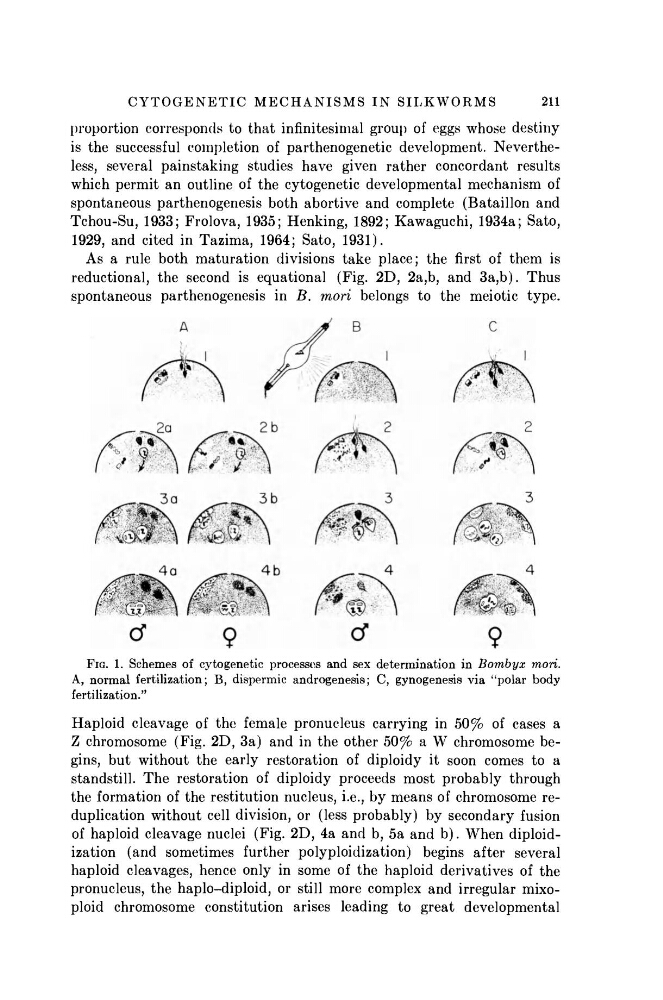
FIG. 1. Schemes of cytogenetic processes and sex determination in Bombyx mon.
A, normal fertilization; B, dispermic androgenesis ; C, gynogenesis via "polar body
fertilization."
Haploid cleavage of the female pronucleus carrying in 50% of cases a
Z chromosome (Fig. 2D, 3a) and in the other 50% a W chromosome begins, but without the early restoration of diploidy it soon comes to a
standstill. The restoration of diploidy proceeds most probably through
the formation of the restitution nucleus, i.e., by means of chromosome reduplication without cell division, or (less probably) by secondary fusion
of haploid cleavage nuclei (Fig. 2D, 4a and b, 5a and b). When diploidization (and sometimes further polyploidization) begins after several
haploid cleavages, hence only in some of the haploid derivatives of the
pronucleus, the haplo-diploid, or still more complex and irregular mixoploid chromosome constitution arises leading to great developmental
211
proportion corresponds to that infinitesimal group of eggs whose destiny
is the successful completion of parthenogenetic development. Nevertheless, several painstaking studies have given rather concordant results
which permit an outline of the cytogenetic developmental mechanism of
spontaneous parthenogenesis both abortive and complete (Bataillon and
Tchou-Su, 1933; Frolova, 1935; Henking, 1892; Kawaguchi, 1934a; Sato,
1929, and cited in Tazima, 1964; Sato, 1931).
As a rule both maturation divisions take place; the first of them is
reductional, the second is equational (Fig. 2D, 2a,b, and 3a,b). Thus
spontaneous parthenogenesis in B. mori belongs to the meiotic type.
FIG. 1. Schemes of cytogenetic processes and sex determination in Bombyx mon.
A, normal fertilization; B, dispermic androgenesis ; C, gynogenesis via "polar body
fertilization."
Haploid cleavage of the female pronucleus carrying in 50% of cases a
Z chromosome (Fig. 2D, 3a) and in the other 50% a W chromosome begins, but without the early restoration of diploidy it soon comes to a
standstill. The restoration of diploidy proceeds most probably through
the formation of the restitution nucleus, i.e., by means of chromosome reduplication without cell division, or (less probably) by secondary fusion
of haploid cleavage nuclei (Fig. 2D, 4a and b, 5a and b). When diploidization (and sometimes further polyploidization) begins after several
haploid cleavages, hence only in some of the haploid derivatives of the
pronucleus, the haplo-diploid, or still more complex and irregular mixoploid chromosome constitution arises leading to great developmental