

THE BIOLOGY OF TERATOMAS
17
1952). Carleton et al. (1953) observed a higher incidence of induced
testicular teratomas in White Leghorns than in other varieties of fowl
suggesting that there may be genetic differences in susceptibility to
teratocarcinogenesis.
In mice, spontaneous teratomas are almost unknown except for the
inbred strain 129. Some sublines of this strain have higher incidences
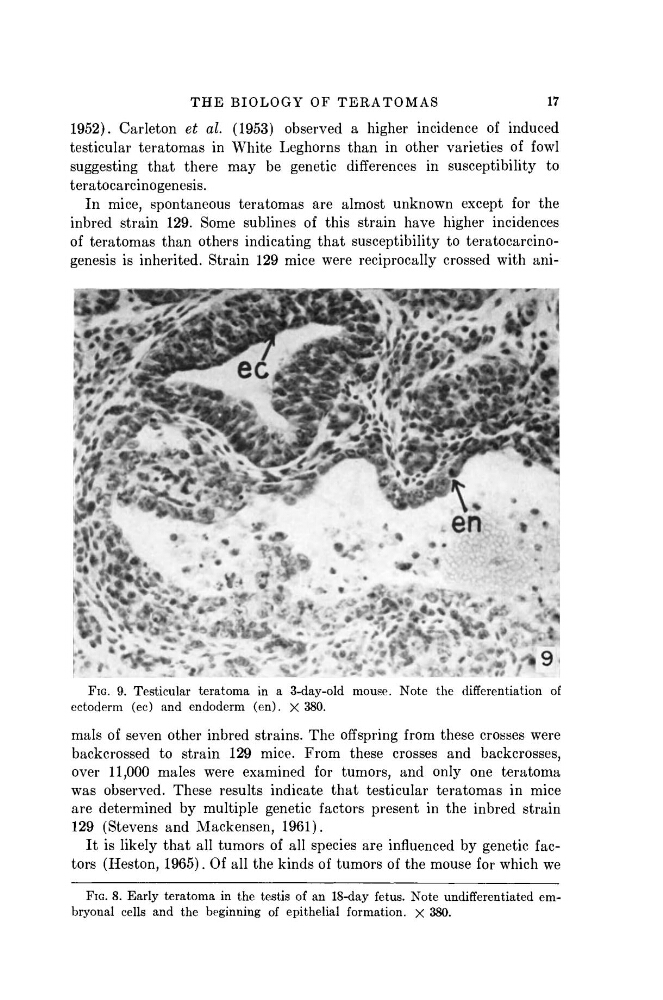
of teratomas than others indicating that susceptibility to teratocarcinogenesis is inherited. Strain 129 mice were reciprocally crossed with aniFIG. 9. Testicular teratoma in a 3-day-old mouse. Note the differentiation of
ectoderm (ec) and endoderm (en). X 380.
mais of seven other inbred strains. The offspring from these crosses were
backcrossed to strain 129 mice. From these crosses and backcrosses,
over 11,000 males were examined for tumors, and only one teratoma
was observed. These results indicate that testicular teratomas in mice
are determined by multiple genetic factors present in the inbred strain
129 (Stevens and Mackensen, 1961).
It is likely that all tumors of all species are influenced by genetic factors (Heston, 1965). Of all the kinds of tumors of the mouse for which we
FIG. 8. Early teratoma in the testis of an 18-day fetus. Note undifferentiated embryonal cells and the beginning of epithelial formation. X 380.
17
1952). Carleton et al. (1953) observed a higher incidence of induced
testicular teratomas in White Leghorns than in other varieties of fowl
suggesting that there may be genetic differences in susceptibility to
teratocarcinogenesis.
In mice, spontaneous teratomas are almost unknown except for the
inbred strain 129. Some sublines of this strain have higher incidences
of teratomas than others indicating that susceptibility to teratocarcinogenesis is inherited. Strain 129 mice were reciprocally crossed with aniFIG. 9. Testicular teratoma in a 3-day-old mouse. Note the differentiation of
ectoderm (ec) and endoderm (en). X 380.
mais of seven other inbred strains. The offspring from these crosses were
backcrossed to strain 129 mice. From these crosses and backcrosses,
over 11,000 males were examined for tumors, and only one teratoma
was observed. These results indicate that testicular teratomas in mice
are determined by multiple genetic factors present in the inbred strain
129 (Stevens and Mackensen, 1961).
It is likely that all tumors of all species are influenced by genetic factors (Heston, 1965). Of all the kinds of tumors of the mouse for which we
FIG. 8. Early teratoma in the testis of an 18-day fetus. Note undifferentiated embryonal cells and the beginning of epithelial formation. X 380.