

192
SAUL WISCHNITZBR
the fact that they both disintegrate into small fragments when treated
with deoxyribonuclease (DNase). This phenomenon does not occur when
the chromosomes are treated with proteolytic enzymes or RNase. These
chemical experiments, taken together with the morphological data at
hand, have led to the formulation of an integrated concept of these giant
chromosomes. They are conceived as being paired DNA-containing axial
strands extending the entire length of each lampbrush chromosome, as
being somehow coiled in two parts in the chromomeres, and as extending
out as the axes of the loops around which RNA-containing material is
synthesized. The results of the isotope-incorporation data (see below)
and enzymatic experiments are best interpreted if each of the axial strands
is considered to be a chromatid containing a very long DNA double
helix, rather than a multifibrilar structure (Gall, 1963b). Now that the
morphology and chemical composition of lampbrush chromosomes have
been considered, the function of these elements can be discussed.
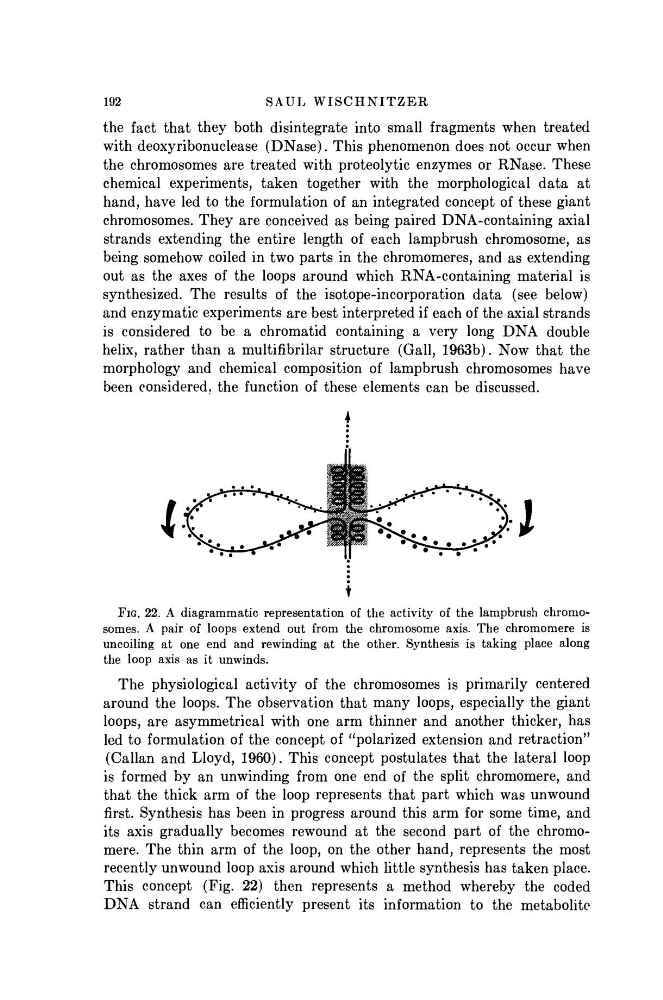
FIG. 22. A diagrammatic representation of the activity of the lampbrush chromosomes. A pair of loops extend out from the chromosome axis. The chromomere is
uncoiling at one end and rewinding at the other. Synthesis is taking place along
the loop axis as it unwinds.
The physiological activity of the chromosomes is primarily centered
around the loops. The observation that many loops, especially the giant
loops, are asymmetrical with one arm thinner and another thicker, has
led to formulation of the concept of "polarized extension and retraction"
(Callan and Lloyd, 1960). This concept postulates that the lateral loop
is formed by an unwinding from one end of the split chromomere, and
that the thick arm of the loop represents that part which was unwound
first. Synthesis has been in progress around this arm for some time, and
its axis gradually becomes rewound at the second part of the chromomere. The thin arm of the loop, on the other hand, represents the most
recently unwound loop axis around which little synthesis has taken place.
This concept (Fig. 22) then represents a method whereby the coded
DNA strand can efficiently present its information to the metabolite
SAUL WISCHNITZBR
the fact that they both disintegrate into small fragments when treated
with deoxyribonuclease (DNase). This phenomenon does not occur when
the chromosomes are treated with proteolytic enzymes or RNase. These
chemical experiments, taken together with the morphological data at
hand, have led to the formulation of an integrated concept of these giant
chromosomes. They are conceived as being paired DNA-containing axial
strands extending the entire length of each lampbrush chromosome, as
being somehow coiled in two parts in the chromomeres, and as extending
out as the axes of the loops around which RNA-containing material is
synthesized. The results of the isotope-incorporation data (see below)
and enzymatic experiments are best interpreted if each of the axial strands
is considered to be a chromatid containing a very long DNA double
helix, rather than a multifibrilar structure (Gall, 1963b). Now that the
morphology and chemical composition of lampbrush chromosomes have
been considered, the function of these elements can be discussed.
FIG. 22. A diagrammatic representation of the activity of the lampbrush chromosomes. A pair of loops extend out from the chromosome axis. The chromomere is
uncoiling at one end and rewinding at the other. Synthesis is taking place along
the loop axis as it unwinds.
The physiological activity of the chromosomes is primarily centered
around the loops. The observation that many loops, especially the giant
loops, are asymmetrical with one arm thinner and another thicker, has
led to formulation of the concept of "polarized extension and retraction"
(Callan and Lloyd, 1960). This concept postulates that the lateral loop
is formed by an unwinding from one end of the split chromomere, and
that the thick arm of the loop represents that part which was unwound
first. Synthesis has been in progress around this arm for some time, and
its axis gradually becomes rewound at the second part of the chromomere. The thin arm of the loop, on the other hand, represents the most
recently unwound loop axis around which little synthesis has taken place.
This concept (Fig. 22) then represents a method whereby the coded
DNA strand can efficiently present its information to the metabolite