

HETEROBLASTIC DEVELOPMENT IN PLANTS
129
may be even more pronounced than those found in the earlier stages.
For these reasons it now seems desirable to refer to the seedling or
sporeling leaves as primary leaves, and to reserve the term juvenile
leaves for plants with relatively sharply separated juvenile and adult
stages.
1. Primary and Later Leaves
The simplest change in the successive leaves of the developing shoot
is an increase in size to a maximum, which sooner or later is followed
by a gradual reduction as growth intensity diminishes. Such size changes
are not restricted to annual plants, but are also found in the renewal
»Mo***
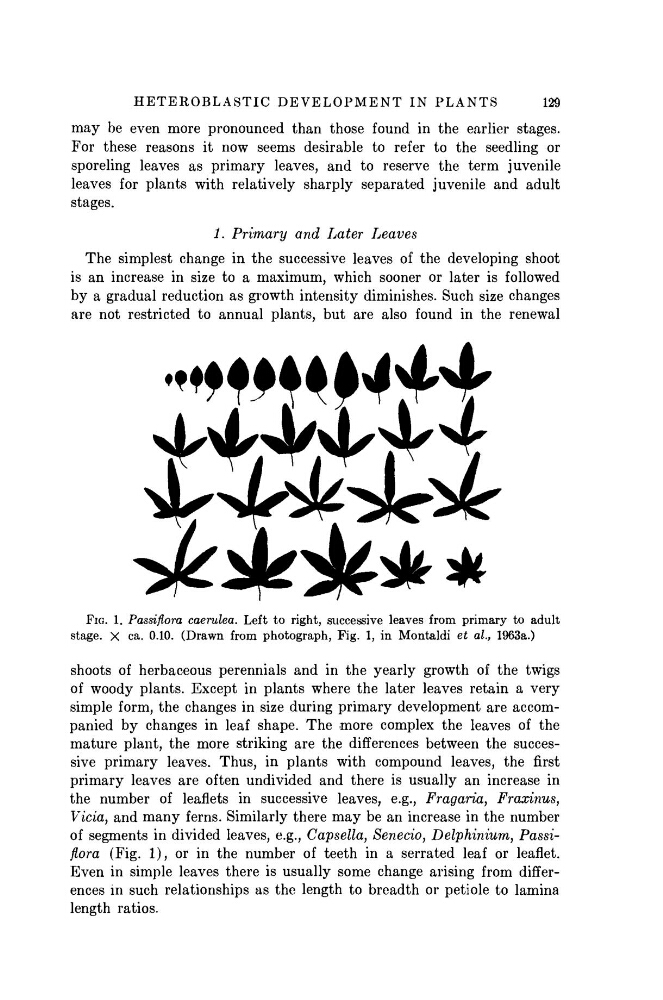
FIG. 1. Passiflora caerulea. Left to right, successive leaves from primary to adult
stage. X ca. 0.10. (Drawn from photograph, Fig. 1, in Montaldi et al., 1963a.)
shoots of herbaceous perennials and in the yearly growth of the twigs
of woody plants. Except in plants where the later leaves retain a very
simple form, the changes in size during primary development are accompanied by changes in leaf shape. The more complex the leaves of the
mature plant, the more striking are the differences between the successive primary leaves. Thus, in plants with compound leaves, the first
primary leaves are often undivided and there is usually an increase in
the number of leaflets in successive leaves, e.g., Fragaria, Fraxinus,
Vicia, and many ferns. Similarly there may be an increase in the number
of segments in divided leaves, e.g., Capsella, Senecio, Delphinium, Passiflora (Fig. 1), or in the number of teeth in a serrated leaf or leaflet.
Even in simple leaves there is usually some change arising from differences in such relationships as the length to breadth or petiole to lamina
length ratios.
129
may be even more pronounced than those found in the earlier stages.
For these reasons it now seems desirable to refer to the seedling or
sporeling leaves as primary leaves, and to reserve the term juvenile
leaves for plants with relatively sharply separated juvenile and adult
stages.
1. Primary and Later Leaves
The simplest change in the successive leaves of the developing shoot
is an increase in size to a maximum, which sooner or later is followed
by a gradual reduction as growth intensity diminishes. Such size changes
are not restricted to annual plants, but are also found in the renewal
»Mo***
FIG. 1. Passiflora caerulea. Left to right, successive leaves from primary to adult
stage. X ca. 0.10. (Drawn from photograph, Fig. 1, in Montaldi et al., 1963a.)
shoots of herbaceous perennials and in the yearly growth of the twigs
of woody plants. Except in plants where the later leaves retain a very
simple form, the changes in size during primary development are accompanied by changes in leaf shape. The more complex the leaves of the
mature plant, the more striking are the differences between the successive primary leaves. Thus, in plants with compound leaves, the first
primary leaves are often undivided and there is usually an increase in
the number of leaflets in successive leaves, e.g., Fragaria, Fraxinus,
Vicia, and many ferns. Similarly there may be an increase in the number
of segments in divided leaves, e.g., Capsella, Senecio, Delphinium, Passiflora (Fig. 1), or in the number of teeth in a serrated leaf or leaflet.
Even in simple leaves there is usually some change arising from differences in such relationships as the length to breadth or petiole to lamina
length ratios.