

EMBRYONIC HEMOGLOBIN SYNTHESIS
115
or morphogenetic event occurs even in the presence of deranged nucleic
acid metabolism. Both Hell (1964b) and Wilt (1965a) have examined
the effect of actinomycin on the initiation of hemoglobin synthesis in
explanted chick blastoderms, with similar results. Hell found that levels
of less than 0.25 /Ag/ml had little effect, but that treatment of blastoderms (one-somite stage or older) with higher levels of the drug had
profound effects. Hemoglobin was restricted to peripheral parts of the
area opaca vasculosa, the red blood cells were smaller, and there was
much less mitosis than is normally present. The net synthesis of both
RNA and DNA was inhibited, and a gradual inhibition of protein synthesis was encountered, although hemoglobin (60% of normal levels)
did accumulate. Wilt employed high levels of the drug (2 jug/ml) which
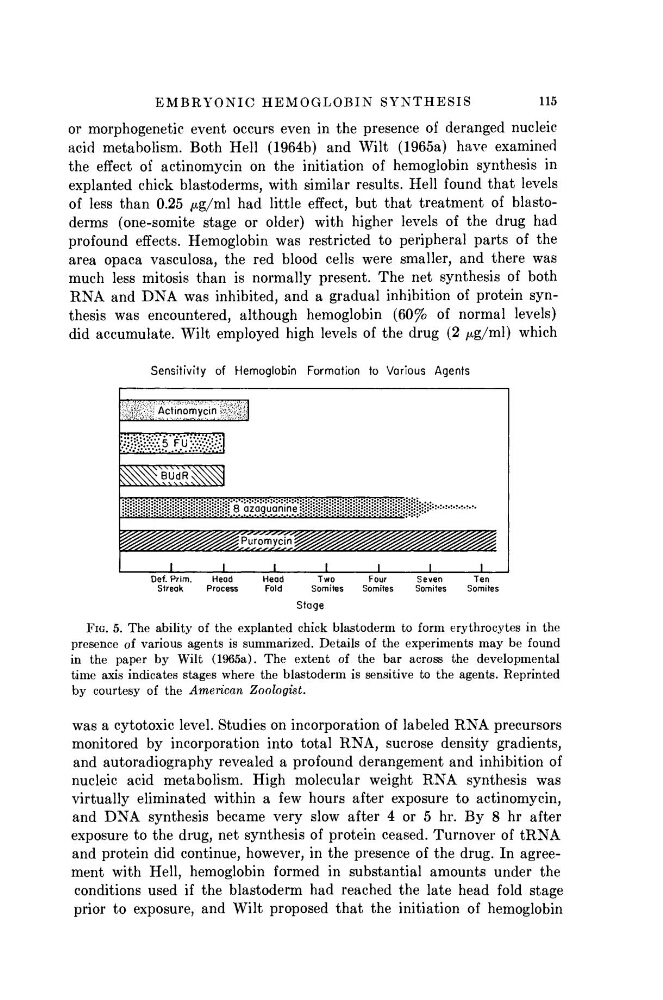
Sensitivity of Hemoglobin Formation to Various Agents
Def. Prim.
Head
Head
Two
Four
Seven
Ten
Streak
Process
Fold
Somites
Somites
Somites
Somites
Stage
FIG. 5. The ability of the explanted chick blastoderm to form erythrocytes in the
presence of various agents is summarized. Details of the experiments may be found
in the paper by Wilt (1965a). The extent of the bar across the developmental
time axis indicates stages where the blastoderm is sensitive to the agents. Reprinted
by courtesy of the American Zoologist.
was a cytotoxic level. Studies on incorporation of labeled RNA precursors
monitored by incorporation into total RNA, sucrose density gradients,
and autoradiography revealed a profound derangement and inhibition of
nucleic acid metabolism. High molecular weight RNA synthesis was
virtually eliminated within a few hours after exposure to actinomycin,
and DNA synthesis became very slow after 4 or 5 hr. By 8 hr after
exposure to the drug, net synthesis of protein ceased. Turnover of tRNA
and protein did continue, however, in the presence of the drug. In agreement with Hell, hemoglobin formed in substantial amounts under the
conditions used if the blastoderm had reached the late head fold stage
prior to exposure, and Wilt proposed that the initiation of hemoglobin
115
or morphogenetic event occurs even in the presence of deranged nucleic
acid metabolism. Both Hell (1964b) and Wilt (1965a) have examined
the effect of actinomycin on the initiation of hemoglobin synthesis in
explanted chick blastoderms, with similar results. Hell found that levels
of less than 0.25 /Ag/ml had little effect, but that treatment of blastoderms (one-somite stage or older) with higher levels of the drug had
profound effects. Hemoglobin was restricted to peripheral parts of the
area opaca vasculosa, the red blood cells were smaller, and there was
much less mitosis than is normally present. The net synthesis of both
RNA and DNA was inhibited, and a gradual inhibition of protein synthesis was encountered, although hemoglobin (60% of normal levels)
did accumulate. Wilt employed high levels of the drug (2 jug/ml) which
Sensitivity of Hemoglobin Formation to Various Agents
Def. Prim.
Head
Head
Two
Four
Seven
Ten
Streak
Process
Fold
Somites
Somites
Somites
Somites
Stage
FIG. 5. The ability of the explanted chick blastoderm to form erythrocytes in the
presence of various agents is summarized. Details of the experiments may be found
in the paper by Wilt (1965a). The extent of the bar across the developmental
time axis indicates stages where the blastoderm is sensitive to the agents. Reprinted
by courtesy of the American Zoologist.
was a cytotoxic level. Studies on incorporation of labeled RNA precursors
monitored by incorporation into total RNA, sucrose density gradients,
and autoradiography revealed a profound derangement and inhibition of
nucleic acid metabolism. High molecular weight RNA synthesis was
virtually eliminated within a few hours after exposure to actinomycin,
and DNA synthesis became very slow after 4 or 5 hr. By 8 hr after
exposure to the drug, net synthesis of protein ceased. Turnover of tRNA
and protein did continue, however, in the presence of the drug. In agreement with Hell, hemoglobin formed in substantial amounts under the
conditions used if the blastoderm had reached the late head fold stage
prior to exposure, and Wilt proposed that the initiation of hemoglobin