

EMBRYONIC HEMOGLOBIN SYNTHESIS
109
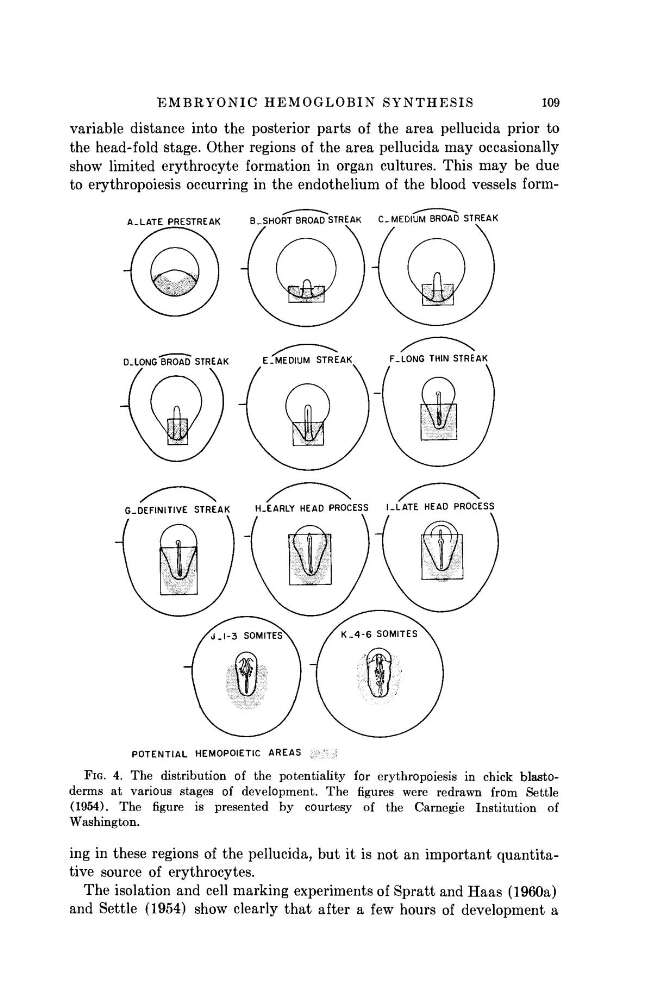
variable distance into the posterior parts of the area pellucida prior to
the head-fold stage. Other regions of the area pellucida may occasionally
show limited erythrocyte formation in organ cultures. This may be due
to erythropoiesis occurring in the endothelium of the blood vessels formPOTENTIAL HEMOPOIETIC AREAS
FIG. 4. The distribution of the potentiality for erythropoiesis in chick blastoderms at various stages of development. The figures were redrawn from Settle
(1954). The figure is presented by courtesy of the Carnegie Institution of
Washington.
ing in these regions of the pellucida, but it is not an important quantitative source of erythrocytes.
The isolation and cell marking experiments of Spratt and Haas (1960a)
and Settle (1954) show clearly that after a few hours of development a
109
variable distance into the posterior parts of the area pellucida prior to
the head-fold stage. Other regions of the area pellucida may occasionally
show limited erythrocyte formation in organ cultures. This may be due
to erythropoiesis occurring in the endothelium of the blood vessels formPOTENTIAL HEMOPOIETIC AREAS
FIG. 4. The distribution of the potentiality for erythropoiesis in chick blastoderms at various stages of development. The figures were redrawn from Settle
(1954). The figure is presented by courtesy of the Carnegie Institution of
Washington.
ing in these regions of the pellucida, but it is not an important quantitative source of erythrocytes.
The isolation and cell marking experiments of Spratt and Haas (1960a)
and Settle (1954) show clearly that after a few hours of development a