

104
F R E D H. W I L T
TABLE II
Chicken Embryo Hb Shifts
Author
D'Amelio
and Salvo
(1959c,
1961)
Fraser (1961,
1964a)
Wilt (1962)
Manwell
et al.
(1963)
Hashimoto
and Wilt
(1966)
Techniques
Immunoelectrophoresis
Electrophoresis,
chromatography
Immunology
Electrophoresis
Electrophoresis
Number of Hb
types
Embryo
2
2
3
2
> 3
Adult
3
3
2
3
>5
Ages studied
(days of
incubation)
2-11 days
5 days to
hatching
0-3 days
3-11 days
5 days, adult
Timing of shift
from embryonic
to adult Hb
Begins at 88 hr
and complete
by 11 days.
Gradual shift in
proportions
from 5 to 11
days. Component 3 seen at 7
days.
Distinct embryonic form present from 0 to 1.5
days.
Gradual shift from
5 to 11 days.
Midpoint of
shift at 7
days.
Some adult component present
at 5 days.
Change in both
subunits during
shift.
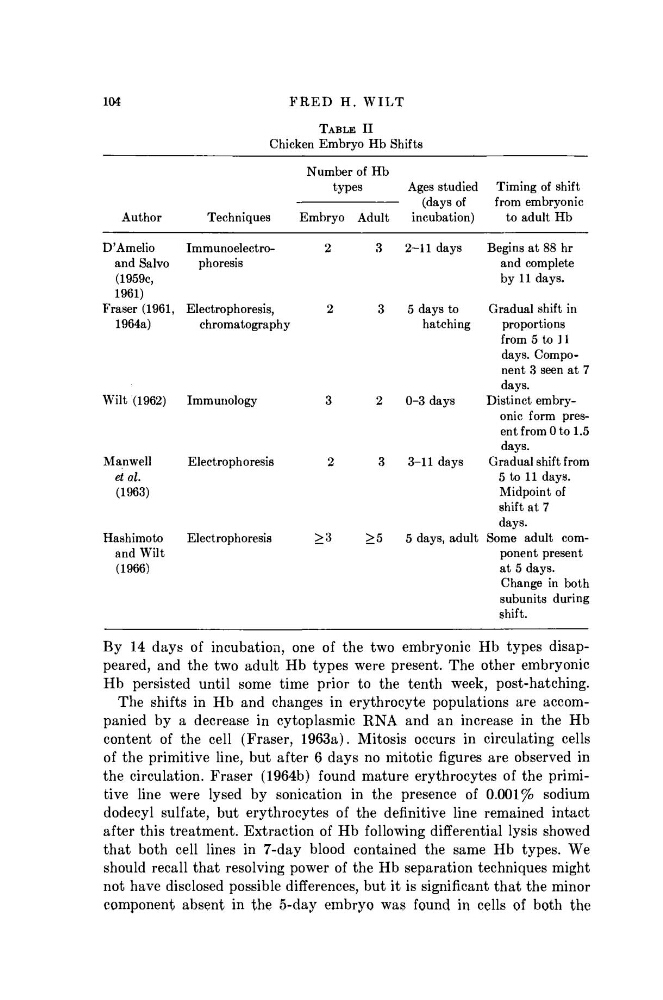
By 14 days of incubation, one of the two embryonic Hb types disappeared, and the two adult Hb types were present. The other embryonic
Hb persisted until some time prior to the tenth week, post-hatching.
The shifts in Hb and changes in erythrocyte populations are accompanied by a decrease in cytoplasmic RNA and an increase in the Hb
content of the cell (Fraser, 1963a). Mitosis occurs in circulating cells
of the primitive line, but after 6 days no mitotic figures are observed in
the circulation. Fraser (1964b) found mature erythrocytes of the primitive line were lysed by sonication in the presence of 0.001% sodium
dodecyl sulfate, but erythrocytes of the definitive line remained intact
after this treatment. Extraction of Hb following differential lysis showed
that both cell lines in 7-day blood contained the same Hb types. We
should recall that resolving power of the Hb separation techniques might
not have disclosed possible differences, but it is significant that the minor
component absent in the 5-day embryo was found in cells of both the
F R E D H. W I L T
TABLE II
Chicken Embryo Hb Shifts
Author
D'Amelio
and Salvo
(1959c,
1961)
Fraser (1961,
1964a)
Wilt (1962)
Manwell
et al.
(1963)
Hashimoto
and Wilt
(1966)
Techniques
Immunoelectrophoresis
Electrophoresis,
chromatography
Immunology
Electrophoresis
Electrophoresis
Number of Hb
types
Embryo
2
2
3
2
> 3
Adult
3
3
2
3
>5
Ages studied
(days of
incubation)
2-11 days
5 days to
hatching
0-3 days
3-11 days
5 days, adult
Timing of shift
from embryonic
to adult Hb
Begins at 88 hr
and complete
by 11 days.
Gradual shift in
proportions
from 5 to 11
days. Component 3 seen at 7
days.
Distinct embryonic form present from 0 to 1.5
days.
Gradual shift from
5 to 11 days.
Midpoint of
shift at 7
days.
Some adult component present
at 5 days.
Change in both
subunits during
shift.
By 14 days of incubation, one of the two embryonic Hb types disappeared, and the two adult Hb types were present. The other embryonic
Hb persisted until some time prior to the tenth week, post-hatching.
The shifts in Hb and changes in erythrocyte populations are accompanied by a decrease in cytoplasmic RNA and an increase in the Hb
content of the cell (Fraser, 1963a). Mitosis occurs in circulating cells
of the primitive line, but after 6 days no mitotic figures are observed in
the circulation. Fraser (1964b) found mature erythrocytes of the primitive line were lysed by sonication in the presence of 0.001% sodium
dodecyl sulfate, but erythrocytes of the definitive line remained intact
after this treatment. Extraction of Hb following differential lysis showed
that both cell lines in 7-day blood contained the same Hb types. We
should recall that resolving power of the Hb separation techniques might
not have disclosed possible differences, but it is significant that the minor
component absent in the 5-day embryo was found in cells of both the