

II.
T H E
EMBRYOLOGY
O F
ASCIDIANS
93
blastomeres were isolated without any damage (Reverberi, 1933b;
Cohen and Berrill, 1936; Pisanö, 1949). The old conclusions were only
modified by the admission that the 'mosaic' is not so rigid. Hemiembryos sometimes possess three palps (Schmidt, 1931), and altogether
they are not exactly a 'half. In the tadpoles which were obtained by
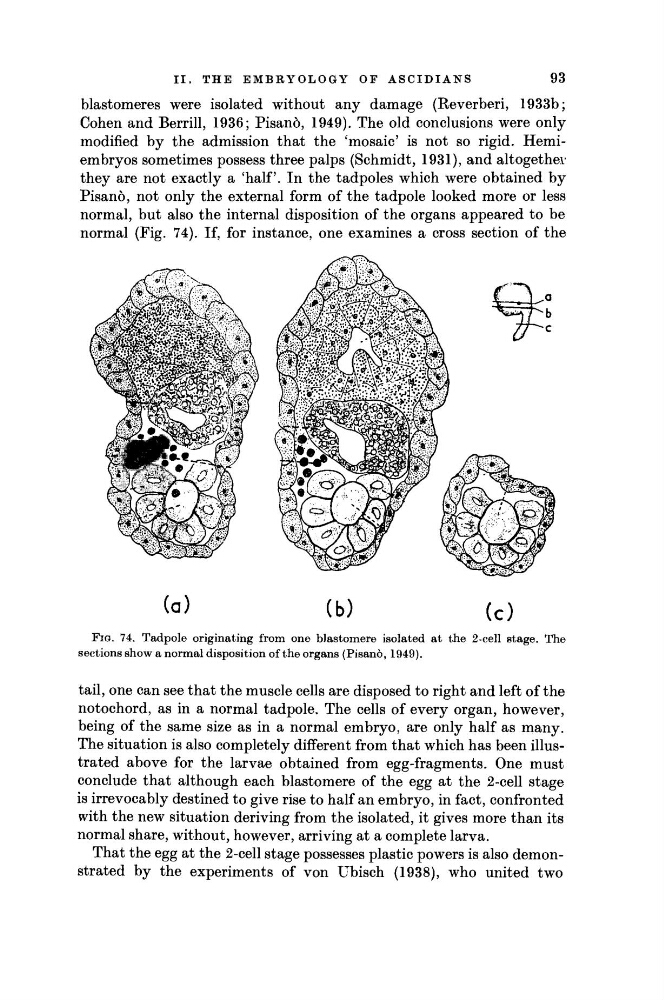
Pisano, not only the external form of the tadpole looked more or less
normal, but also the internal disposition of the organs appeared to be
normal (Fig. 74). If, for instance, one examines a cross section of the
(a)
(b)
(c)
FIG. 74. Tadpole originating from one blastomere isolated at the 2-cell stage. The
sections show a normal disposition of the organs (Pisano, 1949).
tail, one can see that the muscle cells are disposed to right and left of the
notochord, as in a normal tadpole. The cells of every organ, however,
being of the same size as in a normal embryo, are only half as many.
The situation is also completely different from that which has been illustrated above for the larvae obtained from egg-fragments. One must
conclude that although each blastomere of the egg at the 2-cell stage
is irrevocably destined to give rise to half an embryo, in fact, confronted
with the new situation deriving from the isolated, it gives more than its
normal share, without, however, arriving at a complete larva.
That the egg at the 2-cell stage possesses plastic powers is also demonstrated by the experiments of von Ubisch (1938), who united two
T H E
EMBRYOLOGY
O F
ASCIDIANS
93
blastomeres were isolated without any damage (Reverberi, 1933b;
Cohen and Berrill, 1936; Pisanö, 1949). The old conclusions were only
modified by the admission that the 'mosaic' is not so rigid. Hemiembryos sometimes possess three palps (Schmidt, 1931), and altogether
they are not exactly a 'half. In the tadpoles which were obtained by
Pisano, not only the external form of the tadpole looked more or less
normal, but also the internal disposition of the organs appeared to be
normal (Fig. 74). If, for instance, one examines a cross section of the
(a)
(b)
(c)
FIG. 74. Tadpole originating from one blastomere isolated at the 2-cell stage. The
sections show a normal disposition of the organs (Pisano, 1949).
tail, one can see that the muscle cells are disposed to right and left of the
notochord, as in a normal tadpole. The cells of every organ, however,
being of the same size as in a normal embryo, are only half as many.
The situation is also completely different from that which has been illustrated above for the larvae obtained from egg-fragments. One must
conclude that although each blastomere of the egg at the 2-cell stage
is irrevocably destined to give rise to half an embryo, in fact, confronted
with the new situation deriving from the isolated, it gives more than its
normal share, without, however, arriving at a complete larva.
That the egg at the 2-cell stage possesses plastic powers is also demonstrated by the experiments of von Ubisch (1938), who united two