

84
G.
REVERBERI
formations to the nuclei had been exhausted. However, the cause of the
nuclear block could also be imagined as intrinsic to the nuclei. Can an
absence of ATP be responsible?
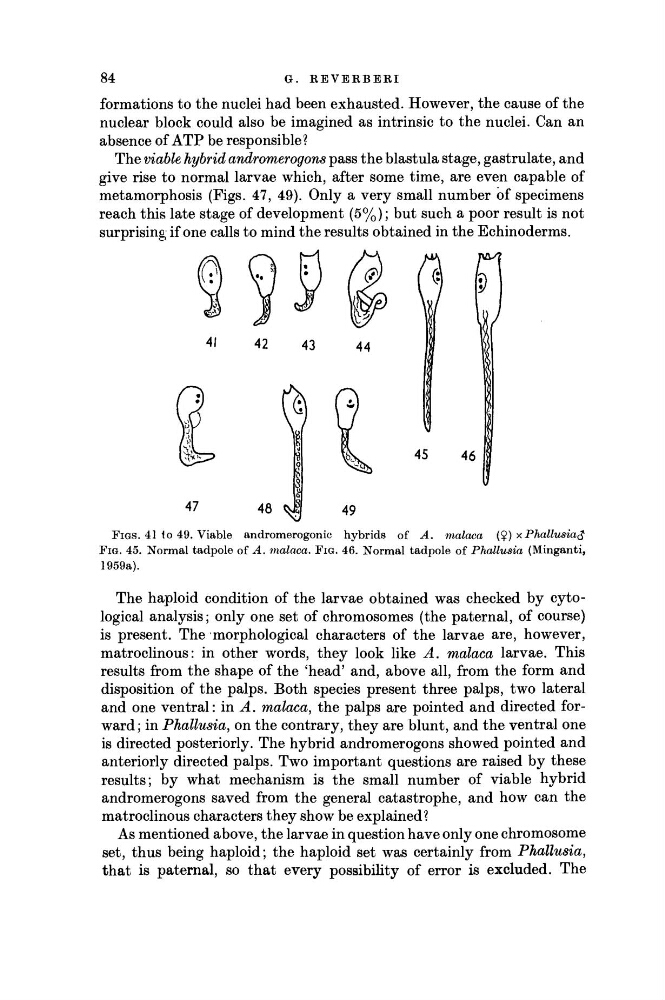
The viable hybrid andromerogons pass the blástula stage, gastrulate, and
give rise to normal larvae which, after some time, are even capable of
metamorphosis (Figs. 47, 49). Only a very small number of specimens
reach this late stage of development (5%); but such a poor result is not
surprising if one calls to mind the results obtained in the Echinoderms.
FIGS. 41 i o 49. Viable
andromerogonic hybrids of A.
malaca
($) χ Phallusia^
FIG. 45. Normal tadpole of A. malaca. FIG. 46. Normal tadpole of Phallusia
(Minganti,
1959a).
The haploid condition of the larvae obtained was checked by cytological analysis; only one set of chromosomes (the paternal, of course)
is present. The morphological characters of the larvae are, however,
matroclinous: in other words, they look like A. malaca larvae. This
results from the shape of the 'head' and, above all, from the form and
disposition of the palps. Both species present three palps, two lateral
and one ventral: in A. malaca, the palps are pointed and directed forward; in Phallusia, on the contrary, they are blunt, and the ventral one
is directed posteriorly. The hybrid andromerogons showed pointed and
anteriorly directed palps. Two important questions are raised by these
results; by what mechanism is the small number of viable hybrid
andromerogons saved from the general catastrophe, and how can the
matroclinous characters they show be explained?
As mentioned above, the larvae in question have only one chromosome
set, thus being haploid; the haploid set was certainly from Phallusia,
that is paternal, so that every possibility of error is excluded. The
G.
REVERBERI
formations to the nuclei had been exhausted. However, the cause of the
nuclear block could also be imagined as intrinsic to the nuclei. Can an
absence of ATP be responsible?
The viable hybrid andromerogons pass the blástula stage, gastrulate, and
give rise to normal larvae which, after some time, are even capable of
metamorphosis (Figs. 47, 49). Only a very small number of specimens
reach this late stage of development (5%); but such a poor result is not
surprising if one calls to mind the results obtained in the Echinoderms.
FIGS. 41 i o 49. Viable
andromerogonic hybrids of A.
malaca
($) χ Phallusia^
FIG. 45. Normal tadpole of A. malaca. FIG. 46. Normal tadpole of Phallusia
(Minganti,
1959a).
The haploid condition of the larvae obtained was checked by cytological analysis; only one set of chromosomes (the paternal, of course)
is present. The morphological characters of the larvae are, however,
matroclinous: in other words, they look like A. malaca larvae. This
results from the shape of the 'head' and, above all, from the form and
disposition of the palps. Both species present three palps, two lateral
and one ventral: in A. malaca, the palps are pointed and directed forward; in Phallusia, on the contrary, they are blunt, and the ventral one
is directed posteriorly. The hybrid andromerogons showed pointed and
anteriorly directed palps. Two important questions are raised by these
results; by what mechanism is the small number of viable hybrid
andromerogons saved from the general catastrophe, and how can the
matroclinous characters they show be explained?
As mentioned above, the larvae in question have only one chromosome
set, thus being haploid; the haploid set was certainly from Phallusia,
that is paternal, so that every possibility of error is excluded. The