

80
G.
REVERBERI
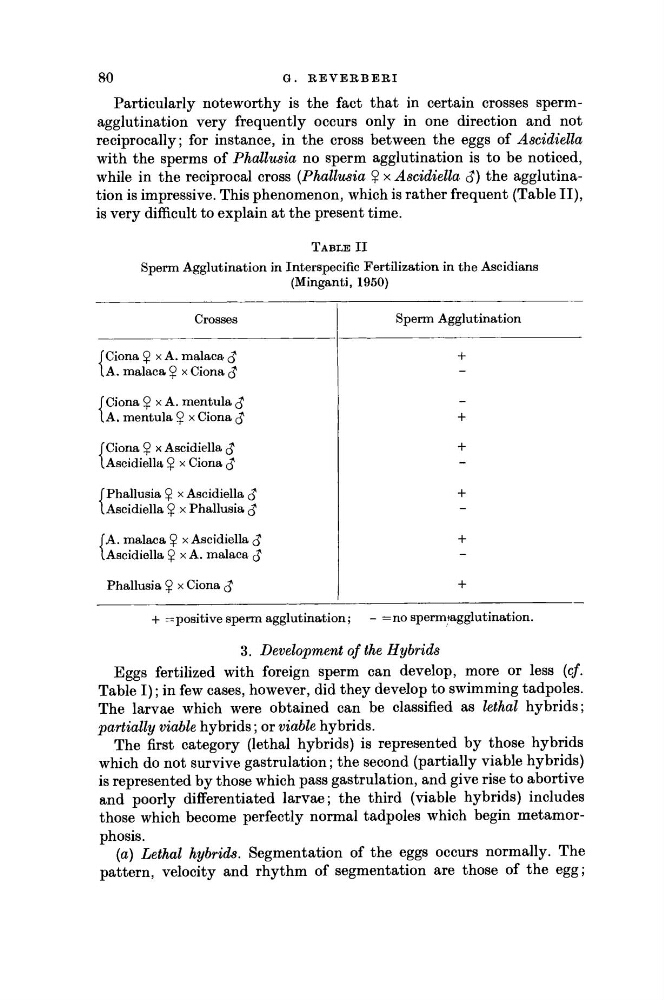
Particularly noteworthy is the fact that in certain crosses spermagglutination very frequently occurs only in one direction and not
reciprocally; for instance, in the cross between the eggs of Ascidiella
with the sperms of Phallusia no sperm agglutination is to be noticed,
while in the reciprocal cross (Phallusia $ χ Ascidiella (?) the agglutination is impressive. This phenomenon, which is rather frequent (Table II),
is very difficult to explain at the present time.
TABLE II
Sperm Agglutination in Interspecific Fertilization in the Ascidians
(Minganti, 1950)
Crosses
Sperm Agglutination
Γ Ciona $ χ A. malaca $
\ A. malaca $ χ Ciona
LA. méntula $ χ Ciona £
Γ Ciona $ χ Ascidiella $
I Ascidiella § χ Ciona
ΓΑ. malaca $ χ Ascidiella
+
+
+ = positive sperm agglutination;
- =no sperimagglutination.
3. Development of the Hybrids
Eggs fertilized with foreign sperm can develop, more or less (cf.
Table I); in few cases, however, did they develop to swimming tadpoles.
The larvae which were obtained can be classified as lethal hybrids;
partially viable hybrids; or viable hybrids.
The first category (lethal hybrids) is represented by those hybrids
which do not survive gastrulation; the second (partially viable hybrids)
is represented by those which pass gastrulation, and give rise to abortive
and poorly differentiated larvae; the third (viable hybrids) includes
those which become perfectly normal tadpoles which begin metamorphosis.
(a) Lethal hybrids. Segmentation of the eggs occurs normally. The
pattern, velocity and rhythm of segmentation are those of the egg;
G.
REVERBERI
Particularly noteworthy is the fact that in certain crosses spermagglutination very frequently occurs only in one direction and not
reciprocally; for instance, in the cross between the eggs of Ascidiella
with the sperms of Phallusia no sperm agglutination is to be noticed,
while in the reciprocal cross (Phallusia $ χ Ascidiella (?) the agglutination is impressive. This phenomenon, which is rather frequent (Table II),
is very difficult to explain at the present time.
TABLE II
Sperm Agglutination in Interspecific Fertilization in the Ascidians
(Minganti, 1950)
Crosses
Sperm Agglutination
Γ Ciona $ χ A. malaca $
\ A. malaca $ χ Ciona
LA. méntula $ χ Ciona £
Γ Ciona $ χ Ascidiella $
I Ascidiella § χ Ciona
ΓΑ. malaca $ χ Ascidiella
+
+
+ = positive sperm agglutination;
- =no sperimagglutination.
3. Development of the Hybrids
Eggs fertilized with foreign sperm can develop, more or less (cf.
Table I); in few cases, however, did they develop to swimming tadpoles.
The larvae which were obtained can be classified as lethal hybrids;
partially viable hybrids; or viable hybrids.
The first category (lethal hybrids) is represented by those hybrids
which do not survive gastrulation; the second (partially viable hybrids)
is represented by those which pass gastrulation, and give rise to abortive
and poorly differentiated larvae; the third (viable hybrids) includes
those which become perfectly normal tadpoles which begin metamorphosis.
(a) Lethal hybrids. Segmentation of the eggs occurs normally. The
pattern, velocity and rhythm of segmentation are those of the egg;