

78
G.
REVERBERI
the nucleus and cytoplasmic substances would be responsible for the
origin of an organism.
No doubt this view is too simplified. The function, for instance, of
RNA in the building of proteins cannot be denied. Some authors
(c/. Brächet, 1957, p. 429) believe that the enzymes are synthesized in
the cytoplasmic RNA granules, rather than in the nucleus; the latter,
however, would control their multiplication. The theory of Morgan has
not only inspired many experiments such as the transplantation of
nuclei, but has oriented embryological research in a new fashion as is
shown in the studies on heterospecific hybridizations and hybrid andromerogons.
In the Ascidians, heterospecific hybridizations proved to be successful
only a short time ago. Morgan (1923), while trying to bring about
autofertilization in Ciona, observed that positive results can be reached
only if one liberates the egg from the enclosing membrane. He did not,
however, try to use the same technique in order to get heterospecific
hybridizations: this was done by Reverberi (1933a) who had some success
in crossing the eggs ofCiona with the sperm of Phallusia; later, Minganti
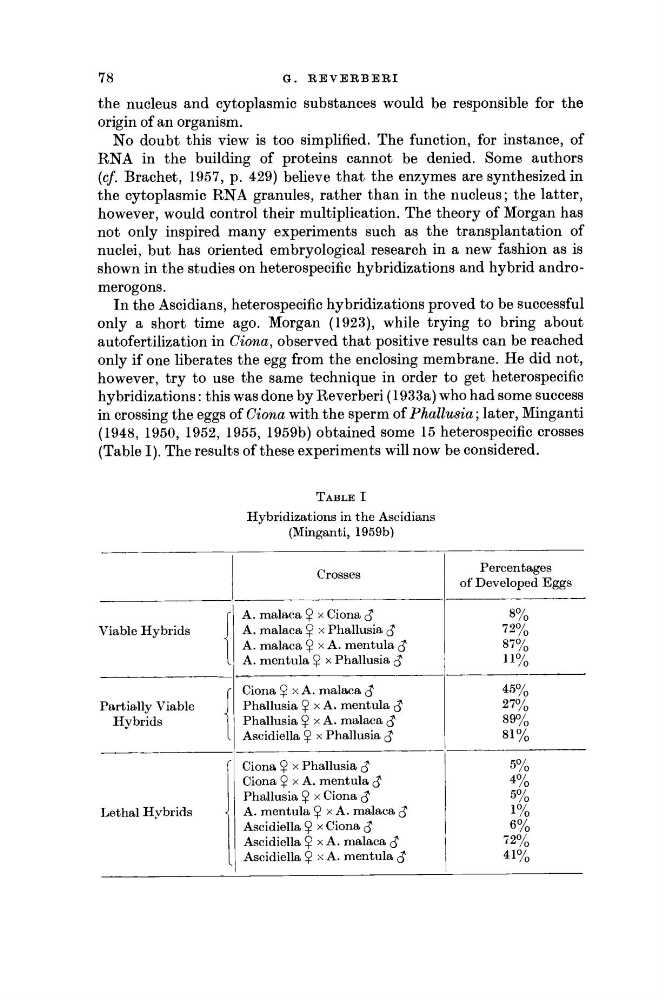
(1948, 1950, 1952, 1955, 1959b) obtained some 15 heterospecific crosses
(Table I). The results of these experiments will now be considered.
TABLE I
Hybridizations in the Ascidians
(Minganti, 1959b)
Crosses
Percentages
of Developed Eggs
Viable Hybrids
8%
72%
87%
Partially Viable
Hybrids
Γ Ciona 9 x A. malaca £
45%
27%
89%
81%
Lethal Hybrids
Ciona $ χ Phallusia ¿
Ciona $ χ A. méntula
A. méntula $ χ A. malaca $
Ascidiella $ χ Ciona $
Ascidiella $ χ A. malaca ¿
Ascidiella $ χ A. méntula
4%
5%
1%
6%
72%
41%
G.
REVERBERI
the nucleus and cytoplasmic substances would be responsible for the
origin of an organism.
No doubt this view is too simplified. The function, for instance, of
RNA in the building of proteins cannot be denied. Some authors
(c/. Brächet, 1957, p. 429) believe that the enzymes are synthesized in
the cytoplasmic RNA granules, rather than in the nucleus; the latter,
however, would control their multiplication. The theory of Morgan has
not only inspired many experiments such as the transplantation of
nuclei, but has oriented embryological research in a new fashion as is
shown in the studies on heterospecific hybridizations and hybrid andromerogons.
In the Ascidians, heterospecific hybridizations proved to be successful
only a short time ago. Morgan (1923), while trying to bring about
autofertilization in Ciona, observed that positive results can be reached
only if one liberates the egg from the enclosing membrane. He did not,
however, try to use the same technique in order to get heterospecific
hybridizations: this was done by Reverberi (1933a) who had some success
in crossing the eggs ofCiona with the sperm of Phallusia; later, Minganti
(1948, 1950, 1952, 1955, 1959b) obtained some 15 heterospecific crosses
(Table I). The results of these experiments will now be considered.
TABLE I
Hybridizations in the Ascidians
(Minganti, 1959b)
Crosses
Percentages
of Developed Eggs
Viable Hybrids
8%
72%
87%
Partially Viable
Hybrids
Γ Ciona 9 x A. malaca £
45%
27%
89%
81%
Lethal Hybrids
Ciona $ χ Phallusia ¿
Ciona $ χ A. méntula
A. méntula $ χ A. malaca $
Ascidiella $ χ Ciona $
Ascidiella $ χ A. malaca ¿
Ascidiella $ χ A. méntula
4%
5%
1%
6%
72%
41%