

I I .
T H E E M B R Y O L O G Y O F
A S C I D I A N S
75
and looked like the posterior part, which, however, possessed notochord,
musculature and mesenchymal cells, in their usual disposition (Fig. 23).
The mechanism of this abnormality awaits a better analysis, but it is
already evident that the 'neural ectoderm' did not form the brain, its
material having been converted into epidermis. The reason why the
brain did not form is not clear, mainly because the action of LiCl is not
clear. According to Lallier (1955) LiCl acts on microsomes, or on those
formations which, in part, seem to be portions of the fragmented
ergastoplasm (cf. Brächet, 1957, p. 40) and possibly influences the
synthesis of RNA. The LiCl may interfere with this synthesis, as do the
inhibitors of oxidative phosphorylation, or the purine and pyrimidine
analogues.
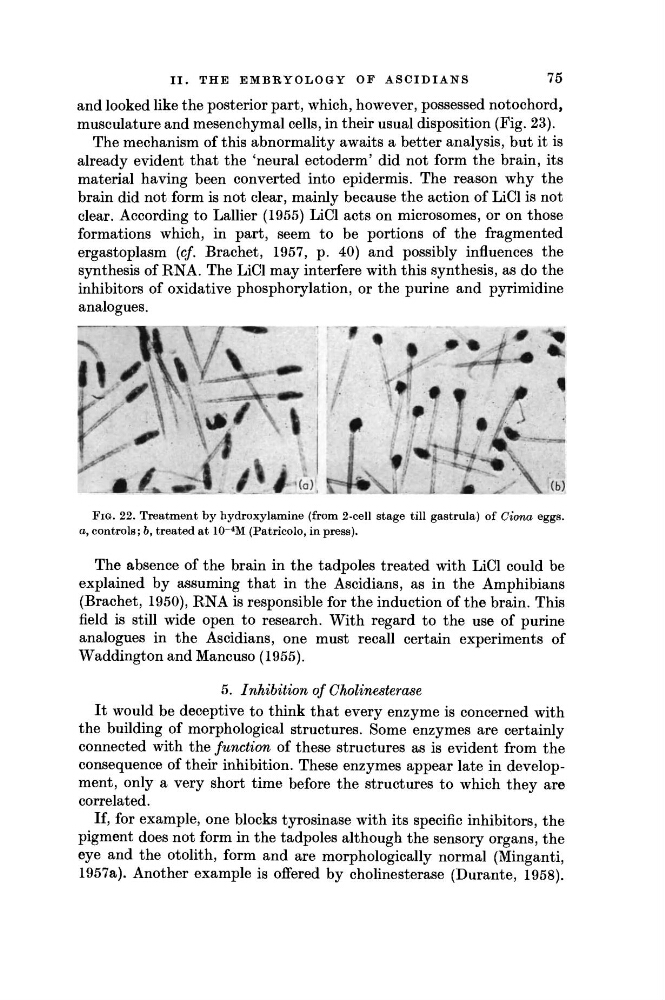
F I G . 2 2 . Treatment b y hydroxylamine (from 2-cell stage till gastrula) of Ciona eggs.
a, controls; b, treated at 1 0 ~ 4M (Patricolo, in press).
The absence of the brain in the tadpoles treated with LiCl could be
explained by assuming that in the Ascidians, as in the Amphibians
(Brächet, 1950), RNA is responsible for the induction of the brain. This
field is still wide open to research. With regard to the use of purine
analogues in the Ascidians, one must recall certain experiments of
Waddington and Mancuso (1955).
5. Inhibition of Cholinesterase
It would be deceptive to think that every enzyme is concerned with
the building of morphological structures. Some enzymes are certainly
connected with the function of these structures as is evident from the
consequence of their inhibition. These enzymes appear late in development, only a very short time before the structures to which they are
correlated.
If, for example, one blocks tyrosinase with its specific inhibitors, the
pigment does not form in the tadpoles although the sensory organs, the
eye and the otolith, form and are morphologically normal (Minganti,
1957a). Another example is offered by Cholinesterase (Durante, 1958).
T H E E M B R Y O L O G Y O F
A S C I D I A N S
75
and looked like the posterior part, which, however, possessed notochord,
musculature and mesenchymal cells, in their usual disposition (Fig. 23).
The mechanism of this abnormality awaits a better analysis, but it is
already evident that the 'neural ectoderm' did not form the brain, its
material having been converted into epidermis. The reason why the
brain did not form is not clear, mainly because the action of LiCl is not
clear. According to Lallier (1955) LiCl acts on microsomes, or on those
formations which, in part, seem to be portions of the fragmented
ergastoplasm (cf. Brächet, 1957, p. 40) and possibly influences the
synthesis of RNA. The LiCl may interfere with this synthesis, as do the
inhibitors of oxidative phosphorylation, or the purine and pyrimidine
analogues.
F I G . 2 2 . Treatment b y hydroxylamine (from 2-cell stage till gastrula) of Ciona eggs.
a, controls; b, treated at 1 0 ~ 4M (Patricolo, in press).
The absence of the brain in the tadpoles treated with LiCl could be
explained by assuming that in the Ascidians, as in the Amphibians
(Brächet, 1950), RNA is responsible for the induction of the brain. This
field is still wide open to research. With regard to the use of purine
analogues in the Ascidians, one must recall certain experiments of
Waddington and Mancuso (1955).
5. Inhibition of Cholinesterase
It would be deceptive to think that every enzyme is concerned with
the building of morphological structures. Some enzymes are certainly
connected with the function of these structures as is evident from the
consequence of their inhibition. These enzymes appear late in development, only a very short time before the structures to which they are
correlated.
If, for example, one blocks tyrosinase with its specific inhibitors, the
pigment does not form in the tadpoles although the sensory organs, the
eye and the otolith, form and are morphologically normal (Minganti,
1957a). Another example is offered by Cholinesterase (Durante, 1958).