

72
G .
R E V E R B E R I
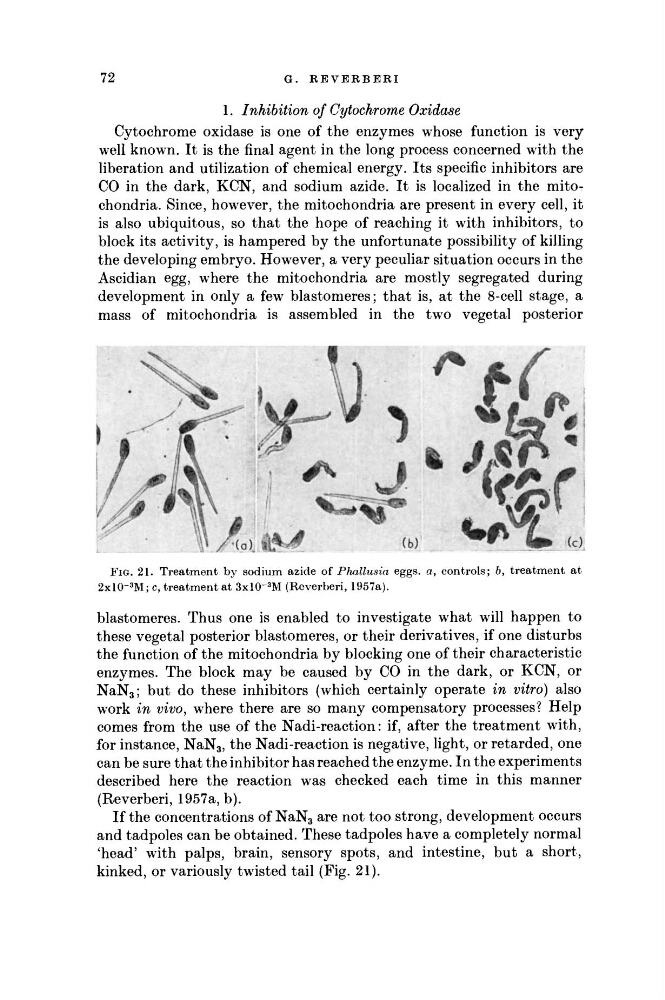
F I G . 2 1 . Treatment b y sodium azide of Phallusia eggs, a, controls; b, treatment at
2 x l O ~ 3M ; c, treatment at 3 x l O - 3M (Reverberi, 1957a).
blastomeres. Thus one is enabled to investigate what will happen to
these vegetal posterior blastomeres, or their derivatives, if one disturbs
the function of the mitochondria by blocking one of their characteristic
enzymes. The block may be caused by CO in the dark, or KCN, or
NaN3; but do these inhibitors (which certainly operate in vitro) also
work in vivo, where there are so many compensatory processes? Help
comes from the use of the Nadi-reaction: if, after the treatment with,
for instance, NaN3, the Nadi-reaction is negative, light, or retarded, one
can be sure that the inhibitor has reached the enzyme. In the experiments
described here the reaction was checked each time in this manner
(Reverberi, 1957a, b).
If the concentrations of NaN3 are not too strong, development occurs
and tadpoles can be obtained. These tadpoles have a completely normal
'head' with palps, brain, sensory spots, and intestine, but a short,
kinked, or variously twisted tail (Fig. 21).
1. Inhibition of Cytochrome Oxidase
Cytochrome oxidase is one of the enzymes whose function is very
well known. It is the final agent in the long process concerned with the
liberation and utilization of chemical energy. Its specific inhibitors are
CO in the dark, KCN, and sodium azide. It is localized in the mitochondria. Since, however, the mitochondria are present in every cell, it
is also ubiquitous, so that the hope of reaching it with inhibitors, to
block its activity, is hampered by the unfortunate possibility of killing
the developing embryo. However, a very peculiar situation occurs in the
Ascidian egg, where the mitochondria are mostly segregated during
development in only a few blastomeres; that is, at the 8-cell stage, a
mass of mitochondria is assembled in the two vegetal posterior
G .
R E V E R B E R I
F I G . 2 1 . Treatment b y sodium azide of Phallusia eggs, a, controls; b, treatment at
2 x l O ~ 3M ; c, treatment at 3 x l O - 3M (Reverberi, 1957a).
blastomeres. Thus one is enabled to investigate what will happen to
these vegetal posterior blastomeres, or their derivatives, if one disturbs
the function of the mitochondria by blocking one of their characteristic
enzymes. The block may be caused by CO in the dark, or KCN, or
NaN3; but do these inhibitors (which certainly operate in vitro) also
work in vivo, where there are so many compensatory processes? Help
comes from the use of the Nadi-reaction: if, after the treatment with,
for instance, NaN3, the Nadi-reaction is negative, light, or retarded, one
can be sure that the inhibitor has reached the enzyme. In the experiments
described here the reaction was checked each time in this manner
(Reverberi, 1957a, b).
If the concentrations of NaN3 are not too strong, development occurs
and tadpoles can be obtained. These tadpoles have a completely normal
'head' with palps, brain, sensory spots, and intestine, but a short,
kinked, or variously twisted tail (Fig. 21).
1. Inhibition of Cytochrome Oxidase
Cytochrome oxidase is one of the enzymes whose function is very
well known. It is the final agent in the long process concerned with the
liberation and utilization of chemical energy. Its specific inhibitors are
CO in the dark, KCN, and sodium azide. It is localized in the mitochondria. Since, however, the mitochondria are present in every cell, it
is also ubiquitous, so that the hope of reaching it with inhibitors, to
block its activity, is hampered by the unfortunate possibility of killing
the developing embryo. However, a very peculiar situation occurs in the
Ascidian egg, where the mitochondria are mostly segregated during
development in only a few blastomeres; that is, at the 8-cell stage, a
mass of mitochondria is assembled in the two vegetal posterior