

II.
THE EMBRYOLOGY
OF ASCIDIANS
69
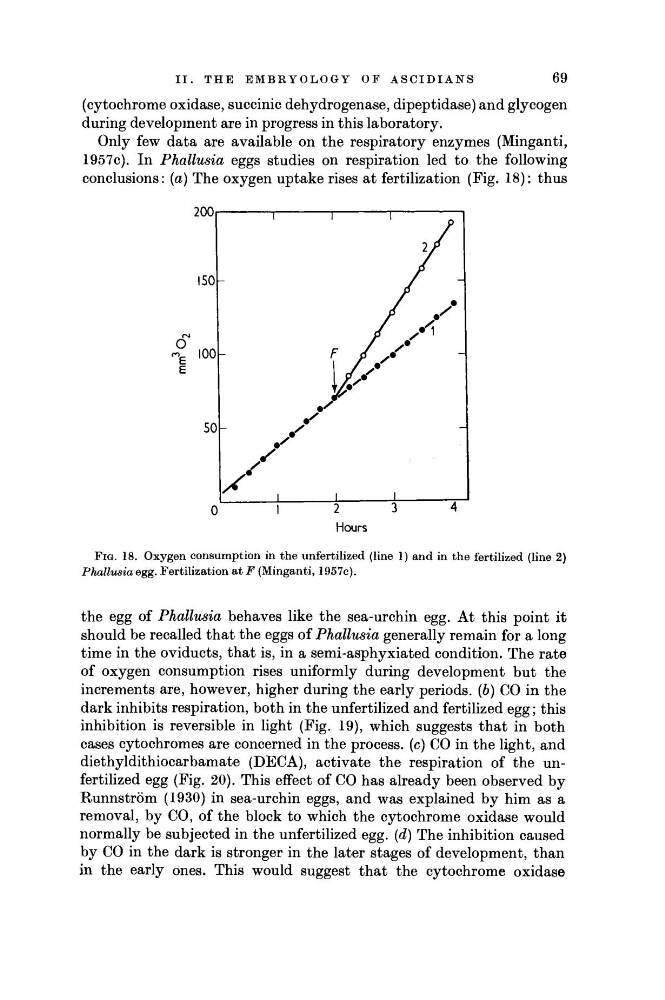
FIG. 18. Oxygen consumption in the unfertilized (line 1) and in the fertilized (line 2)
Phallusia egg. Fertilization at F (Minganti, 1957c).
the egg of Phallusia behaves like the sea-urchin egg. At this point it
should be recalled that the eggs of Phallusia generally remain for a long
time in the oviducts, that is, in a semi-asphyxiated condition. The rate
of oxygen consumption rises uniformly during development but the
increments are, however, higher during the early periods. (6) CO in the
dark inhibits respiration, both in the unfertilized and fertilized egg; this
inhibition is reversible in light (Fig. 19), which suggests that in both
cases cytochromes are concerned in the process, (c) CO in the light, and
diethyldithiocarbamate (DECA), activate the respiration of the unfertilized egg (Fig. 20). This effect of CO has already been observed by
Runnström (1930) in sea-urchin eggs, and was explained by him as a
removal, by CO, of the block to which the cytochrome oxidase would
normally be subjected in the unfertilized egg. (d) The inhibition caused
by CO in the dark is stronger in the later stages of development, than
in the early ones. This would suggest that the cytochrome oxidase
(cytochrome oxidase, succinic dehydrogenase, dipeptidase) and glycogen
during development are in progress in this laboratory.
Only few data are available on the respiratory enzymes (Minganti,
1957c). In Phallusia eggs studies on respiration led to the following
conclusions: (a) The oxygen uptake rises at fertilization (Fig. 18): thus
THE EMBRYOLOGY
OF ASCIDIANS
69
FIG. 18. Oxygen consumption in the unfertilized (line 1) and in the fertilized (line 2)
Phallusia egg. Fertilization at F (Minganti, 1957c).
the egg of Phallusia behaves like the sea-urchin egg. At this point it
should be recalled that the eggs of Phallusia generally remain for a long
time in the oviducts, that is, in a semi-asphyxiated condition. The rate
of oxygen consumption rises uniformly during development but the
increments are, however, higher during the early periods. (6) CO in the
dark inhibits respiration, both in the unfertilized and fertilized egg; this
inhibition is reversible in light (Fig. 19), which suggests that in both
cases cytochromes are concerned in the process, (c) CO in the light, and
diethyldithiocarbamate (DECA), activate the respiration of the unfertilized egg (Fig. 20). This effect of CO has already been observed by
Runnström (1930) in sea-urchin eggs, and was explained by him as a
removal, by CO, of the block to which the cytochrome oxidase would
normally be subjected in the unfertilized egg. (d) The inhibition caused
by CO in the dark is stronger in the later stages of development, than
in the early ones. This would suggest that the cytochrome oxidase
(cytochrome oxidase, succinic dehydrogenase, dipeptidase) and glycogen
during development are in progress in this laboratory.
Only few data are available on the respiratory enzymes (Minganti,
1957c). In Phallusia eggs studies on respiration led to the following
conclusions: (a) The oxygen uptake rises at fertilization (Fig. 18): thus