

414
CH. DEVILLERS
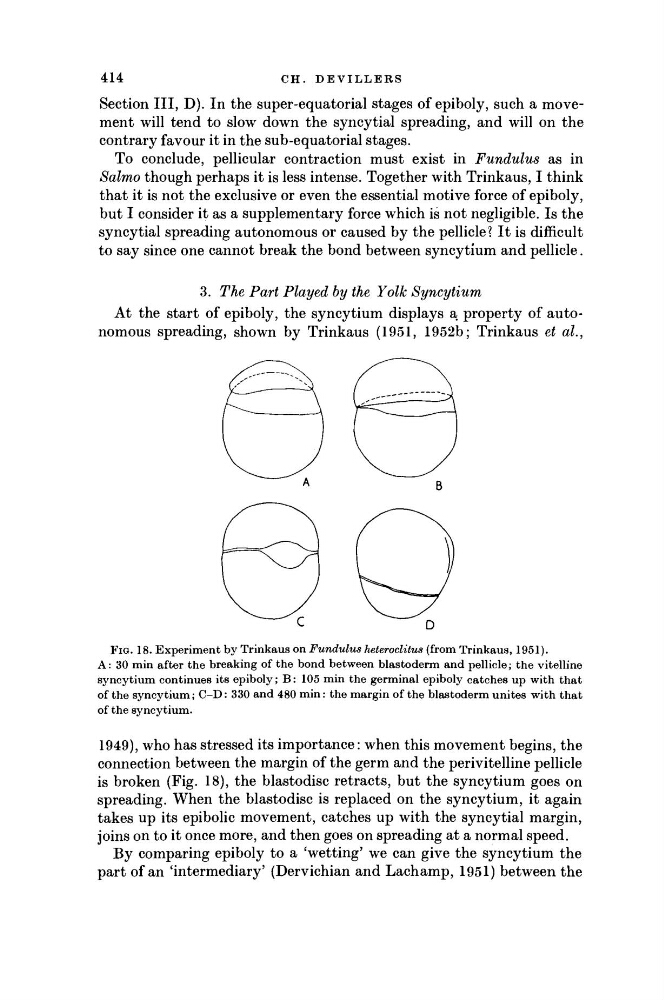
FIG. 18. Experiment by Trinkaus on Fundulus heteroclüus (from Trinkaus, 1951).
A: 30 min after the breaking of the bond between blastoderm and pellicle; the vitelline
syncytium continues its epiboly; B: 105 min the germinal epiboly catches up with that
of the syncytium; C-D: 330 and 480 min: the margin of the blastoderm unites with that
of the syncytium.
1949), who has stressed its importance: when this movement begins, the
connection between the margin of the germ and the perivitelline pellicle
is broken (Fig. 18), the blastodisc retracts, but the syncytium goes on
spreading. When the blastodisc is replaced on the syncytium, it again
takes up its epibolic movement, catches up with the syncytial margin,
joins on to it once more, and then goes on spreading at a normal speed.
By comparing epiboly to a Vetting' we can give the syncytium the
part of an 'intermediary' (Dervichian and Lachamp, 1951) between the
Section III, D). In the super-equatorial stages of epiboly, such a movement will tend to slow down the syncytial spreading, and will on the
contrary favour it in the sub-equatorial stages.
To conclude, pellicular contraction must exist in Fundulus as in
Salmo though perhaps it is less intense. Together with Trinkaus, I think
that it is not the exclusive or even the essential motive force of epiboly,
but I consider it as a supplementary force which is not negligible. Is the
syncytial spreading autonomous or caused by the pellicle? It is difficult
to say since one cannot break the bond between syncytium and pellicle.
3. The Part Played by the Yolk Syncytium
At the start of epiboly, the syncytium displays a property of autonomous spreading, shown by Trinkaus (1951, 1952b; Trinkaus et al.,
CH. DEVILLERS
FIG. 18. Experiment by Trinkaus on Fundulus heteroclüus (from Trinkaus, 1951).
A: 30 min after the breaking of the bond between blastoderm and pellicle; the vitelline
syncytium continues its epiboly; B: 105 min the germinal epiboly catches up with that
of the syncytium; C-D: 330 and 480 min: the margin of the blastoderm unites with that
of the syncytium.
1949), who has stressed its importance: when this movement begins, the
connection between the margin of the germ and the perivitelline pellicle
is broken (Fig. 18), the blastodisc retracts, but the syncytium goes on
spreading. When the blastodisc is replaced on the syncytium, it again
takes up its epibolic movement, catches up with the syncytial margin,
joins on to it once more, and then goes on spreading at a normal speed.
By comparing epiboly to a Vetting' we can give the syncytium the
part of an 'intermediary' (Dervichian and Lachamp, 1951) between the
Section III, D). In the super-equatorial stages of epiboly, such a movement will tend to slow down the syncytial spreading, and will on the
contrary favour it in the sub-equatorial stages.
To conclude, pellicular contraction must exist in Fundulus as in
Salmo though perhaps it is less intense. Together with Trinkaus, I think
that it is not the exclusive or even the essential motive force of epiboly,
but I consider it as a supplementary force which is not negligible. Is the
syncytial spreading autonomous or caused by the pellicle? It is difficult
to say since one cannot break the bond between syncytium and pellicle.
3. The Part Played by the Yolk Syncytium
At the start of epiboly, the syncytium displays a property of autonomous spreading, shown by Trinkaus (1951, 1952b; Trinkaus et al.,