

404
CH. DEVILLERS
Β
C
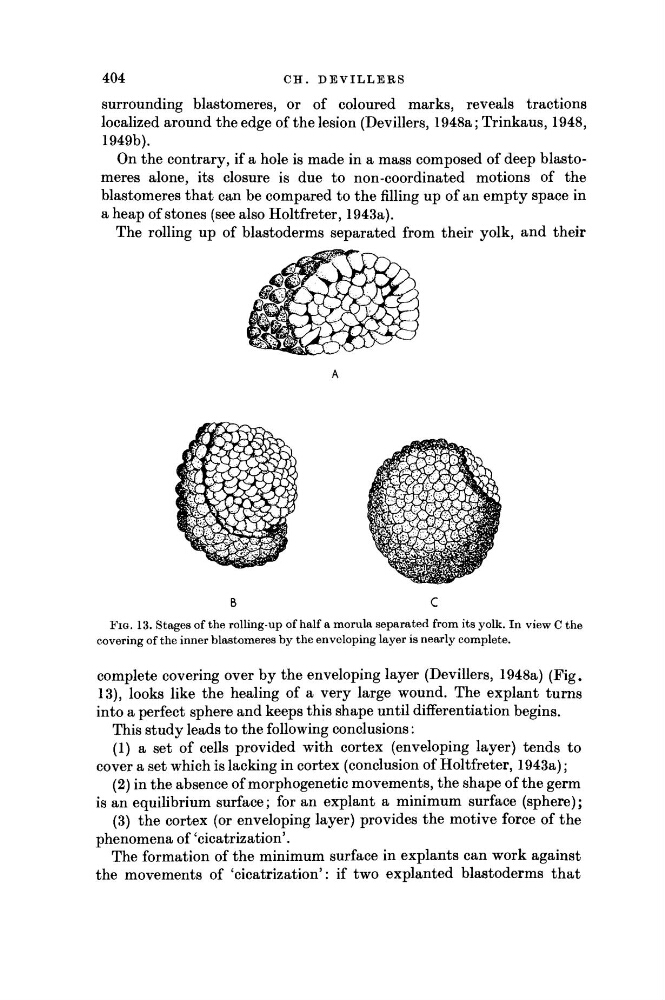
FIG. 13. Stages of the rolling-up of half a morula separated from its yolk. In view C the
covering of the inner blastomeres by the enveloping layer is nearly complete.
complete covering over by the enveloping layer (Devillers, 1948a) (Fig.
13), looks like the healing of a very large wound. The explant turns
into a perfect sphere and keeps this shape until differentiation begins.
This study leads to the following conclusions:
(1) a set of cells provided with cortex (enveloping layer) tends to
cover a set which is lacking in cortex (conclusion of Holtfreter, 1943a);
(2) in the absence of morphogenetic movements, the shape of the germ
is an equilibrium surface; for an explant a minimum surface (sphere);
(3) the cortex (or enveloping layer) provides the motive force of the
phenomena of 'cicatrization'.
The formation of the minimum surface in explants can work against
the movements of 'cicatrization': if two explanted blastoderms that
surrounding blastomeres, or of coloured marks, reveals tractions
localized around the edge of the lesion (Devillers, 1948a; Trinkaus, 1948,
1949b).
On the contrary, if a hole is made in a mass composed of deep blastomeres alone, its closure is due to non-coordinated motions of the
blastomeres that can be compared to the filling up of an empty space in
a heap of stones (see also Holtfreter, 1943a).
The rolling up of blastoderms separated from their yolk, and their
CH. DEVILLERS
Β
C
FIG. 13. Stages of the rolling-up of half a morula separated from its yolk. In view C the
covering of the inner blastomeres by the enveloping layer is nearly complete.
complete covering over by the enveloping layer (Devillers, 1948a) (Fig.
13), looks like the healing of a very large wound. The explant turns
into a perfect sphere and keeps this shape until differentiation begins.
This study leads to the following conclusions:
(1) a set of cells provided with cortex (enveloping layer) tends to
cover a set which is lacking in cortex (conclusion of Holtfreter, 1943a);
(2) in the absence of morphogenetic movements, the shape of the germ
is an equilibrium surface; for an explant a minimum surface (sphere);
(3) the cortex (or enveloping layer) provides the motive force of the
phenomena of 'cicatrization'.
The formation of the minimum surface in explants can work against
the movements of 'cicatrization': if two explanted blastoderms that
surrounding blastomeres, or of coloured marks, reveals tractions
localized around the edge of the lesion (Devillers, 1948a; Trinkaus, 1948,
1949b).
On the contrary, if a hole is made in a mass composed of deep blastomeres alone, its closure is due to non-coordinated motions of the
blastomeres that can be compared to the filling up of an empty space in
a heap of stones (see also Holtfreter, 1943a).
The rolling up of blastoderms separated from their yolk, and their