

402
CH.
DEVILLERS
then, a little later, a second and smaller wound is made which follows
the same evolution as the first. If there were an elastic retraction, the
widening of the first wound should eliminate pellicle tension so that the
second wound should not expand. The enlargement of the wound is thus
an active process. In fact, the cortical movements are not free since they
are held back by the egg contents underneath; a release of tension at the
level of one wound does not spread to the whole cortex. If the vitelline
contents are taken out, thus removing friction, the second wound no
longer widens, but closes up, the tension having been released over the
entire surface (unpublished observations on Salmo).
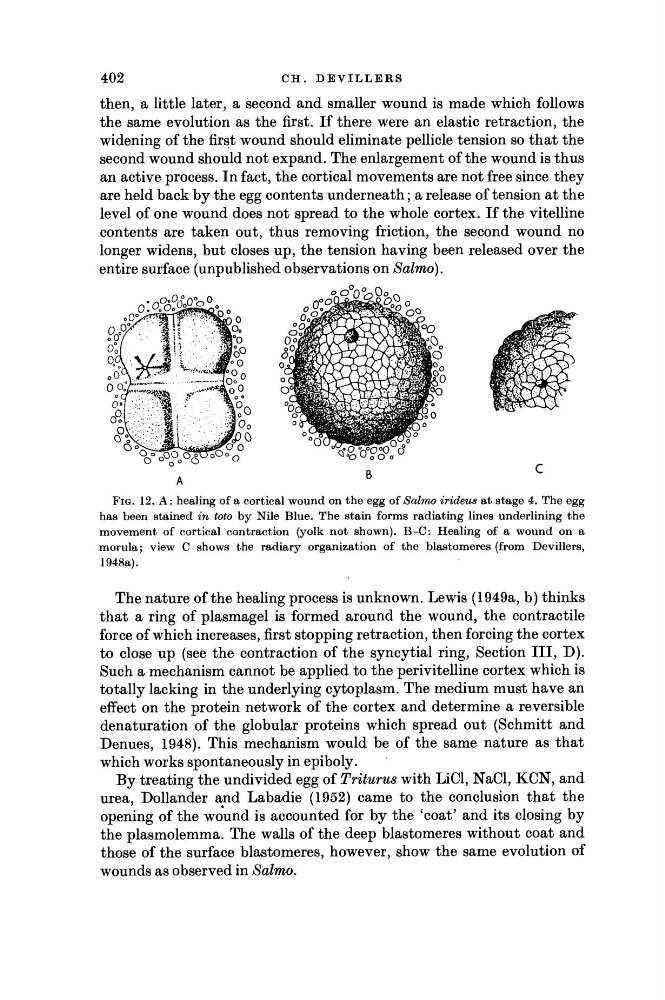
FIG. 12. A: healing of a cortical wound on the egg of Salmo irideus at stage 4. The egg
has been stained in toto by Nile Blue. The stain forms radiating lines underlining the
movement of cortical contraction (yolk not shown). B-C: Healing of a wound on a
morula; view C shows the radiary organization of the blastomeres (from Devillers,
1948a).
The nature of the healing process is unknown. Lewis (1949a, b) thinks
that a ring of plasmagel is formed around the wound, the contractile
force of which increases, first stopping retraction, then forcing the cortex
to close up (see the contraction of the syncytial ring, Section III, D).
Such a mechanism cannot be applied to the perivitelline cortex which is
totally lacking in the underlying cytoplasm. The medium must have an
effect on the protein network of the cortex and determine a reversible
denaturation of the globular proteins which spread out (Schmitt and
Denues, 1948). This mechanism would be of the same nature as that
which works spontaneously in epiboly.
By treating the undivided egg of Triturus with LiCl, NaCl, KCN, and
urea, Dollander and Labadie (1952) came to the conclusion that the
opening of the wound is accounted for by the 'coat' and its closing by
the plasmolemma. The walls of the deep blastomeres without coat and
those of the surface blastomeres, however, show the same evolution of
wounds as observed in Salmo.
C
A
Β
CH.
DEVILLERS
then, a little later, a second and smaller wound is made which follows
the same evolution as the first. If there were an elastic retraction, the
widening of the first wound should eliminate pellicle tension so that the
second wound should not expand. The enlargement of the wound is thus
an active process. In fact, the cortical movements are not free since they
are held back by the egg contents underneath; a release of tension at the
level of one wound does not spread to the whole cortex. If the vitelline
contents are taken out, thus removing friction, the second wound no
longer widens, but closes up, the tension having been released over the
entire surface (unpublished observations on Salmo).
FIG. 12. A: healing of a cortical wound on the egg of Salmo irideus at stage 4. The egg
has been stained in toto by Nile Blue. The stain forms radiating lines underlining the
movement of cortical contraction (yolk not shown). B-C: Healing of a wound on a
morula; view C shows the radiary organization of the blastomeres (from Devillers,
1948a).
The nature of the healing process is unknown. Lewis (1949a, b) thinks
that a ring of plasmagel is formed around the wound, the contractile
force of which increases, first stopping retraction, then forcing the cortex
to close up (see the contraction of the syncytial ring, Section III, D).
Such a mechanism cannot be applied to the perivitelline cortex which is
totally lacking in the underlying cytoplasm. The medium must have an
effect on the protein network of the cortex and determine a reversible
denaturation of the globular proteins which spread out (Schmitt and
Denues, 1948). This mechanism would be of the same nature as that
which works spontaneously in epiboly.
By treating the undivided egg of Triturus with LiCl, NaCl, KCN, and
urea, Dollander and Labadie (1952) came to the conclusion that the
opening of the wound is accounted for by the 'coat' and its closing by
the plasmolemma. The walls of the deep blastomeres without coat and
those of the surface blastomeres, however, show the same evolution of
wounds as observed in Salmo.
C
A
Β