

390
CH. D Ε VILLERS
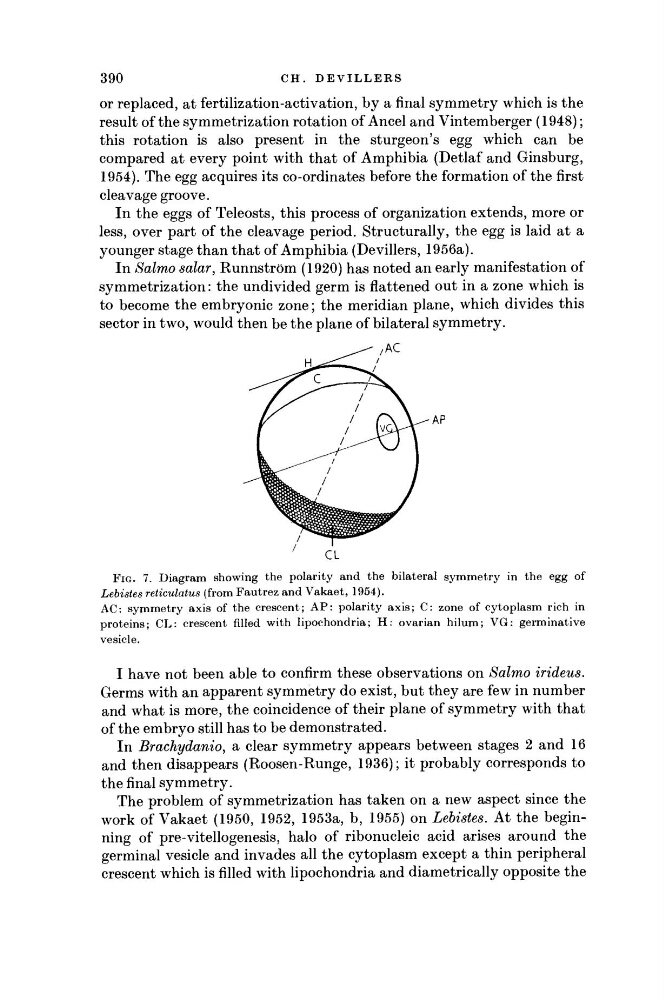
FIG. 7. Diagram showing the polarity and the bilateral symmetry in the egg of
Lebistes reticulatus (from Fautrez and Vakaet, 1954).
AC: symmetry axis of the crescent; AP: polarity axis; C: zone of cytoplasm rich in
proteins; CL: crescent filled with lipochondria; H: ovarian hilum; VG: germinativo
vesicle.
I have not been able to confirm these observations on Salmo irideus.
Germs with an apparent symmetry do exist, but they are few in number
and what is more, the coincidence of their plane of symmetry with that
of the embryo still has to be demonstrated.
In Brachydanio, a clear symmetry appears between stages 2 and 16
and then disappears (Roosen-Runge, 1936); it probably corresponds to
the final symmetry.
The problem of symmetrization has taken on a new aspect since the
work of Vakaet (1950, 1952, 1953a, b, 1955) on Lebistes. At the beginning of pre-vitellogenesis, halo of ribonucleic acid arises around the
germinal vesicle and invades all the cytoplasm except a thin peripheral
crescent which is filled with lipochondria and diametrically opposite the
or replaced, at fertilization-activation, by a final symmetry which is the
result of the symmetrization rotation of Ancel and Vintemberger (1948);
this rotation is also present in the sturgeon's egg which can be
compared at every point with that of Amphibia (Detlaf and Ginsburg,
1954). The egg acquires its co-ordinates before the formation of the first
cleavage groove.
In the eggs of Teleosts, this process of organization extends, more or
less, over part of the cleavage period. Structurally, the egg is laid at a
younger stage than that of Amphibia (Devillers, 1956a).
In Salmo salar, Runnström (1920) has noted an early manifestation of
symmetrization: the undivided germ is flattened out in a zone which is
to become the embryonic zone; the meridian plane, which divides this
sector in two, would then be the plane of bilateral symmetry.
CH. D Ε VILLERS
FIG. 7. Diagram showing the polarity and the bilateral symmetry in the egg of
Lebistes reticulatus (from Fautrez and Vakaet, 1954).
AC: symmetry axis of the crescent; AP: polarity axis; C: zone of cytoplasm rich in
proteins; CL: crescent filled with lipochondria; H: ovarian hilum; VG: germinativo
vesicle.
I have not been able to confirm these observations on Salmo irideus.
Germs with an apparent symmetry do exist, but they are few in number
and what is more, the coincidence of their plane of symmetry with that
of the embryo still has to be demonstrated.
In Brachydanio, a clear symmetry appears between stages 2 and 16
and then disappears (Roosen-Runge, 1936); it probably corresponds to
the final symmetry.
The problem of symmetrization has taken on a new aspect since the
work of Vakaet (1950, 1952, 1953a, b, 1955) on Lebistes. At the beginning of pre-vitellogenesis, halo of ribonucleic acid arises around the
germinal vesicle and invades all the cytoplasm except a thin peripheral
crescent which is filled with lipochondria and diametrically opposite the
or replaced, at fertilization-activation, by a final symmetry which is the
result of the symmetrization rotation of Ancel and Vintemberger (1948);
this rotation is also present in the sturgeon's egg which can be
compared at every point with that of Amphibia (Detlaf and Ginsburg,
1954). The egg acquires its co-ordinates before the formation of the first
cleavage groove.
In the eggs of Teleosts, this process of organization extends, more or
less, over part of the cleavage period. Structurally, the egg is laid at a
younger stage than that of Amphibia (Devillers, 1956a).
In Salmo salar, Runnström (1920) has noted an early manifestation of
symmetrization: the undivided germ is flattened out in a zone which is
to become the embryonic zone; the meridian plane, which divides this
sector in two, would then be the plane of bilateral symmetry.