

386
CH.
DΕVILLERS
has been denied by several authors at different times (Costello, 1945;
Lison, 1935).
(3) Spek (1918) accounts for cytodieresis in the egg of Nematodes by
a local decrease in surface tension which gives rise to a cytoplasmic
current from the interior towards this zone. This current is reflected on
the cellular surface and forms a counter-current. Such movements have
been observed in the egg of Brachydanio by Roosen-Runge (1938). The
first decrease in tension takes place in the region of elimination of the
polar bodies, and subsequent decreases are located where the future
grooves are foreshadowed by an area of gelified cytoplasm (Nicholas,
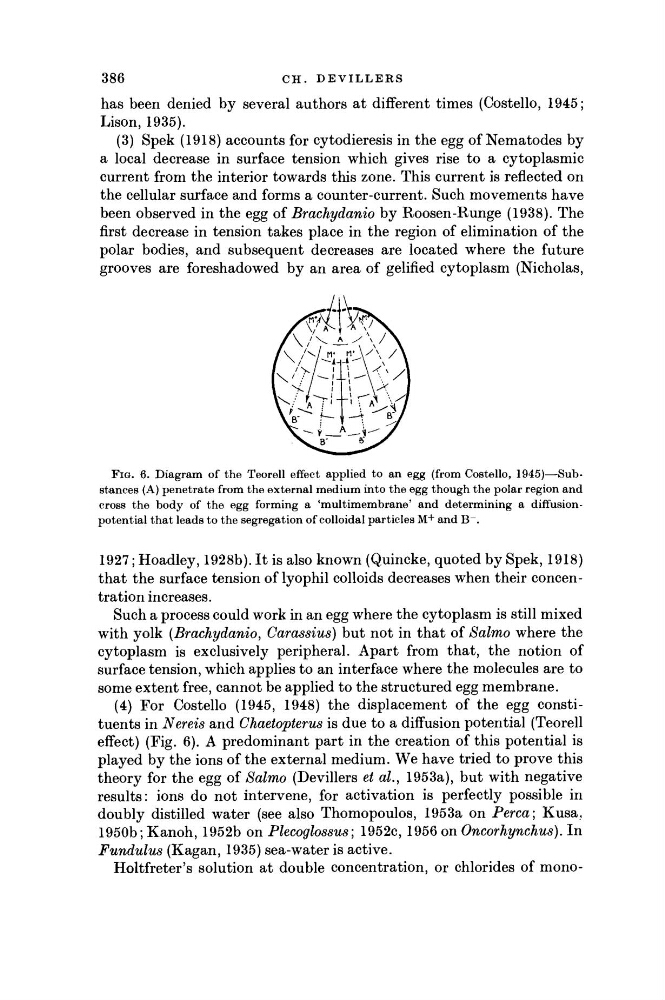
FIG. 6. Diagram of the Teorell effect applied to an egg (from Costello, 1945)—Substances (A) penetrate from the external medium into the egg though the polar region and
cross the body of the egg forming a 'multimembrane' and determining a diffusionpotential that leads to the segregation of colloidal particles M+ and B~.
1927; Hoadley, 1928b). It is also known (Quincke, quoted by Spek, 1918)
that the surface tension of lyophil colloids decreases when their concentration increases.
Such a process could work in an egg where the cytoplasm is still mixed
with yolk (Brachydanio, Carassius) but not in that of Salmo where the
cytoplasm is exclusively peripheral. Apart from that, the notion of
surface tension, which applies to an interface where the molecules are to
some extent free, cannot be applied to the structured egg membrane.
(4) For Costello (1945, 1948) the displacement of the egg constituents in Nereis and Chaetopterus is due to a diffusion potential (Teorell
effect) (Fig. 6). A predominant part in the creation of this potential is
played by the ions of the external medium. We have tried to prove this
theory for the egg of Salmo (Devillers et al., 1953a), but with negative
results: ions do not intervene, for activation is perfectly possible in
doubly distilled water (see also Thomopoulos, 1953a on Perca; Kusa,
1950b; Kanoh, 1952b on Plecoglossus; 1952c, 1956 on Oncorhynchus). In
Fundulus (Kagan, 1935) sea-water is active.
Holtfreter's solution at double concentration, or chlorides of mono-
CH.
DΕVILLERS
has been denied by several authors at different times (Costello, 1945;
Lison, 1935).
(3) Spek (1918) accounts for cytodieresis in the egg of Nematodes by
a local decrease in surface tension which gives rise to a cytoplasmic
current from the interior towards this zone. This current is reflected on
the cellular surface and forms a counter-current. Such movements have
been observed in the egg of Brachydanio by Roosen-Runge (1938). The
first decrease in tension takes place in the region of elimination of the
polar bodies, and subsequent decreases are located where the future
grooves are foreshadowed by an area of gelified cytoplasm (Nicholas,
FIG. 6. Diagram of the Teorell effect applied to an egg (from Costello, 1945)—Substances (A) penetrate from the external medium into the egg though the polar region and
cross the body of the egg forming a 'multimembrane' and determining a diffusionpotential that leads to the segregation of colloidal particles M+ and B~.
1927; Hoadley, 1928b). It is also known (Quincke, quoted by Spek, 1918)
that the surface tension of lyophil colloids decreases when their concentration increases.
Such a process could work in an egg where the cytoplasm is still mixed
with yolk (Brachydanio, Carassius) but not in that of Salmo where the
cytoplasm is exclusively peripheral. Apart from that, the notion of
surface tension, which applies to an interface where the molecules are to
some extent free, cannot be applied to the structured egg membrane.
(4) For Costello (1945, 1948) the displacement of the egg constituents in Nereis and Chaetopterus is due to a diffusion potential (Teorell
effect) (Fig. 6). A predominant part in the creation of this potential is
played by the ions of the external medium. We have tried to prove this
theory for the egg of Salmo (Devillers et al., 1953a), but with negative
results: ions do not intervene, for activation is perfectly possible in
doubly distilled water (see also Thomopoulos, 1953a on Perca; Kusa,
1950b; Kanoh, 1952b on Plecoglossus; 1952c, 1956 on Oncorhynchus). In
Fundulus (Kagan, 1935) sea-water is active.
Holtfreter's solution at double concentration, or chlorides of mono-