

384
CH.
D ΕVILLERS
The development of Salmo is very slow; gastrulation alone takes 6 to
7 days at 6° C. At the closure of the blastopore, organogenesis of the
embryo is much more advanced (eyes, brain, otic vesicles (Henneguy,
1888; Pasteeis, 1936)) than in the eggs of Perca or Fundulus (Oppenheimer, 1937) which develop rapidly.
III. Structural Evolution During Premorphogenesis
A. Bipolar Differentiation
This process has been carefully examined by Spek (1933), Konopacka
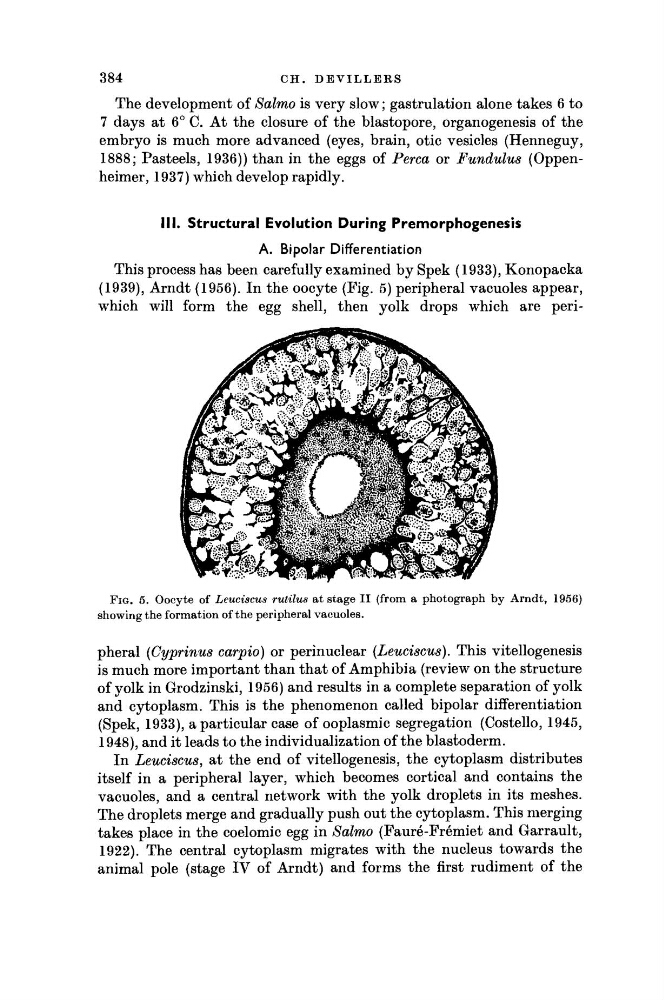
(1939), Arndt (1956). In the oocyte (Pig. 5) peripheral vacuoles appear,
which will form the egg shell, then yolk drops which are periFIG. 5. Oocyte of Leuciscus rutilus at stage II (from a photograph by Arndt, 1956)
showing the formation of the peripheral vacuoles.
pheral (Cyprinus carpió) or perinuclear (Leuciscus). This vitellogenesis
is much more important than that of Amphibia (review on the structure
of yolk in Grodzinski, 1956) and results in a complete separation of yolk
and cytoplasm. This is the phenomenon called bipolar differentiation
(Spek, 1933), a particular case of ooplasmic segregation (Costello, 1945,
1948), and it leads to the individualization of the blastoderm.
In Leuciscus, at the end of vitellogenesis, the cytoplasm distributes
itself in a peripheral layer, which becomes cortical and contains the
vacuoles, and a central network with the yolk droplets in its meshes.
The droplets merge and gradually push out the cytoplasm. This merging
takes place in the coelomic egg in Salmo (Fauré-Frémiet and Garrault,
1922). The central cytoplasm migrates with the nucleus towards the
animal pole (stage IV of Arndt) and forms the first rudiment of the
CH.
D ΕVILLERS
The development of Salmo is very slow; gastrulation alone takes 6 to
7 days at 6° C. At the closure of the blastopore, organogenesis of the
embryo is much more advanced (eyes, brain, otic vesicles (Henneguy,
1888; Pasteeis, 1936)) than in the eggs of Perca or Fundulus (Oppenheimer, 1937) which develop rapidly.
III. Structural Evolution During Premorphogenesis
A. Bipolar Differentiation
This process has been carefully examined by Spek (1933), Konopacka
(1939), Arndt (1956). In the oocyte (Pig. 5) peripheral vacuoles appear,
which will form the egg shell, then yolk drops which are periFIG. 5. Oocyte of Leuciscus rutilus at stage II (from a photograph by Arndt, 1956)
showing the formation of the peripheral vacuoles.
pheral (Cyprinus carpió) or perinuclear (Leuciscus). This vitellogenesis
is much more important than that of Amphibia (review on the structure
of yolk in Grodzinski, 1956) and results in a complete separation of yolk
and cytoplasm. This is the phenomenon called bipolar differentiation
(Spek, 1933), a particular case of ooplasmic segregation (Costello, 1945,
1948), and it leads to the individualization of the blastoderm.
In Leuciscus, at the end of vitellogenesis, the cytoplasm distributes
itself in a peripheral layer, which becomes cortical and contains the
vacuoles, and a central network with the yolk droplets in its meshes.
The droplets merge and gradually push out the cytoplasm. This merging
takes place in the coelomic egg in Salmo (Fauré-Frémiet and Garrault,
1922). The central cytoplasm migrates with the nucleus towards the
animal pole (stage IV of Arndt) and forms the first rudiment of the