

VIII.
MORPHOGENESIS
OF THE VERTEBRATE
EYE
361
sively increases, there appears the definitive collagen and metachromatic
mucopolysaccharide which fill the stroma by the end of this period, and
the water content approaches the level of the adult cornea (Coulombre
and Coulombre, 1958b). Similar changes accompany the appearance of
corneal transparency in rabbits (Smelser and Ozanicz, 1956). Water loss
from the cornea starts before the appearance of the transparency. This
suggests that, though a definite level of dehydration is necessary for its
appearance, a more important role is played here by the appearance of
metachromasy and of condensed collagen (Coulombre and Coulombre,
1958b).
The cornea of the adult eye has a lesser radius of curvature than the
sclera. Corneal curvature appears for the first time at the 8th day of
incubation. At the same stage the chondrification of the sclera takes
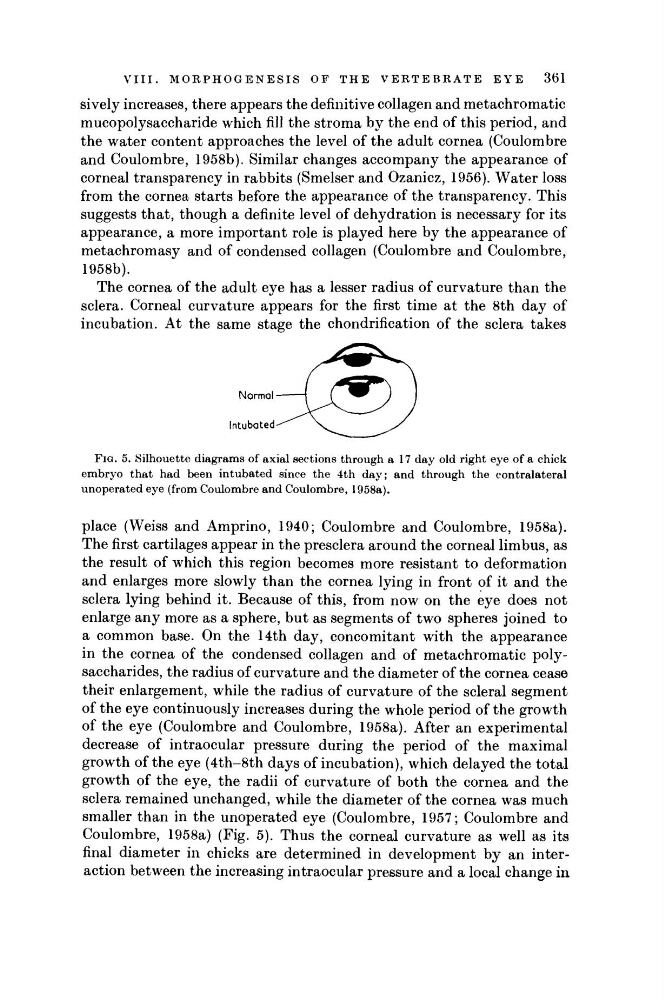
Normal
Intubated
FIG. 5. Silhouette diagrams of axial sections through a 17 day old right eye of a chick
embryo that had been intubated since the 4th day; and through the contralateral
unoperated eye (from Coulombre and Coulombre, 1958a).
place (Weiss and Amprino, 1940; Coulombre and Coulombre, 1958a).
The first cartilages appear in the presclera around the corneal limbus, as
the result of which this region becomes more resistant to deformation
and enlarges more slowly than the cornea lying in front of it and the
sclera lying behind it. Because of this, from now on the eye does not
enlarge any more as a sphere, but as segments of two spheres joined to
a common base. On the 14th day, concomitant with the appearance
in the cornea of the condensed collagen and of metachromatic polysaccharides, the radius of curvature and the diameter of the cornea cease
their enlargement, while the radius of curvature of the scleral segment
of the eye continuously increases during the whole period of the growth
of the eye (Coulombre and Coulombre, 1958a). After an experimental
decrease of intraocular pressure during the period of the maximal
growth of the eye (4th-8th days of incubation), which delayed the total
growth of the eye, the radii of curvature of both the cornea and the
sclera remained unchanged, while the diameter of the cornea was much
smaller than in the unoperated eye (Coulombre, 1957; Coulombre and
Coulombre, 1958a) (Fig. 5). Thus the corneal curvature as well as its
final diameter in chicks are determined in development by an interaction between the increasing intraocular pressure and a local change in
MORPHOGENESIS
OF THE VERTEBRATE
EYE
361
sively increases, there appears the definitive collagen and metachromatic
mucopolysaccharide which fill the stroma by the end of this period, and
the water content approaches the level of the adult cornea (Coulombre
and Coulombre, 1958b). Similar changes accompany the appearance of
corneal transparency in rabbits (Smelser and Ozanicz, 1956). Water loss
from the cornea starts before the appearance of the transparency. This
suggests that, though a definite level of dehydration is necessary for its
appearance, a more important role is played here by the appearance of
metachromasy and of condensed collagen (Coulombre and Coulombre,
1958b).
The cornea of the adult eye has a lesser radius of curvature than the
sclera. Corneal curvature appears for the first time at the 8th day of
incubation. At the same stage the chondrification of the sclera takes
Normal
Intubated
FIG. 5. Silhouette diagrams of axial sections through a 17 day old right eye of a chick
embryo that had been intubated since the 4th day; and through the contralateral
unoperated eye (from Coulombre and Coulombre, 1958a).
place (Weiss and Amprino, 1940; Coulombre and Coulombre, 1958a).
The first cartilages appear in the presclera around the corneal limbus, as
the result of which this region becomes more resistant to deformation
and enlarges more slowly than the cornea lying in front of it and the
sclera lying behind it. Because of this, from now on the eye does not
enlarge any more as a sphere, but as segments of two spheres joined to
a common base. On the 14th day, concomitant with the appearance
in the cornea of the condensed collagen and of metachromatic polysaccharides, the radius of curvature and the diameter of the cornea cease
their enlargement, while the radius of curvature of the scleral segment
of the eye continuously increases during the whole period of the growth
of the eye (Coulombre and Coulombre, 1958a). After an experimental
decrease of intraocular pressure during the period of the maximal
growth of the eye (4th-8th days of incubation), which delayed the total
growth of the eye, the radii of curvature of both the cornea and the
sclera remained unchanged, while the diameter of the cornea was much
smaller than in the unoperated eye (Coulombre, 1957; Coulombre and
Coulombre, 1958a) (Fig. 5). Thus the corneal curvature as well as its
final diameter in chicks are determined in development by an interaction between the increasing intraocular pressure and a local change in