

I.
PROBLEM
OF THE ORGANIZER
27
The protein which has been identified as the bone marrow factor
differs, from the mesoderm inducing protein isolated by Tiedemann and
Tiedemann from the chick embryo, in solubility in acid medium, and
probably also in sedimentation constant.
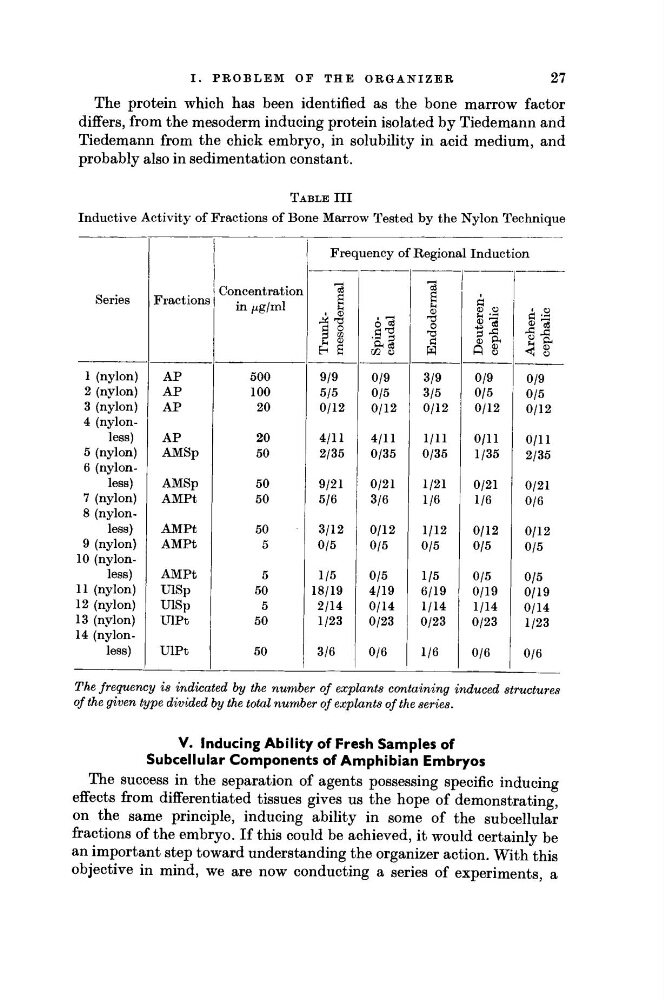
TABLE III
Inductive Activity of Fractions of Bone Marrow Tested by the Nylon Technique
Series
Fractions
Concentration
in μg|wl
Frequency of Regional Induction
Series
Fractions
Concentration
in μg|wl
Trunkmesodermal
Spinocaudal
Endodermal
Deuterencephalic
Archencephalic
1 (nylon)
AP
500
9/9
0/9
3/9
0/9
0/9
2 (nylon)
AP
100
5/5
0/5
3/5
0/5
0/5
3 (nylon)
AP
20
0/12
0/12
0/12
0/12
0/12
4 (nylon0/12
less)
AP
20
4/11
4/11
1/11
0/11
0/11
5 (nylon)
AMSp
50
2/35
0/35
0/35
1/35
2/35
6 (nylon2/35
less)
AMSp
50
9/21
0/21
1/21
0/21
0/21
7 (nylon)
AMPt
50
5/6
3/6
1/6
1/6
0/6
8 (nylon0/6
less)
AMPt
50
3/12
0/12
1/12
0/12
0/12
9 (nylon)
AMPt
5
0/5
0/5
0/5
0/5
0/5
10 (nylon0/5
less)
AMPt
5
1/5
0/5
1/5
0/5
0/5
11 (nylon)
UISp
50
18/19
4/19
6/19
0/19
0/19
12 (nylon)
UISp
5
2/14
0/14
1/14
1/14
0/14
13 (nylon)
UlPt
50
1/23
0/23
0/23
0/23
1/23
14 (nylon -
1/23
less)
UlPt
50
3/6
0/6
1/6
0/6
0/6
The frequency is indicated by the number of exptonts containing induced structures
of the given type divided by the total number ofexplants of the series.
V. Inducing Ability of Fresh Samples of
Subcellular Components of Amphibian Embryos
The success in the separation of agents possessing specific inducing
effects from differentiated tissues gives us the hope of demonstrating,
on the same principle, inducing ability in some of the subcellular
fractions of the embryo. If this could be achieved, it would certainly be
an important step toward understanding the organizer action. With this
objective in mind, we are now conducting a series of experiments, a
PROBLEM
OF THE ORGANIZER
27
The protein which has been identified as the bone marrow factor
differs, from the mesoderm inducing protein isolated by Tiedemann and
Tiedemann from the chick embryo, in solubility in acid medium, and
probably also in sedimentation constant.
TABLE III
Inductive Activity of Fractions of Bone Marrow Tested by the Nylon Technique
Series
Fractions
Concentration
in μg|wl
Frequency of Regional Induction
Series
Fractions
Concentration
in μg|wl
Trunkmesodermal
Spinocaudal
Endodermal
Deuterencephalic
Archencephalic
1 (nylon)
AP
500
9/9
0/9
3/9
0/9
0/9
2 (nylon)
AP
100
5/5
0/5
3/5
0/5
0/5
3 (nylon)
AP
20
0/12
0/12
0/12
0/12
0/12
4 (nylon0/12
less)
AP
20
4/11
4/11
1/11
0/11
0/11
5 (nylon)
AMSp
50
2/35
0/35
0/35
1/35
2/35
6 (nylon2/35
less)
AMSp
50
9/21
0/21
1/21
0/21
0/21
7 (nylon)
AMPt
50
5/6
3/6
1/6
1/6
0/6
8 (nylon0/6
less)
AMPt
50
3/12
0/12
1/12
0/12
0/12
9 (nylon)
AMPt
5
0/5
0/5
0/5
0/5
0/5
10 (nylon0/5
less)
AMPt
5
1/5
0/5
1/5
0/5
0/5
11 (nylon)
UISp
50
18/19
4/19
6/19
0/19
0/19
12 (nylon)
UISp
5
2/14
0/14
1/14
1/14
0/14
13 (nylon)
UlPt
50
1/23
0/23
0/23
0/23
1/23
14 (nylon -
1/23
less)
UlPt
50
3/6
0/6
1/6
0/6
0/6
The frequency is indicated by the number of exptonts containing induced structures
of the given type divided by the total number ofexplants of the series.
V. Inducing Ability of Fresh Samples of
Subcellular Components of Amphibian Embryos
The success in the separation of agents possessing specific inducing
effects from differentiated tissues gives us the hope of demonstrating,
on the same principle, inducing ability in some of the subcellular
fractions of the embryo. If this could be achieved, it would certainly be
an important step toward understanding the organizer action. With this
objective in mind, we are now conducting a series of experiments, a