

V I .
D I F F E R E N T I A T I O N
O F V E R T E B R A T E P I G M E N T C E L L S
2 8 7
4r*~* :
' % IT
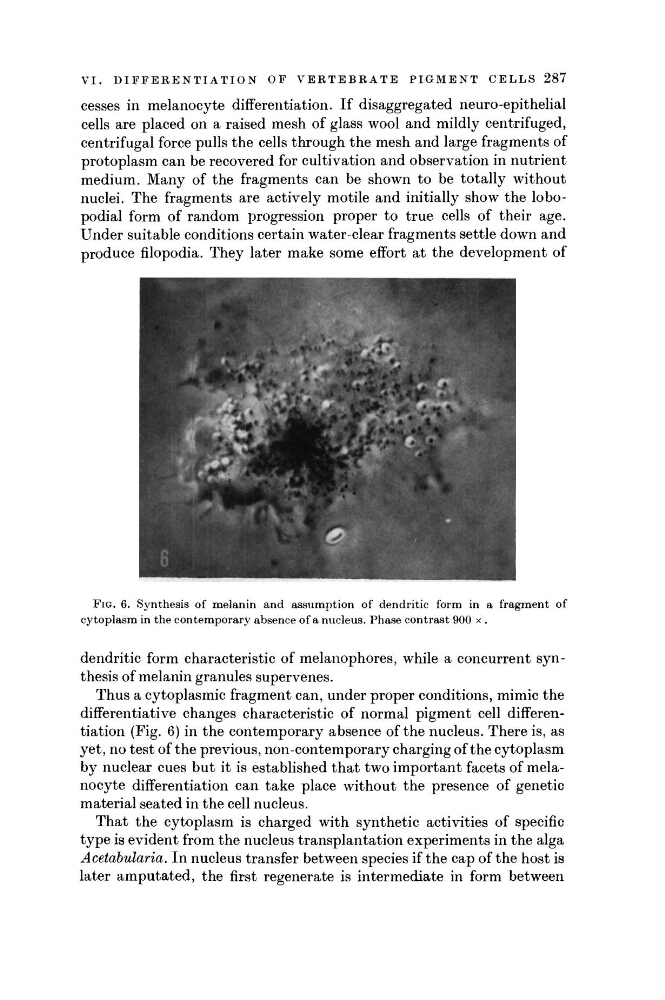
F I G . 6. Synthesis of melanin and assumption of dendritic form in a fragment of
cytoplasm in the contemporary absence of a nucleus. Phase contrast 900 χ .
dendritic form characteristic of melanophores, while a concurrent synthesis of melanin granules supervenes.
Thus a cytoplasmic fragment can, under proper conditions, mimic the
differentiative changes characteristic of normal pigment cell differentiation (Fig. 6) in the contemporary absence of the nucleus. There is, as
yet, no test of the previous, non-contemporary charging of the cytoplasm
by nuclear cues but it is established that two important facets of melanocyte differentiation can take place without the presence of genetic
material seated in the cell nucleus.
That the cytoplasm is charged with synthetic activities of specific
type is evident from the nucleus transplantation experiments in the alga
Acetabularia. In nucleus transfer between species if the cap of the host is
later amputated, the first regenerate is intermediate in form between
cesses in melanocyte differentiation. If disaggregated neuro-epithelial
cells are placed on a raised mesh of glass wool and mildly centrifuged,
centrifugal force pulls the cells through the mesh and large fragments of
protoplasm can be recovered for cultivation and observation in nutrient
medium. Many of the fragments can be shown to be totally without
nuclei. The fragments are actively motile and initially show the lobopodial form of random progression proper to true cells of their age.
Under suitable conditions certain water-clear fragments settle down and
produce filopodia. They later make some effort at the development of
D I F F E R E N T I A T I O N
O F V E R T E B R A T E P I G M E N T C E L L S
2 8 7
4r*~* :
' % IT
F I G . 6. Synthesis of melanin and assumption of dendritic form in a fragment of
cytoplasm in the contemporary absence of a nucleus. Phase contrast 900 χ .
dendritic form characteristic of melanophores, while a concurrent synthesis of melanin granules supervenes.
Thus a cytoplasmic fragment can, under proper conditions, mimic the
differentiative changes characteristic of normal pigment cell differentiation (Fig. 6) in the contemporary absence of the nucleus. There is, as
yet, no test of the previous, non-contemporary charging of the cytoplasm
by nuclear cues but it is established that two important facets of melanocyte differentiation can take place without the presence of genetic
material seated in the cell nucleus.
That the cytoplasm is charged with synthetic activities of specific
type is evident from the nucleus transplantation experiments in the alga
Acetabularia. In nucleus transfer between species if the cap of the host is
later amputated, the first regenerate is intermediate in form between
cesses in melanocyte differentiation. If disaggregated neuro-epithelial
cells are placed on a raised mesh of glass wool and mildly centrifuged,
centrifugal force pulls the cells through the mesh and large fragments of
protoplasm can be recovered for cultivation and observation in nutrient
medium. Many of the fragments can be shown to be totally without
nuclei. The fragments are actively motile and initially show the lobopodial form of random progression proper to true cells of their age.
Under suitable conditions certain water-clear fragments settle down and
produce filopodia. They later make some effort at the development of