

V I .
D I F F E R E N T I A T I O N O F V E R T E B R A T E P I G M E N T C E L L S
273
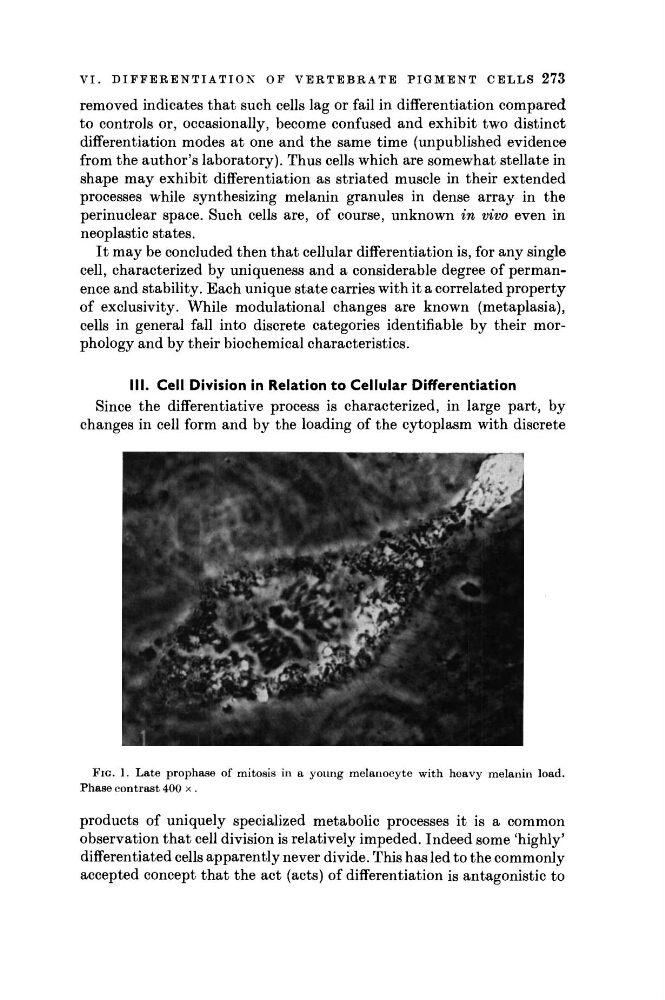
F I G . 1. L a t e prophase of mitosis in a young melanocyte with h e a v y melanin load.
Phase contrast 400 χ .
products of uniquely specialized metabolic processes it is a common
observation that cell division is relatively impeded. Indeed some 'highly'
differentiated cells apparently never divide. This has led to the commonly
accepted concept that the act (acts) of differentiation is antagonistic to
removed indicates that such cells lag or fail in differentiation compared
to controls or, occasionally, become confused and exhibit two distinct
differentiation modes at one and the same time (unpublished evidence
from the author's laboratory). Thus cells which are somewhat stellate in
shape may exhibit differentiation as striated muscle in their extended
processes while synthesizing melanin granules in dense array in the
perinuclear space. Such cells are, of course, unknown in vivo even in
neoplastic states.
It may be concluded then that cellular differentiation is, for any single
cell, characterized by uniqueness and a considerable degree of permanence and stability. Each unique state carries with it a correlated property
of exclusivity. While modulational changes are known (metaplasia),
cells in general fall into discrete categories identifiable by their morphology and by their biochemical characteristics.
III. Cell Division in Relation to Cellular Differentiation
Since the differentiative process is characterized, in large part, by
changes in cell form and by the loading of the cytoplasm with discrete
D I F F E R E N T I A T I O N O F V E R T E B R A T E P I G M E N T C E L L S
273
F I G . 1. L a t e prophase of mitosis in a young melanocyte with h e a v y melanin load.
Phase contrast 400 χ .
products of uniquely specialized metabolic processes it is a common
observation that cell division is relatively impeded. Indeed some 'highly'
differentiated cells apparently never divide. This has led to the commonly
accepted concept that the act (acts) of differentiation is antagonistic to
removed indicates that such cells lag or fail in differentiation compared
to controls or, occasionally, become confused and exhibit two distinct
differentiation modes at one and the same time (unpublished evidence
from the author's laboratory). Thus cells which are somewhat stellate in
shape may exhibit differentiation as striated muscle in their extended
processes while synthesizing melanin granules in dense array in the
perinuclear space. Such cells are, of course, unknown in vivo even in
neoplastic states.
It may be concluded then that cellular differentiation is, for any single
cell, characterized by uniqueness and a considerable degree of permanence and stability. Each unique state carries with it a correlated property
of exclusivity. While modulational changes are known (metaplasia),
cells in general fall into discrete categories identifiable by their morphology and by their biochemical characteristics.
III. Cell Division in Relation to Cellular Differentiation
Since the differentiative process is characterized, in large part, by
changes in cell form and by the loading of the cytoplasm with discrete