

22
TUNEO
YAMADA
resulted in induction of endodermal tissues. Thus a direct induction of
the endodermal differentiation in the ectoderm by the bone marrow
appears more probable. On the other hand, it is likely that the subsequent histogenesis of the endodermal structures is realized under the
influence of mesodermal tissues developed within the explant, since it
is known that differentiation of endodermal tissues is dependent upon
the presence and nature of the mesodermal tissues in its environment
CT.S.Okada, 1957).
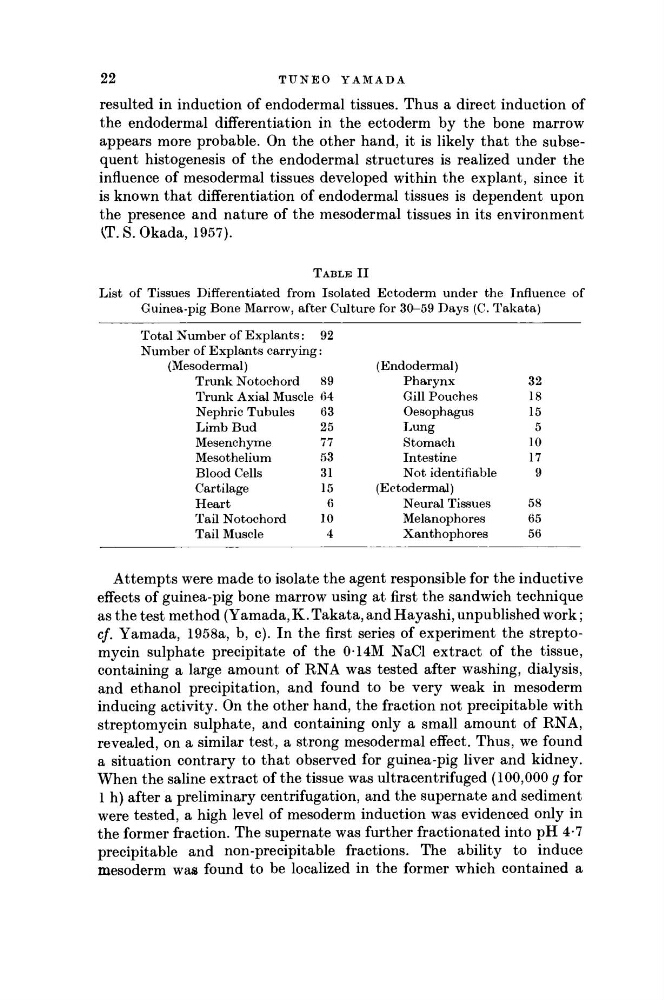
TABLE II
List of Tissues Differentiated from Isolated Ectoderm under the Influence of
Guinea-pig Bone Marrow, after Culture for 30-59 Days (C. Takata)
Total Number of Explants: 92
Number of Explants carrying
(Mesodermal)
(Endodermal)
Trunk Notochord
89
Pharynx
32
Trunk Axial Muscle (34
Gill Pouches
18
Nephric Tubules
63
Oesophagus
15
Limb Bud
25
Lung
5
Mesenchyme
77
Stomach
10
Mesothelium
53
Intestine
17
Blood Cells
31
Not identifiable
9
Cartilage
15
(Ectodermal)
Heart
6
Neural Tissues
58
Tail Notochord
10
Melanophores
65
Tail Muscle
4
Xanthophores
56
Attempts were made to isolate the agent responsible for the inductive
effects of guinea-pig bone marrow using at first the sandwich technique
as the test method (Yamada, K. Takata, and Hayashi, unpublished work;
c/. Yamada, 1958a, b, c). In the first series of experiment the streptomycin sulphate precipitate of the 014M NaCl extract of the tissue,
containing a large amount of RNA was tested after washing, dialysis,
and ethanol precipitation, and found to be very weak in mesoderm
inducing activity. On the other hand, the fraction not precipitable with
streptomycin sulphate, and containing only a small amount of RNA,
revealed, on a similar test, a strong mesodermal effect. Thus, we found
a situation contrary to that observed for guinea-pig liver and kidney.
When the saline extract of the tissue was ultracentrifuged (100,000 g for
1 h) after a preliminary centrifugation, and the supernate and sediment
were tested, a high level of mesoderm induction was evidenced only in
the former fraction. The supernate was further fractionated into pH 4-7
precipitable and non-precipitable fractions. The ability to induce
mesoderm was found to be localized in the former which contained a
TUNEO
YAMADA
resulted in induction of endodermal tissues. Thus a direct induction of
the endodermal differentiation in the ectoderm by the bone marrow
appears more probable. On the other hand, it is likely that the subsequent histogenesis of the endodermal structures is realized under the
influence of mesodermal tissues developed within the explant, since it
is known that differentiation of endodermal tissues is dependent upon
the presence and nature of the mesodermal tissues in its environment
CT.S.Okada, 1957).
TABLE II
List of Tissues Differentiated from Isolated Ectoderm under the Influence of
Guinea-pig Bone Marrow, after Culture for 30-59 Days (C. Takata)
Total Number of Explants: 92
Number of Explants carrying
(Mesodermal)
(Endodermal)
Trunk Notochord
89
Pharynx
32
Trunk Axial Muscle (34
Gill Pouches
18
Nephric Tubules
63
Oesophagus
15
Limb Bud
25
Lung
5
Mesenchyme
77
Stomach
10
Mesothelium
53
Intestine
17
Blood Cells
31
Not identifiable
9
Cartilage
15
(Ectodermal)
Heart
6
Neural Tissues
58
Tail Notochord
10
Melanophores
65
Tail Muscle
4
Xanthophores
56
Attempts were made to isolate the agent responsible for the inductive
effects of guinea-pig bone marrow using at first the sandwich technique
as the test method (Yamada, K. Takata, and Hayashi, unpublished work;
c/. Yamada, 1958a, b, c). In the first series of experiment the streptomycin sulphate precipitate of the 014M NaCl extract of the tissue,
containing a large amount of RNA was tested after washing, dialysis,
and ethanol precipitation, and found to be very weak in mesoderm
inducing activity. On the other hand, the fraction not precipitable with
streptomycin sulphate, and containing only a small amount of RNA,
revealed, on a similar test, a strong mesodermal effect. Thus, we found
a situation contrary to that observed for guinea-pig liver and kidney.
When the saline extract of the tissue was ultracentrifuged (100,000 g for
1 h) after a preliminary centrifugation, and the supernate and sediment
were tested, a high level of mesoderm induction was evidenced only in
the former fraction. The supernate was further fractionated into pH 4-7
precipitable and non-precipitable fractions. The ability to induce
mesoderm was found to be localized in the former which contained a