

V.
DETERMINING
FACTORS
IN
CELL
GROWTH
245
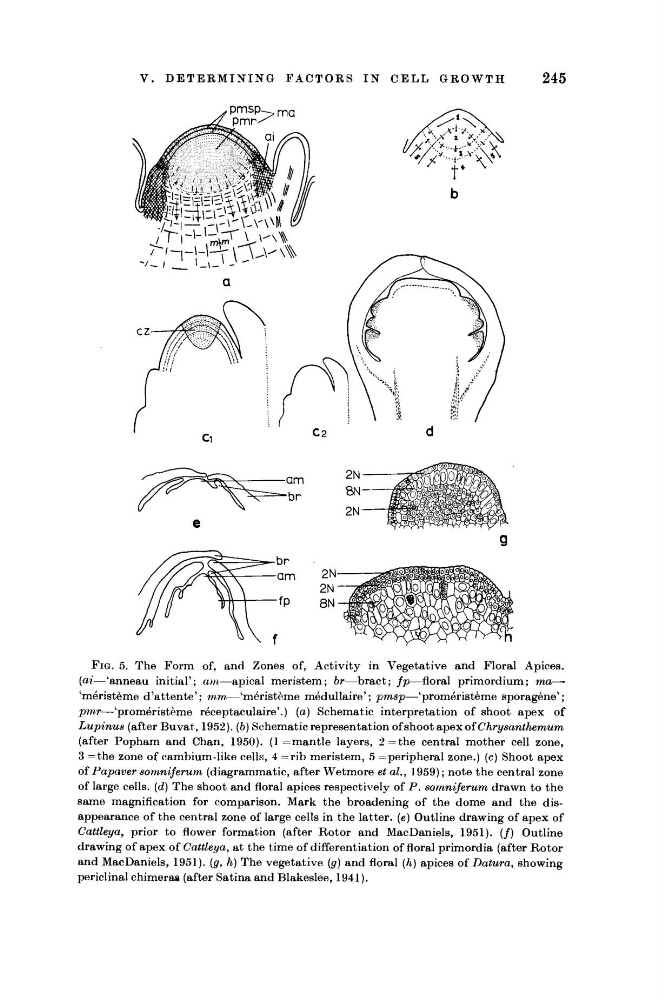
FIG. 5. The Form of, and Zones of, Activity in Vegetative and Floral Apices.
(at—'anneau
initial'; am—apical
meristem; br—bract; fp—floral
primordium; ma—
'méristéme d'attente'; mm—'méristéme
médullaire'; pmsp—'proméristéme
sporagéne';
pmr—'proméristéme
réceptaculaire'.) (a) Schematic interpretation of shoot apex of
Lupinus (after Buvat, 1952). (b) Schematic representation of shoot apex of Chrysanthemum
(after Popham and Chan, 1950). (1 =mantle layers, 2= the central mother cell zone,
3 =the zone of cambium-like cells, 4 =rib meristem, 5 = peripheral zone.) (c) Shoot apex
of Papaver somniferum (diagrammatic, after Wetmore et al., 1959); note the central zone
of large cells, (d) The shoot and floral apices respectively of P. somniferum drawn to the
same magnification for comparison. Mark the broadening of the dome and the disappearance of the central zone of large cells in the latter, (e) Outline drawing of apex of
Cattleya, prior to flower formation (after Rotor and MacDaniels, 1951). (/) Outline
drawing of apex of Cattleya, at the time of differentiation of floral primordia (after Rotor
and MacDaniels, 1951). (g, h) The vegetative (g) and floral (h) apices of Datura, showing
periclinal chimeras (after Satina and Blakeslee, 1941).
DETERMINING
FACTORS
IN
CELL
GROWTH
245
FIG. 5. The Form of, and Zones of, Activity in Vegetative and Floral Apices.
(at—'anneau
initial'; am—apical
meristem; br—bract; fp—floral
primordium; ma—
'méristéme d'attente'; mm—'méristéme
médullaire'; pmsp—'proméristéme
sporagéne';
pmr—'proméristéme
réceptaculaire'.) (a) Schematic interpretation of shoot apex of
Lupinus (after Buvat, 1952). (b) Schematic representation of shoot apex of Chrysanthemum
(after Popham and Chan, 1950). (1 =mantle layers, 2= the central mother cell zone,
3 =the zone of cambium-like cells, 4 =rib meristem, 5 = peripheral zone.) (c) Shoot apex
of Papaver somniferum (diagrammatic, after Wetmore et al., 1959); note the central zone
of large cells, (d) The shoot and floral apices respectively of P. somniferum drawn to the
same magnification for comparison. Mark the broadening of the dome and the disappearance of the central zone of large cells in the latter, (e) Outline drawing of apex of
Cattleya, prior to flower formation (after Rotor and MacDaniels, 1951). (/) Outline
drawing of apex of Cattleya, at the time of differentiation of floral primordia (after Rotor
and MacDaniels, 1951). (g, h) The vegetative (g) and floral (h) apices of Datura, showing
periclinal chimeras (after Satina and Blakeslee, 1941).