

V.
DETERMINING
FACTORS IN CELL
GROWTH
227
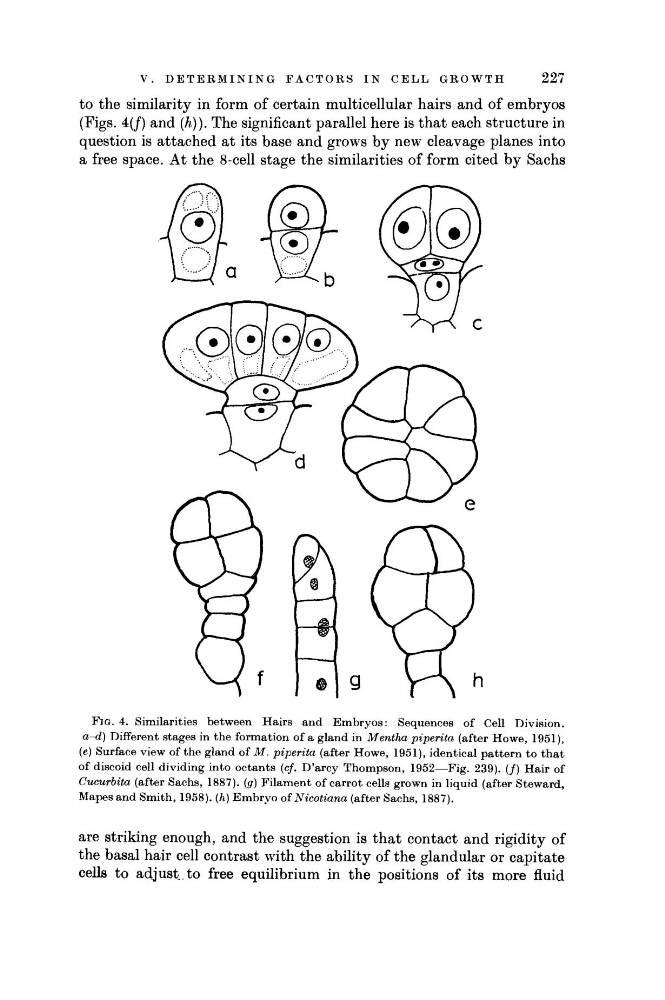
to the similarity in form of certain multicellular hairs and of embryos
(Figs. 4(/) and (h)). The significant parallel here is that each structure in
question is attached at its base and grows by new cleavage planes into
a free space. At the 8-cell stage the similarities of form cited by Sachs
FIG. 4. Similarities between Hairs and Embryos: Sequences of Cell Division.
a-d) Different stages in the formation of a gland in Mentha piperita (after Howe, 1951),
(e) Surface view of the gland of M. piperita (after Howe, 1951), identical pattern to that
of discoid cell dividing into octants (c/. D'arcy Thompson, 1952—Fig. 239). (/) Hair of
Cucurbita (after Sachs, 1887). (g) Filament of carrot cells grown in liquid (after Steward,
Mapes and Smith, 1958). (h) Embryo of Nicotiana (after Sachs, 1887).
are striking enough, and the suggestion is that contact and rigidity of
the basal hair cell contrast with the ability of the glandular or capitate
cells to adjust.to free equilibrium in the positions of its more fluid
DETERMINING
FACTORS IN CELL
GROWTH
227
to the similarity in form of certain multicellular hairs and of embryos
(Figs. 4(/) and (h)). The significant parallel here is that each structure in
question is attached at its base and grows by new cleavage planes into
a free space. At the 8-cell stage the similarities of form cited by Sachs
FIG. 4. Similarities between Hairs and Embryos: Sequences of Cell Division.
a-d) Different stages in the formation of a gland in Mentha piperita (after Howe, 1951),
(e) Surface view of the gland of M. piperita (after Howe, 1951), identical pattern to that
of discoid cell dividing into octants (c/. D'arcy Thompson, 1952—Fig. 239). (/) Hair of
Cucurbita (after Sachs, 1887). (g) Filament of carrot cells grown in liquid (after Steward,
Mapes and Smith, 1958). (h) Embryo of Nicotiana (after Sachs, 1887).
are striking enough, and the suggestion is that contact and rigidity of
the basal hair cell contrast with the ability of the glandular or capitate
cells to adjust.to free equilibrium in the positions of its more fluid