

178
F . Ε . L E H M A N N
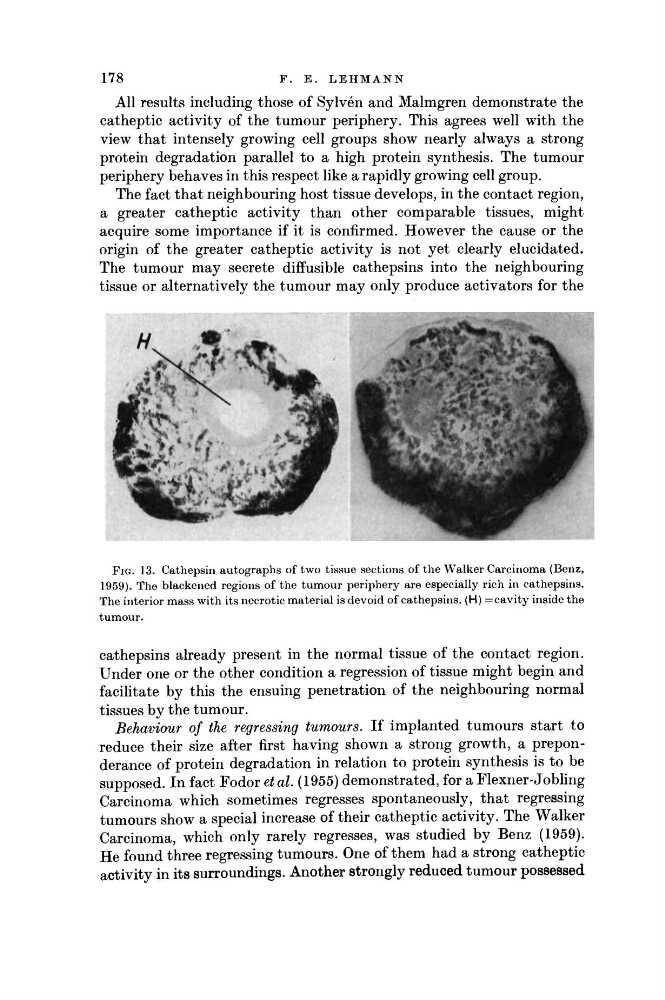
FIG. 13. Cathepsin autographs of two tissue sections of the W a l k e r Carcinoma (Benz,
1959). The blackened regions of the tumour periphery are especially rich in cathepsins.
The interior mass with its necrotic material is devoid of cathepsins. (H) = cavity inside the
tumour.
cathepsins already present in the normal tissue of the contact region.
Under one or the other condition a regression of tissue might begin and
facilitate by this the ensuing penetration of the neighbouring normal
tissues by the tumour.
Behaviour of the regressing tumours. If implanted tumours start to
reduce their size after first having shown a strong growth, a preponderance of protein degradation in relation to protein synthesis is to be
supposed. In fact Fodor et ah (1955) demonstrated, for a Flexner-Jobling
Carcinoma which sometimes regresses spontaneously, that regressing
tumours show a special increase of their catheptic activity. The Walker
Carcinoma, which only rarely regresses, was studied by Benz (1959).
He found three regressing tumours. One of them had a strong catheptic
activity in its surroundings. Another strongly reduced tumour possessed
All results including those of Sylvén and Malmgren demonstrate the
catheptic activity of the tumour periphery. This agrees well with the
view that intensely growing cell groups show nearly always a strong
protein degradation parallel to a high protein synthesis. The tumour
periphery behaves in this respect like a rapidly growing cell group.
The fact that neighbouring host tissue develops, in the contact region,
a greater catheptic activity than other comparable tissues, might
acquire some importance if it is confirmed. However the cause or the
origin of the greater catheptic activity is not yet clearly elucidated.
The tumour may secrete diffusible cathepsins into the neighbouring
tissue or alternatively the tumour may only produce activators for the
F . Ε . L E H M A N N
FIG. 13. Cathepsin autographs of two tissue sections of the W a l k e r Carcinoma (Benz,
1959). The blackened regions of the tumour periphery are especially rich in cathepsins.
The interior mass with its necrotic material is devoid of cathepsins. (H) = cavity inside the
tumour.
cathepsins already present in the normal tissue of the contact region.
Under one or the other condition a regression of tissue might begin and
facilitate by this the ensuing penetration of the neighbouring normal
tissues by the tumour.
Behaviour of the regressing tumours. If implanted tumours start to
reduce their size after first having shown a strong growth, a preponderance of protein degradation in relation to protein synthesis is to be
supposed. In fact Fodor et ah (1955) demonstrated, for a Flexner-Jobling
Carcinoma which sometimes regresses spontaneously, that regressing
tumours show a special increase of their catheptic activity. The Walker
Carcinoma, which only rarely regresses, was studied by Benz (1959).
He found three regressing tumours. One of them had a strong catheptic
activity in its surroundings. Another strongly reduced tumour possessed
All results including those of Sylvén and Malmgren demonstrate the
catheptic activity of the tumour periphery. This agrees well with the
view that intensely growing cell groups show nearly always a strong
protein degradation parallel to a high protein synthesis. The tumour
periphery behaves in this respect like a rapidly growing cell group.
The fact that neighbouring host tissue develops, in the contact region,
a greater catheptic activity than other comparable tissues, might
acquire some importance if it is confirmed. However the cause or the
origin of the greater catheptic activity is not yet clearly elucidated.
The tumour may secrete diffusible cathepsins into the neighbouring
tissue or alternatively the tumour may only produce activators for the