

14
T U N E O
Y A M A D A
by the use of sucrose, glucose, and 2,4-dinitrophenol (Karasaki, 1957b).
Observation with the phase contrast microscope revealed here that,
whereas sucrose and glucose suppress the ammonia-evoked protoplasmic
solation, dinitrophenol fails to show any effect on the protoplasmic
condition. Apparently the suppressive effect of dinitrophenol does not
affect the structural aspect, but inhibits a phase of cellular metabolism
which is essential in bringing about neural differentiation.
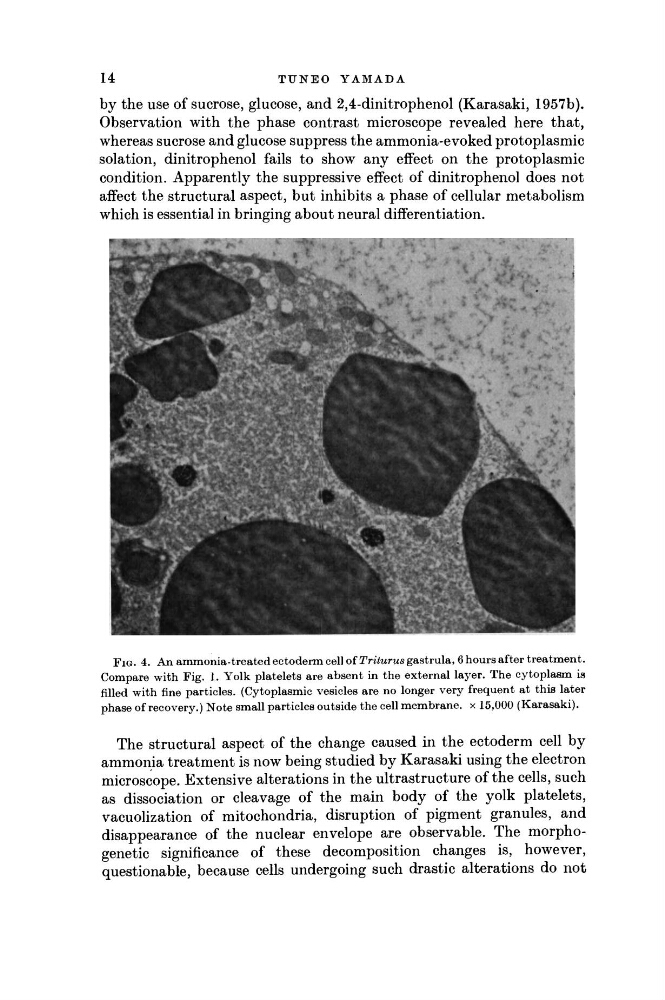
F I G . 4 . A n ammonia-treated ectoderm cell of Triturus gastrula, 6 hours after treatment.
Compare with Fig. 1 . Y o l k platelets are absent in the external layer. T h e cytoplasm is
filled with fine particles. (Cytoplasmic vesicles are no longer very frequent at this later
phase of recovery.) N o t e small particles outside the cell membrane, χ 1 5 , 0 0 0 (Karasaki).
The structural aspect of the change caused in the ectoderm cell b y
ammonia treatment is now being studied by Karasaki using the electron
microscope. Extensive alterations in the ultrastructure of the cells, such
as dissociation or cleavage of the main body of the yolk platelets,
vacuolization of mitochondria, disruption of pigment granules, and
disappearance of the nuclear envelope are observable. The morphogenetic significance of these decomposition changes is, however,
questionable, because cells undergoing such drastic alterations do not
T U N E O
Y A M A D A
by the use of sucrose, glucose, and 2,4-dinitrophenol (Karasaki, 1957b).
Observation with the phase contrast microscope revealed here that,
whereas sucrose and glucose suppress the ammonia-evoked protoplasmic
solation, dinitrophenol fails to show any effect on the protoplasmic
condition. Apparently the suppressive effect of dinitrophenol does not
affect the structural aspect, but inhibits a phase of cellular metabolism
which is essential in bringing about neural differentiation.
F I G . 4 . A n ammonia-treated ectoderm cell of Triturus gastrula, 6 hours after treatment.
Compare with Fig. 1 . Y o l k platelets are absent in the external layer. T h e cytoplasm is
filled with fine particles. (Cytoplasmic vesicles are no longer very frequent at this later
phase of recovery.) N o t e small particles outside the cell membrane, χ 1 5 , 0 0 0 (Karasaki).
The structural aspect of the change caused in the ectoderm cell b y
ammonia treatment is now being studied by Karasaki using the electron
microscope. Extensive alterations in the ultrastructure of the cells, such
as dissociation or cleavage of the main body of the yolk platelets,
vacuolization of mitochondria, disruption of pigment granules, and
disappearance of the nuclear envelope are observable. The morphogenetic significance of these decomposition changes is, however,
questionable, because cells undergoing such drastic alterations do not