

132
R . J .
G O S S
from which it originates (Weiss, 1939). W e have seen in the preceding
section, that doubling the amount of stump tissues does not result in the
regeneration of an enlarged single hand, but in the production of separate
regenerates which may later undergo partial unification. Thus, although
the limbs were grafted, their respective limb fields remained segregated
except in so far as they become secondarily superimposed as the result
of convergence during regeneration. Therefore, the morphogenetic
field of a limb is not undisturbed by increasing its material substrate.
It will be of interest to learn if a decrease in the amount of stump tissue
will similarly diminish the limb field. Weiss (1924a, 1926) demonstrated
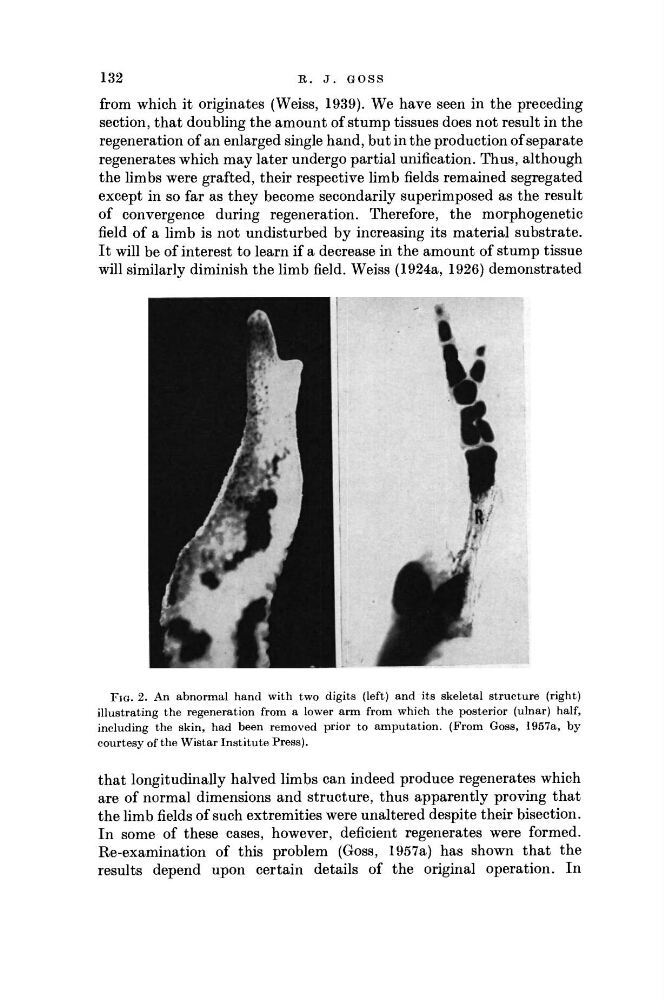
F I G . 2. A n abnormal hand with two digits (left) and its skeletal structure (right)
illustrating the regeneration from a lower arm from which the posterior (ulnar) half,
including the skin, had been removed prior to amputation. (From Goss, 1957a, b y
courtesy of the W i s t a r Institute Press).
that longitudinally halved limbs can indeed produce regenerates which
are of normal dimensions and structure, thus apparently proving that
the limb fields of such extremities were unaltered despite their bisection.
In some of these cases, however, deficient regenerates were formed.
Re-examination of this problem (Goss, 1957a) has shown that the
results depend upon certain details of the original operation. In
R . J .
G O S S
from which it originates (Weiss, 1939). W e have seen in the preceding
section, that doubling the amount of stump tissues does not result in the
regeneration of an enlarged single hand, but in the production of separate
regenerates which may later undergo partial unification. Thus, although
the limbs were grafted, their respective limb fields remained segregated
except in so far as they become secondarily superimposed as the result
of convergence during regeneration. Therefore, the morphogenetic
field of a limb is not undisturbed by increasing its material substrate.
It will be of interest to learn if a decrease in the amount of stump tissue
will similarly diminish the limb field. Weiss (1924a, 1926) demonstrated
F I G . 2. A n abnormal hand with two digits (left) and its skeletal structure (right)
illustrating the regeneration from a lower arm from which the posterior (ulnar) half,
including the skin, had been removed prior to amputation. (From Goss, 1957a, b y
courtesy of the W i s t a r Institute Press).
that longitudinally halved limbs can indeed produce regenerates which
are of normal dimensions and structure, thus apparently proving that
the limb fields of such extremities were unaltered despite their bisection.
In some of these cases, however, deficient regenerates were formed.
Re-examination of this problem (Goss, 1957a) has shown that the
results depend upon certain details of the original operation. In