

130
R.
J.
GOSS
sides of the combined structures are lacking. In fused hands arranged
beside each other, entire digits may be fused or eliminated. Monroy
(1943) interpreted results of these kinds in terms of the limb field theory
originally proposed by Weiss (1926). According to this, the organizational
pattern of the whole limb regenerate is attributable to a field effect
emanating from the stump. When two stumps are conjoined parallel
to each other, their fields will also be parallel and two nearly separate
regenerates will result. However, if the grafted limbs converge, their
respective fields will overlap. Thus, fusion of the two regenerates ensues,
ΰ
abe
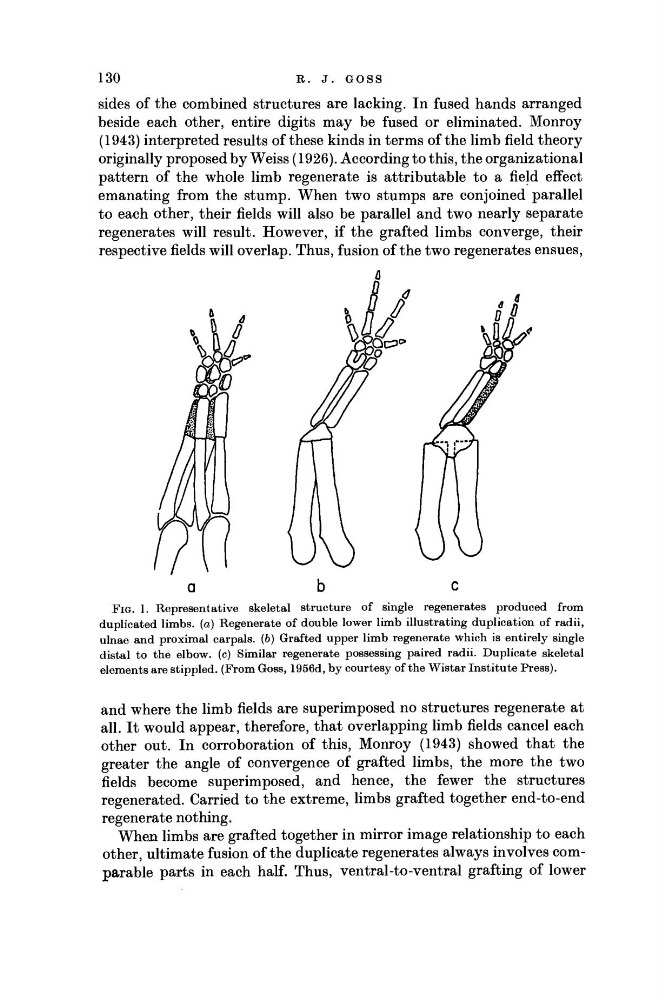
FIG. 1. Representative
skeletal structure of single regenerates produced from
duplicated limbs, (a) Regenerate of double lower limb illustrating duplication of radii,
ulnae and proximal carpáis. (6) Grafted upper limb regenerate which is entirely single
distal to the elbow, (c) Similar regenerate possessing paired radii. Duplicate skeletal
elements are stippled. (From Goss, 1956d, by courtesy of the Wistar Institute Press).
and where the limb fields are superimposed no structures regenerate at
all. It would appear, therefore, that overlapping limb fields cancel each
other out. In corroboration of this, Monroy (1943) showed that the
greater the angle of convergence of grafted limbs, the more the two
fields become superimposed, and hence, the fewer the structures
regenerated. Carried to the extreme, limbs grafted together end-to-end
regenerate nothing.
When limbs are grafted together in mirror image relationship to each
other, ultimate fusion of the duplicate regenerates always involves comparable parts in each half. Thus, ventral-to-ventral grafting of lower
R.
J.
GOSS
sides of the combined structures are lacking. In fused hands arranged
beside each other, entire digits may be fused or eliminated. Monroy
(1943) interpreted results of these kinds in terms of the limb field theory
originally proposed by Weiss (1926). According to this, the organizational
pattern of the whole limb regenerate is attributable to a field effect
emanating from the stump. When two stumps are conjoined parallel
to each other, their fields will also be parallel and two nearly separate
regenerates will result. However, if the grafted limbs converge, their
respective fields will overlap. Thus, fusion of the two regenerates ensues,
ΰ
abe
FIG. 1. Representative
skeletal structure of single regenerates produced from
duplicated limbs, (a) Regenerate of double lower limb illustrating duplication of radii,
ulnae and proximal carpáis. (6) Grafted upper limb regenerate which is entirely single
distal to the elbow, (c) Similar regenerate possessing paired radii. Duplicate skeletal
elements are stippled. (From Goss, 1956d, by courtesy of the Wistar Institute Press).
and where the limb fields are superimposed no structures regenerate at
all. It would appear, therefore, that overlapping limb fields cancel each
other out. In corroboration of this, Monroy (1943) showed that the
greater the angle of convergence of grafted limbs, the more the two
fields become superimposed, and hence, the fewer the structures
regenerated. Carried to the extreme, limbs grafted together end-to-end
regenerate nothing.
When limbs are grafted together in mirror image relationship to each
other, ultimate fusion of the duplicate regenerates always involves comparable parts in each half. Thus, ventral-to-ventral grafting of lower