

304
JOHN RUNNSTRÖM
100
CÛ
2
ο
<
z
X
CO
ο
ü
2
3
MINUTES AFTER INSEMINATION
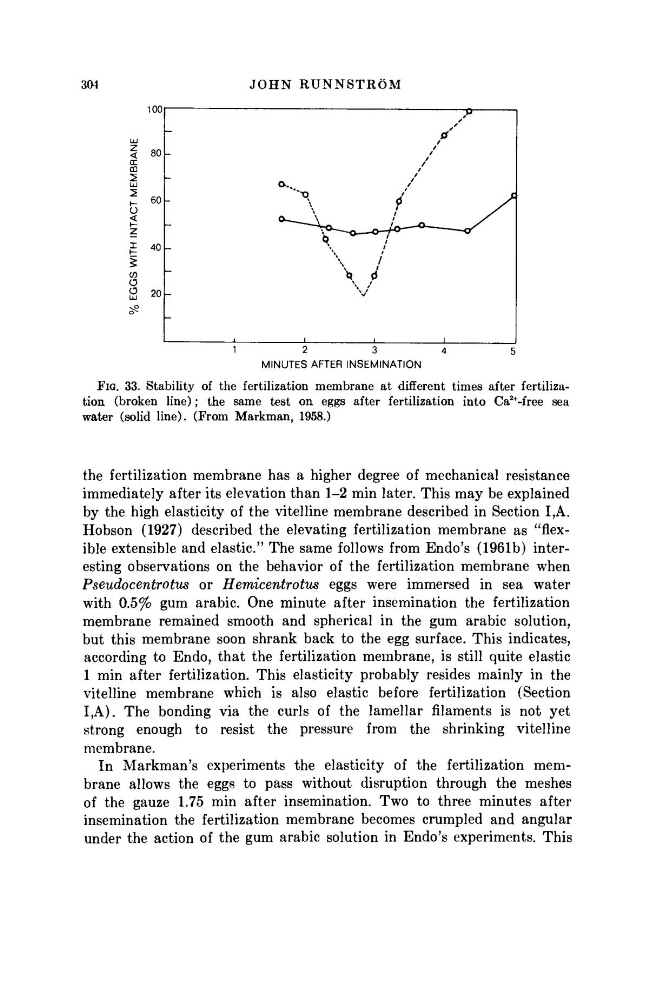
FIG. 33. Stability of the fertilization membrane at different times after fertilization (broken line) ; the same test on eggs after fertilization into Ca
2+
-free sea
water (solid line). (From Markman, 1958.)
the fertilization membrane has a higher degree of mechanical resistance
immediately after its elevation than 1-2 min later. This may be explained
by the high elasticity of the vitelline membrane described in Section I,A.
Hobson (1927) described the elevating fertilization membrane as "flexible extensible and elastic." The same follows from Endo's (1961b) interesting observations on the behavior of the fertilization membrane when
Pseudocentrotus
or Hemicentrotus
eggs were immersed in sea water
with 0.5% gum arabic. One minute after insemination the fertilization
membrane remained smooth and spherical in the gum arabic solution,
but this membrane soon shrank back to the egg surface. This indicates,
according to Endo, that the fertilization membrane, is still quite elastic
1 min after fertilization. This elasticity probably resides mainly in the
vitelline membrane which is also elastic before fertilization (Section
I,A). The bonding via the curls of the lamellar filaments is not yet
strong enough to resist the pressure from the shrinking vitelline
membrane.
In Markman's experiments the elasticity of the fertilization membrane allows the eggs to pass without disruption through the meshes
of the gauze 1.75 min after insemination. Two to three minutes after
insemination the fertilization membrane becomes crumpled and angular
under the action of the gum arabic solution in Endo's experiments. This
JOHN RUNNSTRÖM
100
CÛ
2
ο
<
z
X
CO
ο
ü
2
3
MINUTES AFTER INSEMINATION
FIG. 33. Stability of the fertilization membrane at different times after fertilization (broken line) ; the same test on eggs after fertilization into Ca
2+
-free sea
water (solid line). (From Markman, 1958.)
the fertilization membrane has a higher degree of mechanical resistance
immediately after its elevation than 1-2 min later. This may be explained
by the high elasticity of the vitelline membrane described in Section I,A.
Hobson (1927) described the elevating fertilization membrane as "flexible extensible and elastic." The same follows from Endo's (1961b) interesting observations on the behavior of the fertilization membrane when
Pseudocentrotus
or Hemicentrotus
eggs were immersed in sea water
with 0.5% gum arabic. One minute after insemination the fertilization
membrane remained smooth and spherical in the gum arabic solution,
but this membrane soon shrank back to the egg surface. This indicates,
according to Endo, that the fertilization membrane, is still quite elastic
1 min after fertilization. This elasticity probably resides mainly in the
vitelline membrane which is also elastic before fertilization (Section
I,A). The bonding via the curls of the lamellar filaments is not yet
strong enough to resist the pressure from the shrinking vitelline
membrane.
In Markman's experiments the elasticity of the fertilization membrane allows the eggs to pass without disruption through the meshes
of the gauze 1.75 min after insemination. Two to three minutes after
insemination the fertilization membrane becomes crumpled and angular
under the action of the gum arabic solution in Endo's experiments. This