

FEATHERS AND PATTERNS
25
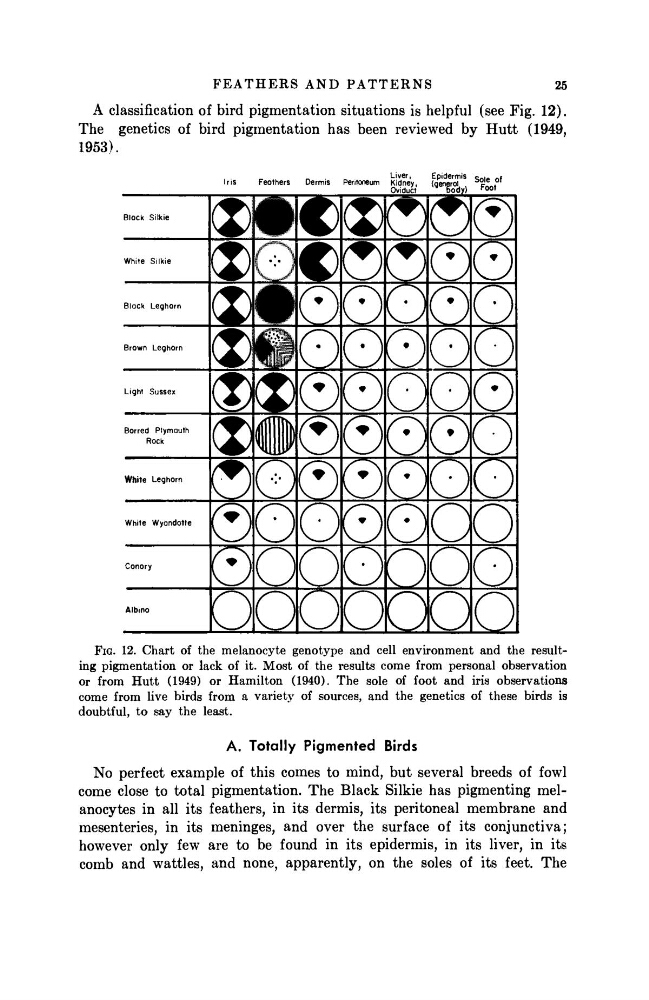
A classification of bird pigmentation situations is helpful (see Fig. 12).
The genetics of bird pigmentation has been reviewed by Hütt (1949,
1953).
•.
«
L i v e r
>
Epidermis e n i 0
rt
»
Ins
Feathers
Dermis
Peritoneum
Kidney,
(general
c 4
__
Oviduct
body)
t
"
0 0
t
BLOB MM®
Black Leghorn
Brown Leghorn
Light Sussex
Barred Plymouth
Rock
White Leghorn
White Wyandotte
MR
MM
OOOOÖ
©G
Canary
mm
mm DO
G
Ο
ΩΟ
©Ω
GO
00
Go
OO
FIG. 12. Chart of the melanocyte genotype and cell environment and the resulting pigmentation or lack of it. Most of the results come from personal observation
or from Hütt (1949) or Hamilton (1940). The sole of foot and iris observations
come from live birds from a variety of sources, and the genetics of these birds is
doubtful, to say the least.
A. Totally Pigmented Birds
No perfect example of this comes to mind, but several breeds of fowl
come close to total pigmentation. The Black Silkie has pigmenting melanocytes in all its feathers, in its dermis, its peritoneal membrane and
mesenteries, in its meninges, and over the surface of its conjunctiva;
however only few are to be found in its epidermis, in its liver, in its
comb and wattles, and none, apparently, on the soles of its feet. The
25
A classification of bird pigmentation situations is helpful (see Fig. 12).
The genetics of bird pigmentation has been reviewed by Hütt (1949,
1953).
•.
«
L i v e r
>
Epidermis e n i 0
rt
»
Ins
Feathers
Dermis
Peritoneum
Kidney,
(general
c 4
__
Oviduct
body)
t
"
0 0
t
BLOB MM®
Black Leghorn
Brown Leghorn
Light Sussex
Barred Plymouth
Rock
White Leghorn
White Wyandotte
MR
MM
OOOOÖ
©G
Canary
mm
mm DO
G
Ο
ΩΟ
©Ω
GO
00
Go
OO
FIG. 12. Chart of the melanocyte genotype and cell environment and the resulting pigmentation or lack of it. Most of the results come from personal observation
or from Hütt (1949) or Hamilton (1940). The sole of foot and iris observations
come from live birds from a variety of sources, and the genetics of these birds is
doubtful, to say the least.
A. Totally Pigmented Birds
No perfect example of this comes to mind, but several breeds of fowl
come close to total pigmentation. The Black Silkie has pigmenting melanocytes in all its feathers, in its dermis, its peritoneal membrane and
mesenteries, in its meninges, and over the surface of its conjunctiva;
however only few are to be found in its epidermis, in its liver, in its
comb and wattles, and none, apparently, on the soles of its feet. The