

284
JOHN RUNNSTRÖM
10 20
40
80
SECONDS
18Ö
"05"
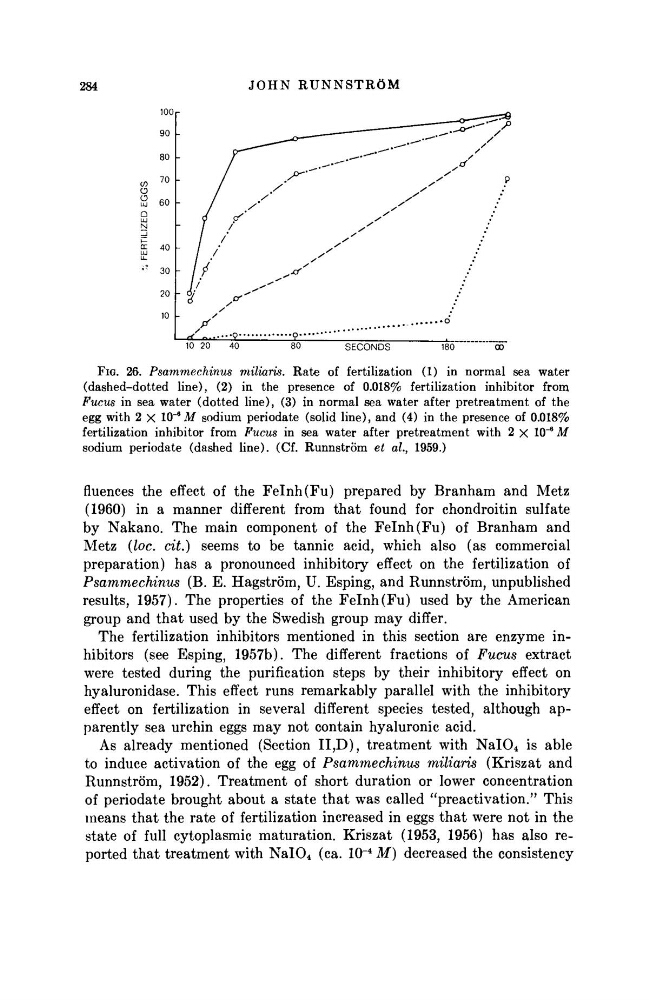
FIG. 26. Psammechinus miliaris. Rate of fertilization (1) in normal sea water
(dashed-dotted line), (2) in the presence of 0.018% fertilization inhibitor from
Fucus in sea water (dotted line), (3) in normal sea water after pretreatment of the
egg with 2 X 10"
E
M sodium periodate (solid line), and (4) in the presence of 0.018%
fertilization inhibitor from Fucus in sea water after pretreatment with 2 χ 10~
e
ilf
sodium periodate (dashed line). (Cf. Runnström et al., 1959.)
fluences the effect of the Felnh(Fu) prepared by Branham and Metz
(1960) in a manner different from that found for chondroitin sulfate
by Nakano. The main component of the Felnh(Fu) of Branham and
Metz (loc. cit.) seems to be tannic acid, which also (as commercial
preparation) has a pronounced inhibitory effect on the fertilization of
Psammechinus
(Β. Ε. Hagström, U. Esping, and Runnström, unpublished
results, 1957). The properties of the Felnh(Fu) used by the American
group and that used by the Swedish group may differ.
The fertilization inhibitors mentioned in this section are enzyme inhibitors (see Esping, 1957b). The different fractions of Fucus extract
were tested during the purification steps by their inhibitory effect on
hyaluronidase. This effect runs remarkably parallel with the inhibitory
effect on fertilization in several different species tested, although apparently sea urchin eggs may not contain hyaluronic acid.
As already mentioned (Section H,D), treatment with NaI0 4 is able
to induce activation of the egg of Psammechinus
miliaris (Kriszat and
Runnström, 1952). Treatment of short duration or lower concentration
of periodate brought about a state that was called "preactivation." This
means that the rate of fertilization increased in eggs that were not in the
state of full cytoplasmic maturation. Kriszat (1953, 1956) has also reported that treatment with NaI0 4 (ca. ΙΟ
4 M) decreased the consistency
JOHN RUNNSTRÖM
10 20
40
80
SECONDS
18Ö
"05"
FIG. 26. Psammechinus miliaris. Rate of fertilization (1) in normal sea water
(dashed-dotted line), (2) in the presence of 0.018% fertilization inhibitor from
Fucus in sea water (dotted line), (3) in normal sea water after pretreatment of the
egg with 2 X 10"
E
M sodium periodate (solid line), and (4) in the presence of 0.018%
fertilization inhibitor from Fucus in sea water after pretreatment with 2 χ 10~
e
ilf
sodium periodate (dashed line). (Cf. Runnström et al., 1959.)
fluences the effect of the Felnh(Fu) prepared by Branham and Metz
(1960) in a manner different from that found for chondroitin sulfate
by Nakano. The main component of the Felnh(Fu) of Branham and
Metz (loc. cit.) seems to be tannic acid, which also (as commercial
preparation) has a pronounced inhibitory effect on the fertilization of
Psammechinus
(Β. Ε. Hagström, U. Esping, and Runnström, unpublished
results, 1957). The properties of the Felnh(Fu) used by the American
group and that used by the Swedish group may differ.
The fertilization inhibitors mentioned in this section are enzyme inhibitors (see Esping, 1957b). The different fractions of Fucus extract
were tested during the purification steps by their inhibitory effect on
hyaluronidase. This effect runs remarkably parallel with the inhibitory
effect on fertilization in several different species tested, although apparently sea urchin eggs may not contain hyaluronic acid.
As already mentioned (Section H,D), treatment with NaI0 4 is able
to induce activation of the egg of Psammechinus
miliaris (Kriszat and
Runnström, 1952). Treatment of short duration or lower concentration
of periodate brought about a state that was called "preactivation." This
means that the rate of fertilization increased in eggs that were not in the
state of full cytoplasmic maturation. Kriszat (1953, 1956) has also reported that treatment with NaI0 4 (ca. ΙΟ
4 M) decreased the consistency