

270
JOHN RUNNSTRÖM
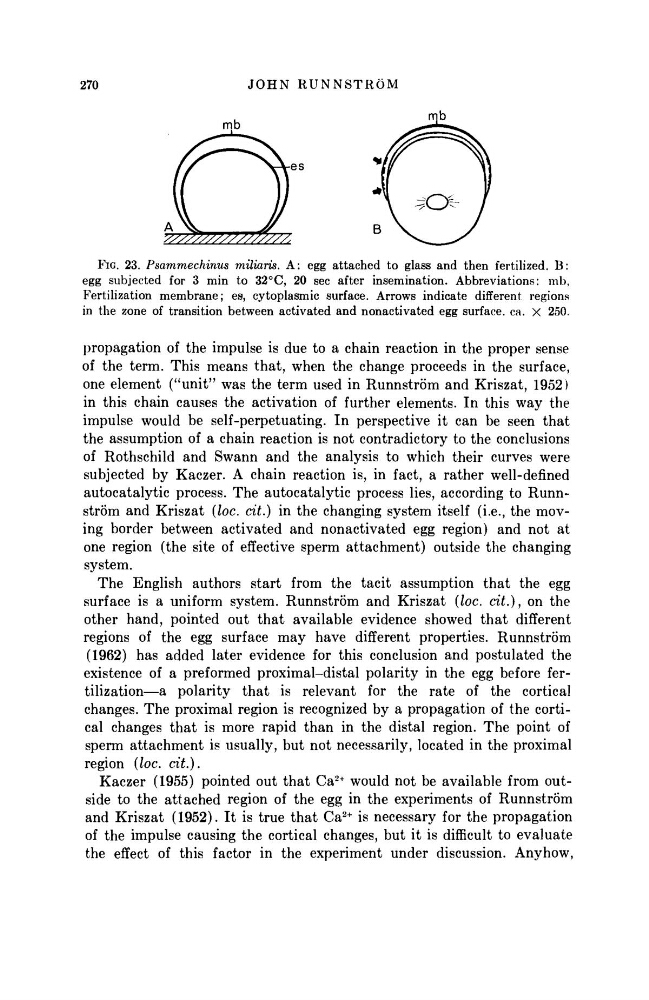
FIG. 23. Psammechinus miliaris. A: egg attached to glass and then fertilized. B:
egg subjected for 3 min to 32°C, 20 sec after insemination. Abbreviations: mb,
Fertilization membrane; es, cytoplasmic surface. Arrows indicate different regions
in the zone of transition between activated and nonactivated egg surface, ca. χ 250.
propagation of the impulse is due to a chain reaction in the proper sense
of the term. This means that, when the change proceeds in the surface,
one element ("unit" was the term used in Runnström and Kriszat, 1952)
in this chain causes the activation of further elements. In this way the
impulse would be self-perpetuating. In perspective it can be seen that
the assumption of a chain reaction is not contradictory to the conclusions
of Rothschild and Swann and the analysis to which their curves were
subjected by Kaczer. A chain reaction is, in fact, a rather well-defined
autocatalytic process. The autocatalytic process lies, according to Runnström and Kriszat (loc. cit.) in the changing system itself (i.e., the moving border between activated and nonactivated egg region) and not at
one region (the site of effective sperm attachment) outside the changing
system.
The English authors start from the tacit assumption that the egg
surface is a uniform system. Runnström and Kriszat (loc. cit.), on the
other hand, pointed out that available evidence showed that different
regions of the egg surface may have different properties. Runnström
(1962) has added later evidence for this conclusion and postulated the
existence of a preformed proximal-distal polarity in the egg before fertilization—a polarity that is relevant for the rate of the cortical
changes. The proximal region is recognized by a propagation of the cortical changes that is more rapid than in the distal region. The point of
sperm attachment is usually, but not necessarily, located in the proximal
region (loc. cit.).
Kaczer (1955) pointed out that Ca
2+ would not be available from outside to the attached region of the egg in the experiments of Runnström
and Kriszat (1952). It is true that Ca
2+ is necessary for the propagation
of the impulse causing the cortical changes, but it is difficult to evaluate
the effect of this factor in the experiment under discussion. Anyhow,
JOHN RUNNSTRÖM
FIG. 23. Psammechinus miliaris. A: egg attached to glass and then fertilized. B:
egg subjected for 3 min to 32°C, 20 sec after insemination. Abbreviations: mb,
Fertilization membrane; es, cytoplasmic surface. Arrows indicate different regions
in the zone of transition between activated and nonactivated egg surface, ca. χ 250.
propagation of the impulse is due to a chain reaction in the proper sense
of the term. This means that, when the change proceeds in the surface,
one element ("unit" was the term used in Runnström and Kriszat, 1952)
in this chain causes the activation of further elements. In this way the
impulse would be self-perpetuating. In perspective it can be seen that
the assumption of a chain reaction is not contradictory to the conclusions
of Rothschild and Swann and the analysis to which their curves were
subjected by Kaczer. A chain reaction is, in fact, a rather well-defined
autocatalytic process. The autocatalytic process lies, according to Runnström and Kriszat (loc. cit.) in the changing system itself (i.e., the moving border between activated and nonactivated egg region) and not at
one region (the site of effective sperm attachment) outside the changing
system.
The English authors start from the tacit assumption that the egg
surface is a uniform system. Runnström and Kriszat (loc. cit.), on the
other hand, pointed out that available evidence showed that different
regions of the egg surface may have different properties. Runnström
(1962) has added later evidence for this conclusion and postulated the
existence of a preformed proximal-distal polarity in the egg before fertilization—a polarity that is relevant for the rate of the cortical
changes. The proximal region is recognized by a propagation of the cortical changes that is more rapid than in the distal region. The point of
sperm attachment is usually, but not necessarily, located in the proximal
region (loc. cit.).
Kaczer (1955) pointed out that Ca
2+ would not be available from outside to the attached region of the egg in the experiments of Runnström
and Kriszat (1952). It is true that Ca
2+ is necessary for the propagation
of the impulse causing the cortical changes, but it is difficult to evaluate
the effect of this factor in the experiment under discussion. Anyhow,