

108
BRIAN POOLE
1964). It has also been reported that partial hepatectomy slows the regression rate in regressing liver autografts (Sigel et al, 1963).
Another experimental approach to the problem has been to inject or
transfuse serum or blood from normal or partially hepatectomized rats
into normal or partially hepatectomized rats, and to study the effect on
liver mitotic index or DNA synthesis. There have been so many studies
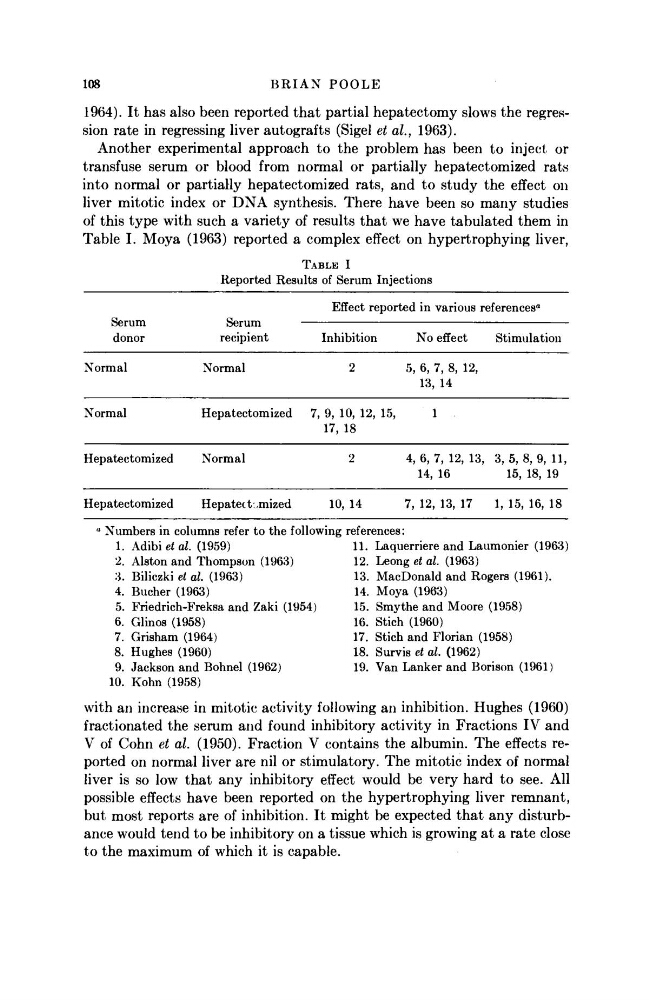
of this type with such a variety of results that we have tabulated them in
Table I. Moya (1963) reported a complex effect on hypertrophying liver,
TABLE I
Reported Results of Serum Injections
Serum
donor
Serum
recipient
Effect reported in various references
0
Serum
donor
Serum
recipient
Inhibition
No effect
Stimulation
Normal
Normal
2
5, 6, 7, 8, 12,
13, 14
Normal
Hepatectomized
7, 9, 10, 12, 15,
17, 18
1
Hepatectomized
Normal
2
4, 6, 7, 12, 13,
14, 16
3, 5, 8, 9 :
15, 18,
, 11,
19
Hepatectomized
Hepatect ,mized
10, 14
7, 12, 13, 17
1, 15, 16, 18
a Numbers in columns refer to the following references:
1. Adibi et al. (1959)
11. Laquerriere and Laumonier (1963)
2. Alston and Thompson (1963)
12. Leong et al. (1963)
3. Biliczki et al. (1963)
13. MacDonald and Rogers (1961).
4. Bucher (1963)
14. Moya (1963)
5. Friedrich-Freksa and Zaki (1954)
15. Smythe and Moore (1958)
6. Glinos (1958)
16. Stich (1960)
7. Grisham (1964)
17. Stich and Florian (1958)
8. Hughes (1960)
18. Survis et al. (1962)
9. Jackson and Bohnel (1962)
19. Van Lanker and Borison (1961)
10. Kohn (1958)
with an increase in mitotic activity following an inhibition. Hughes (1960)
fractionated the serum and found inhibitory activity in Fractions IV and
V of Cohn et al. (1950). Fraction V contains the albumin. The effects reported on normal liver are nil or stimulatory. The mitotic index of normal
liver is so low that any inhibitory effect would be very hard to see. All
possible effects have been reported on the hypertrophying liver remnant,
but most reports are of inhibition. It might be expected that any disturbance would tend to be inhibitory on a tissue which is growing at a rate close
to the maximum of which it is capable.
BRIAN POOLE
1964). It has also been reported that partial hepatectomy slows the regression rate in regressing liver autografts (Sigel et al, 1963).
Another experimental approach to the problem has been to inject or
transfuse serum or blood from normal or partially hepatectomized rats
into normal or partially hepatectomized rats, and to study the effect on
liver mitotic index or DNA synthesis. There have been so many studies
of this type with such a variety of results that we have tabulated them in
Table I. Moya (1963) reported a complex effect on hypertrophying liver,
TABLE I
Reported Results of Serum Injections
Serum
donor
Serum
recipient
Effect reported in various references
0
Serum
donor
Serum
recipient
Inhibition
No effect
Stimulation
Normal
Normal
2
5, 6, 7, 8, 12,
13, 14
Normal
Hepatectomized
7, 9, 10, 12, 15,
17, 18
1
Hepatectomized
Normal
2
4, 6, 7, 12, 13,
14, 16
3, 5, 8, 9 :
15, 18,
, 11,
19
Hepatectomized
Hepatect ,mized
10, 14
7, 12, 13, 17
1, 15, 16, 18
a Numbers in columns refer to the following references:
1. Adibi et al. (1959)
11. Laquerriere and Laumonier (1963)
2. Alston and Thompson (1963)
12. Leong et al. (1963)
3. Biliczki et al. (1963)
13. MacDonald and Rogers (1961).
4. Bucher (1963)
14. Moya (1963)
5. Friedrich-Freksa and Zaki (1954)
15. Smythe and Moore (1958)
6. Glinos (1958)
16. Stich (1960)
7. Grisham (1964)
17. Stich and Florian (1958)
8. Hughes (1960)
18. Survis et al. (1962)
9. Jackson and Bohnel (1962)
19. Van Lanker and Borison (1961)
10. Kohn (1958)
with an increase in mitotic activity following an inhibition. Hughes (1960)
fractionated the serum and found inhibitory activity in Fractions IV and
V of Cohn et al. (1950). Fraction V contains the albumin. The effects reported on normal liver are nil or stimulatory. The mitotic index of normal
liver is so low that any inhibitory effect would be very hard to see. All
possible effects have been reported on the hypertrophying liver remnant,
but most reports are of inhibition. It might be expected that any disturbance would tend to be inhibitory on a tissue which is growing at a rate close
to the maximum of which it is capable.