

FEATHERS AND PATTERNS
7
C. The Individual Feather
The feather is a dead structure; nevertheless it has attracted the
attention of biologists for many years, and an imposing amount of work
has been done on various aspects of its development. This work ranges
from morphological studies, such as Strong's (1902), to highly sophisticated studies of hormone response, such as those of Trinkaus (1953),
'Espinasse (1939), Lillie and Juhn (1932), and many more. The feather
itself has a very complex structure, and it is probably most convenient
to consider its several aspects under different headings.
1.
Development
The formation of the collar from the papilla and the transformation
of the collar into the définitive feather do not come directly within the
scope of th's paper. Details of feather development should be sought in
Strong (1902) and Davies (1889), as well as in Cohen and 'Espinasse
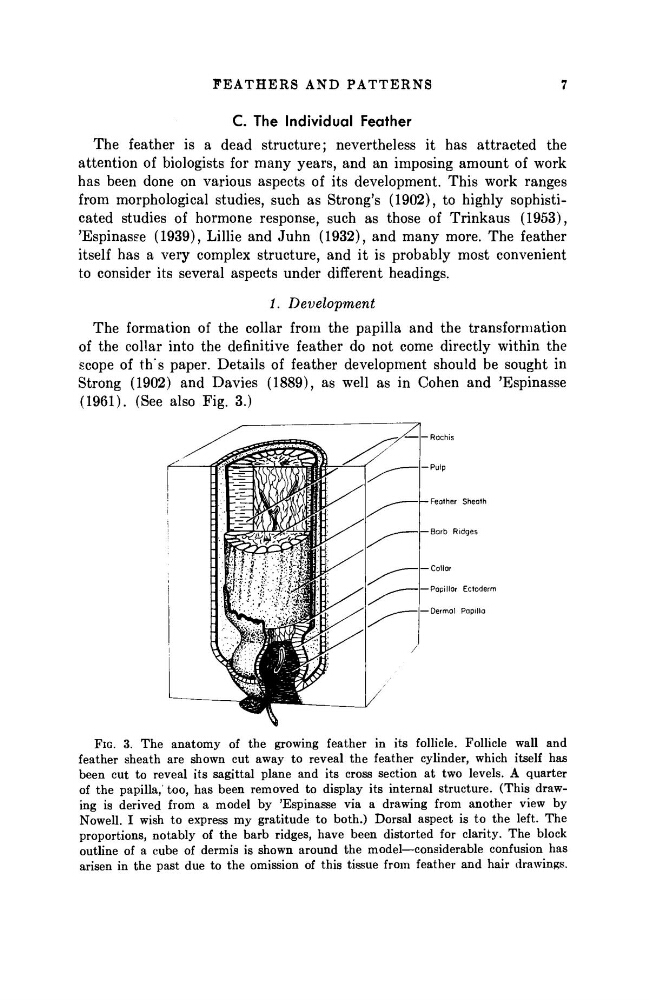
(1961). (See also Fig. 3.)
FIG. 3. The anatomy of the growing feather in its follicle. Follicle wall and
feather sheath are shown cut away to reveal the feather cylinder, which itself has
been cut to reveal its sagittal plane and its cross section at two levels. A quarter
of the papilla, too, has been removed to display its internal structure. (This drawing is derived from a model by 'Espinasse via a drawing from another view by
Nowell. I wish to express my gratitude to both.) Dorsal aspect is to the left. The
proportions, notably of the barb ridges, have been distorted for clarity. The block
outline of a cube of dermis is shown around the model—considerable confusion has
arisen in the past due to the omission of this tissue from feather and hair drawings.
7
C. The Individual Feather
The feather is a dead structure; nevertheless it has attracted the
attention of biologists for many years, and an imposing amount of work
has been done on various aspects of its development. This work ranges
from morphological studies, such as Strong's (1902), to highly sophisticated studies of hormone response, such as those of Trinkaus (1953),
'Espinasse (1939), Lillie and Juhn (1932), and many more. The feather
itself has a very complex structure, and it is probably most convenient
to consider its several aspects under different headings.
1.
Development
The formation of the collar from the papilla and the transformation
of the collar into the définitive feather do not come directly within the
scope of th's paper. Details of feather development should be sought in
Strong (1902) and Davies (1889), as well as in Cohen and 'Espinasse
(1961). (See also Fig. 3.)
FIG. 3. The anatomy of the growing feather in its follicle. Follicle wall and
feather sheath are shown cut away to reveal the feather cylinder, which itself has
been cut to reveal its sagittal plane and its cross section at two levels. A quarter
of the papilla, too, has been removed to display its internal structure. (This drawing is derived from a model by 'Espinasse via a drawing from another view by
Nowell. I wish to express my gratitude to both.) Dorsal aspect is to the left. The
proportions, notably of the barb ridges, have been distorted for clarity. The block
outline of a cube of dermis is shown around the model—considerable confusion has
arisen in the past due to the omission of this tissue from feather and hair drawings.