

THE STIMULUS TO HYPERTROPHIC GROWTH
97
postulates that the cells of each tissue or organ produce a specific substance
which is free to diffuse out of the cells into the general circulation. The
molecules of this substance, called "antitemplates," are destroyed or
excreted by the body at a rate proportional to their concentration in the
LIVER
H 2000
200
200
Body mass in grams
KIDNEY
500
200
200
Body mass in grams
• Tissue mass
ο Number of nuclei
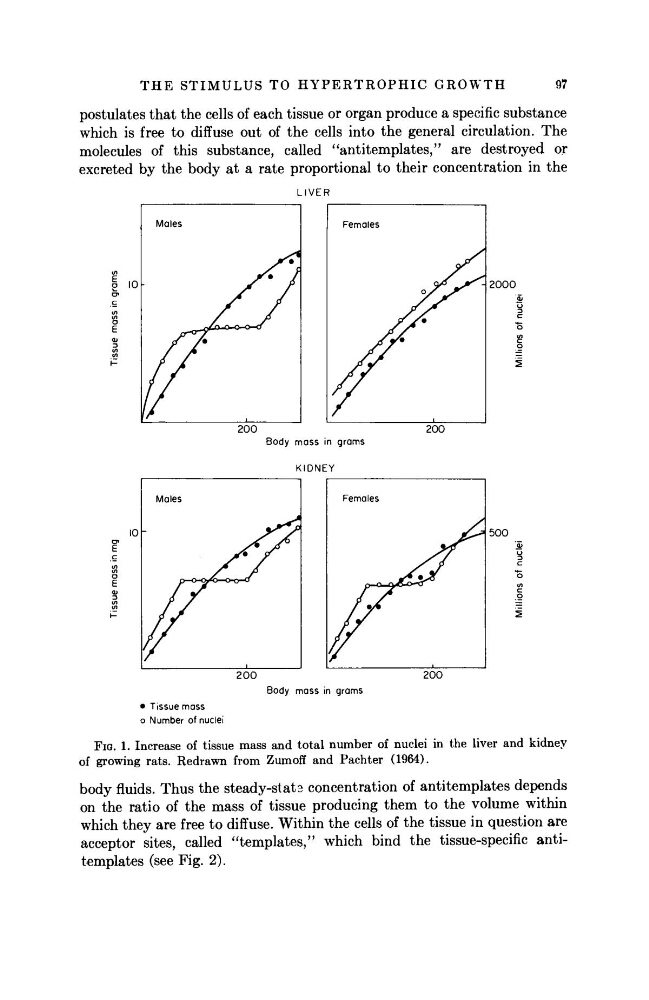
FIG. 1. Increase of tissue mass and total number of nuclei in the liver and kidney
of growing rats. Redrawn from Zum off and Pachter (1964).
body fluids. Thus the steady-stats concentration of antitemplates depends
on the ratio of the mass of tissue producing them to the volume within
which they are free to diffuse. Within the cells of the tissue in question are
acceptor sites, called "templates," which bind the tissue-specific antitemplates (see Fig. 2).
97
postulates that the cells of each tissue or organ produce a specific substance
which is free to diffuse out of the cells into the general circulation. The
molecules of this substance, called "antitemplates," are destroyed or
excreted by the body at a rate proportional to their concentration in the
LIVER
H 2000
200
200
Body mass in grams
KIDNEY
500
200
200
Body mass in grams
• Tissue mass
ο Number of nuclei
FIG. 1. Increase of tissue mass and total number of nuclei in the liver and kidney
of growing rats. Redrawn from Zum off and Pachter (1964).
body fluids. Thus the steady-stats concentration of antitemplates depends
on the ratio of the mass of tissue producing them to the volume within
which they are free to diffuse. Within the cells of the tissue in question are
acceptor sites, called "templates," which bind the tissue-specific antitemplates (see Fig. 2).