

4
J . B . G U R D O N
needed, but in Rana it is done by pricking the egg with a clean glass
needle, and in Ambystoma and Pleurodeles by an electric or hot shock.
Various methods are employed to remove or kill the egg nucleus which
lies just under the surface of the animal pole of the egg, where its
position is marked by a microscopically dark spot. In Rana, a needle is
used to make an exovate in the egg close to where the nucleus lies. In
Xenopus, Ambystoma and Pleurodeles the egg nucleus is killed by a dose
of ultraviolet irradiation which has no detectable effect on the cytoplasm of the egg. The donor tissue which will provide the nuclei to be
transplanted is dissected out from the embryo and is then placed in a
saline solution lacking calcium and magnesium, but usually containing
between 10~
3
and 10~
4
M Versene, phosphate buffered at p H 8-1. This
dissociates the cells which may be kept without deterioration for over
1 h in a saline solution containing calcium and magnesium. In order to
transplant a nucleus, a donor cell is sucked up into a micropipette of
such a size that the cell wall is broken but the nucleus is still surrounded
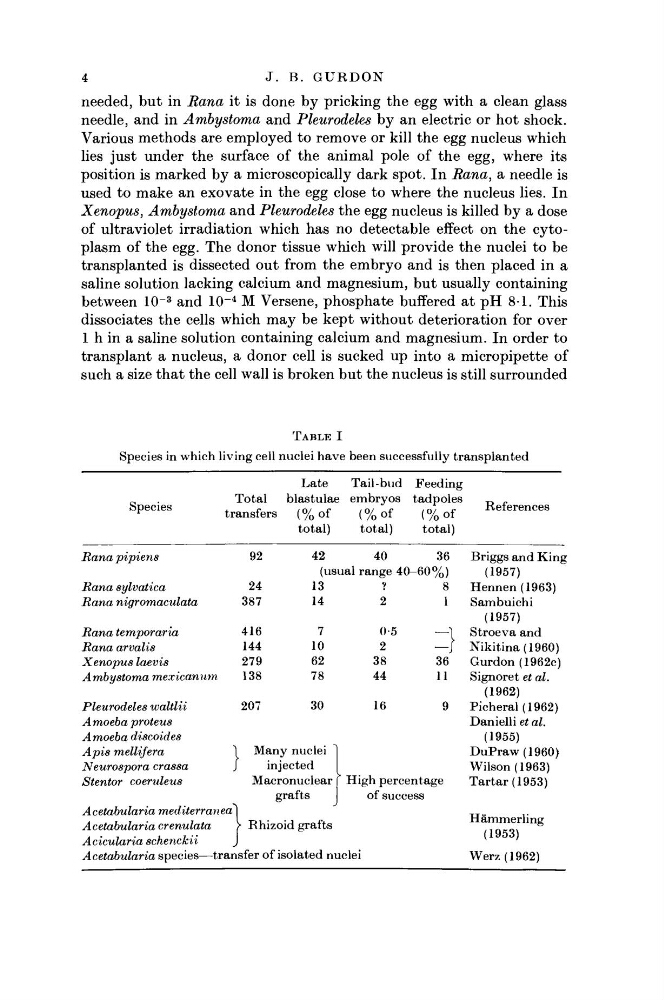
T A B L E I
Species in which living cell nuclei h a v e been successfully transplanted
Species
L a t e
Tail-bud Feeding
Total
blastulae embryos tadpoles
transfers
(% of
(% of
( % o f
total)
total)
total)
References
Rana
pipiens
Rana sylvatica
Rana
nigromaculata
Rana
temporaria
Rana arvalis
Xenopus
laevis
Ambystoma
mexicanum
Pleurodeles waltlii
Amoeba proteus
Amoeba discoid es
Apis
mellifera
Neurospora
crassa
Stentor
coeruleus
92
24
387
416
144
279
138
207
42
40
36
(usual range 4 0 - 6 0 % )
13
?
8
14
2
1
7
10
62
78
30
0-5
2
38
44
16
36
11
Many nuclei
injected
Macronuclear
grafts
f High percentage
of success
Acetabularia
mediterranean
Acetabularia crenulata
> Rhizoid grafts
Acicularia schenckii
J
Acetabularia species—transfer of isolated nuclei
Briggs and K i n g
(1957)
H e n n e n (1963)
Sambuichi
(1957)
Stroeva and
Nikitina (1960)
Gurdon (1962c)
Signoret et al.
(1962)
Picheral(1962)
Danielli et al.
(1955)
D u P r a w ( 1 9 6 0 )
Wilson (1963)
T a r t a r (1953)
H ä m m e r l i n g
(1953)
Werz(1962)
J . B . G U R D O N
needed, but in Rana it is done by pricking the egg with a clean glass
needle, and in Ambystoma and Pleurodeles by an electric or hot shock.
Various methods are employed to remove or kill the egg nucleus which
lies just under the surface of the animal pole of the egg, where its
position is marked by a microscopically dark spot. In Rana, a needle is
used to make an exovate in the egg close to where the nucleus lies. In
Xenopus, Ambystoma and Pleurodeles the egg nucleus is killed by a dose
of ultraviolet irradiation which has no detectable effect on the cytoplasm of the egg. The donor tissue which will provide the nuclei to be
transplanted is dissected out from the embryo and is then placed in a
saline solution lacking calcium and magnesium, but usually containing
between 10~
3
and 10~
4
M Versene, phosphate buffered at p H 8-1. This
dissociates the cells which may be kept without deterioration for over
1 h in a saline solution containing calcium and magnesium. In order to
transplant a nucleus, a donor cell is sucked up into a micropipette of
such a size that the cell wall is broken but the nucleus is still surrounded
T A B L E I
Species in which living cell nuclei h a v e been successfully transplanted
Species
L a t e
Tail-bud Feeding
Total
blastulae embryos tadpoles
transfers
(% of
(% of
( % o f
total)
total)
total)
References
Rana
pipiens
Rana sylvatica
Rana
nigromaculata
Rana
temporaria
Rana arvalis
Xenopus
laevis
Ambystoma
mexicanum
Pleurodeles waltlii
Amoeba proteus
Amoeba discoid es
Apis
mellifera
Neurospora
crassa
Stentor
coeruleus
92
24
387
416
144
279
138
207
42
40
36
(usual range 4 0 - 6 0 % )
13
?
8
14
2
1
7
10
62
78
30
0-5
2
38
44
16
36
11
Many nuclei
injected
Macronuclear
grafts
f High percentage
of success
Acetabularia
mediterranean
Acetabularia crenulata
> Rhizoid grafts
Acicularia schenckii
J
Acetabularia species—transfer of isolated nuclei
Briggs and K i n g
(1957)
H e n n e n (1963)
Sambuichi
(1957)
Stroeva and
Nikitina (1960)
Gurdon (1962c)
Signoret et al.
(1962)
Picheral(1962)
Danielli et al.
(1955)
D u P r a w ( 1 9 6 0 )
Wilson (1963)
T a r t a r (1953)
H ä m m e r l i n g
(1953)
Werz(1962)