

48
H. WARIS AND P. KALLIO
simplified in response to less favourable conditions, or vice versa in
response to better conditions. This fact has led to a great deal of confusion in the systematics of the desmids (cf., for instance, Ducellier,
1915; Krieger, 1937; Lefèvre, 1939; Teiling, 1950; Grönblad and
Rûzioka, 1959). The inequality of the two semieells is sometimes so
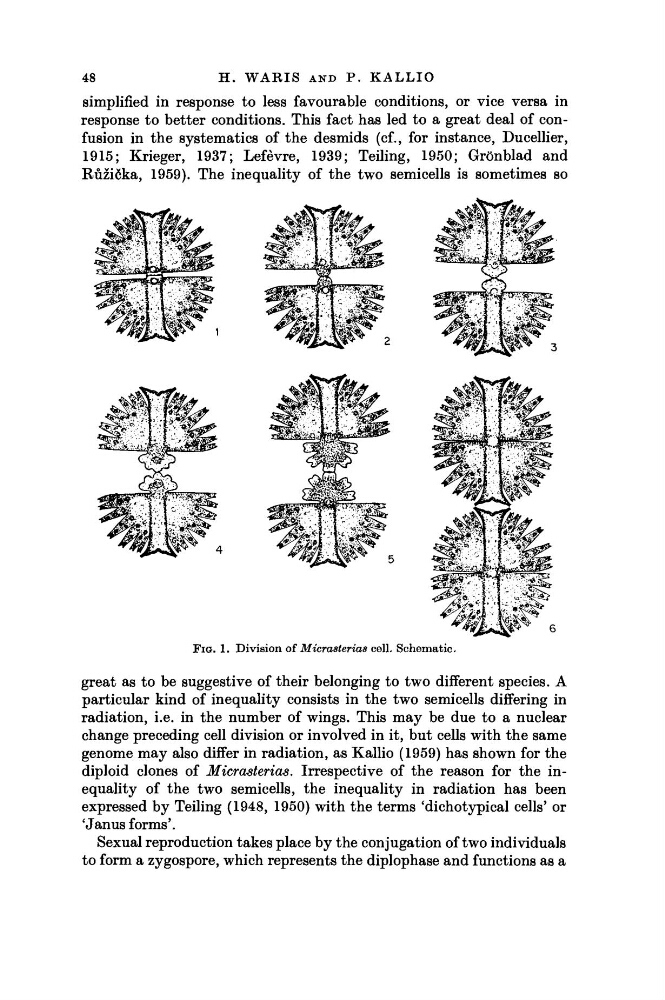
FIG. 1. Division of Micrasterias cell. Schematic.
great as to be suggestive of their belonging to two different species. A
particular kind of inequality consists in the two semieells differing in
radiation, i.e. in the number of wings. This may be due to a nuclear
change preceding cell division or involved in it, but cells with the same
genome may also differ in radiation, as Kallio (1959) has shown for the
diploid clones of Micrasterias. Irrespective of the reason for the inequality of the two semieells, the inequality in radiation has been
expressed by Teiling (1948, 1950) with the terms 'dichotypical cells' or
'Janus forms'.
Sexual reproduction takes place by the conjugation of two individuals
to form a zygospore, which represents the diplophase and functions as a
H. WARIS AND P. KALLIO
simplified in response to less favourable conditions, or vice versa in
response to better conditions. This fact has led to a great deal of confusion in the systematics of the desmids (cf., for instance, Ducellier,
1915; Krieger, 1937; Lefèvre, 1939; Teiling, 1950; Grönblad and
Rûzioka, 1959). The inequality of the two semieells is sometimes so
FIG. 1. Division of Micrasterias cell. Schematic.
great as to be suggestive of their belonging to two different species. A
particular kind of inequality consists in the two semieells differing in
radiation, i.e. in the number of wings. This may be due to a nuclear
change preceding cell division or involved in it, but cells with the same
genome may also differ in radiation, as Kallio (1959) has shown for the
diploid clones of Micrasterias. Irrespective of the reason for the inequality of the two semieells, the inequality in radiation has been
expressed by Teiling (1948, 1950) with the terms 'dichotypical cells' or
'Janus forms'.
Sexual reproduction takes place by the conjugation of two individuals
to form a zygospore, which represents the diplophase and functions as a